
History of Muay Thai: From Battlefield to Ring Legends
You’ve probably felt this moment in the gym: pads are done, sweat’s dripping, and a newer teammate asks, “What is Muay Thai, really? Where did this come from?” The history of Muay Thai isn’t just dates and names. It’s the story of a people turning survival into art—soldiers defending borders, village festivals testing courage, and stadiums where legends wrote their names in blood, sweat, and sarama music.
Knowing the history of Muay Thai changes how you train. You start to see why the teep (push kick) is treated like a royal weapon, why elbows are sharpened like blades, and why the Wai Kru Ram Muay honors your teacher before a single strike is thrown. This is the path from battlefield to ring, and it still shapes how you move today.
Table of Contents
Background & Early Years
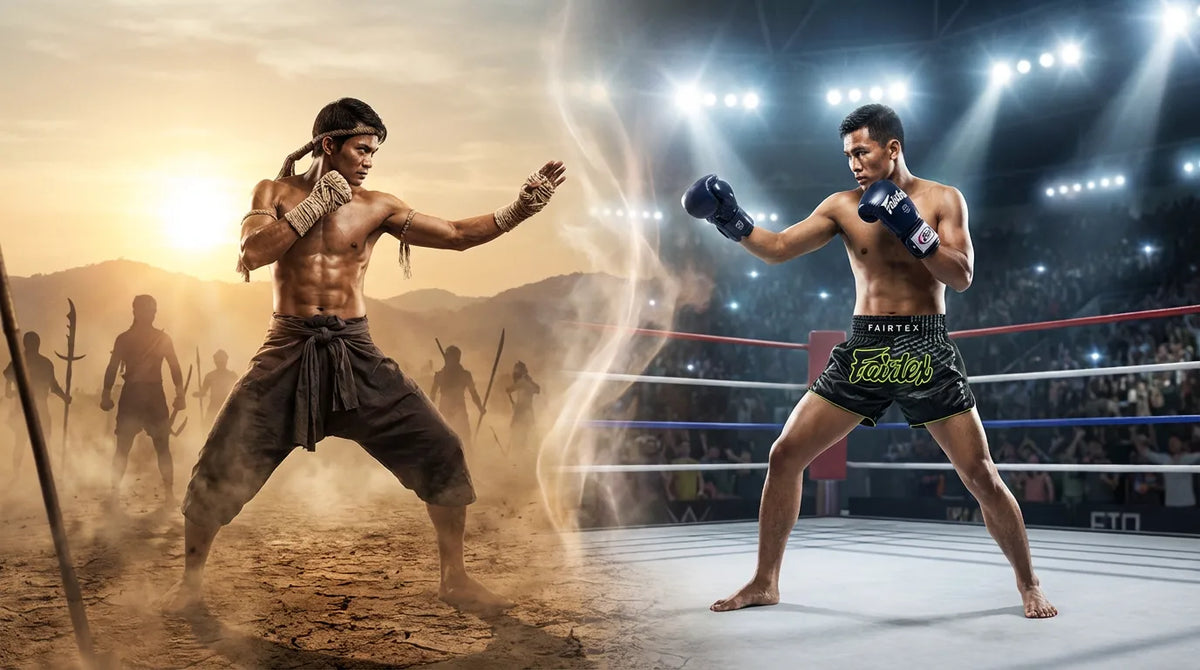
When you talk about the history of Muay Thai, you’re talking about the story of Siam—today’s Thailand—and its need to protect itself. Early forms of the art evolved from battlefield systems used by soldiers when weapons were lost or close-quarters fighting was necessary. These older systems are often grouped under Muay Boran (ancient boxing), with regional flavors like Muay Chaiya, Muay Korat, Muay Thasao, and Muay Lopburi. The techniques were pragmatic: elbows that split skin, knees that crushed ribs, and clinch control that smothered opponents.
Legend and Reality: Nai Khanom Tom

You’ve heard the legend: Nai Khanom Tom, a Siamese fighter captured by the Burmese, earned his freedom by defeating multiple opponents during a festival in 1774. Whether every detail is historically precise or partly myth, the story captures a truth—the art’s power and cultural pride. Thai cultural accounts place this legend as a symbol of national identity and warrior spirit, echoed in modern celebrations on National Muay Thai Day.
Kings, Soldiers, and the “Tiger” Legacy
Figures like King Naresuan (late 1500s) and King Phra Chao Suea—the “Tiger King”—are often cited in Thai oral histories as patrons of martial training. Soldiers drilled in unarmed methods alongside weapon systems. Over time, military practicality met community sport, especially during temple fairs where bouts entertained crowds and tested local champions. That mix of survival and spectacle remains in the DNA of Muay Thai today.
From Muay Boran to the Ring
So how did battlefield techniques become ring sport? Early matches used rope bindings on the fists called kard chuek. Fights could be brutal and open-ended. In the early 20th century, as Siam modernized and internationalized, rules, rings, timekeeping, and gloves were adopted, transforming rough village contests into standardized sport. This shift made Muay Thai safer and more sustainable while preserving its essential weapons.
Codifying the Art
By the 1920s and 1930s, referees, rounds, and weight classes began to appear. Glove use gradually replaced rope bindings, influenced by Western boxing. Stadiums formalized the environment, and promoters worked alongside the Thai military and police athletic programs to systematize training. The balance changed: still vicious in the clinch, but measured by technique, balance, and ring IQ.
Stadiums That Became Temples

Rajadamnern Stadium opened in 1945 and Lumpinee in 1956. These arenas became hallowed ground. To hold a Rajadamnern or Lumpinee belt was the pinnacle. If you’ve ever bowed to a ring corner before stepping in for sparring, that tradition traces to these homes of greatness.
Rise to Prominence
Ask any seasoned fan about the “Golden Era.” Most point to the 1960s through the 1980s, when technique and talent were off the charts. Names like Apidej Sit-Hirun (often called the “hardest kicker”), Dieselnoi Chor Thanasukarn (a towering knee monster), and Samart Payakaroon (slick, untouchable timing) set standards that coaches still reference today.
By the 1990s and early 2000s, Muay Thai began cross-pollinating with global promotions. Fighters like Buakaw Banchamek brought Thai weapons to kickboxing tournaments and woke up the world. Meanwhile, within Thailand, generations of stadium champions refined styles based on ring tempo and scoring—where clean, balanced technique is king, and last-round dominance seals the deal.
Training Anecdote: Learning from Footage
One of my Kru used to pause old Lumpinee DVDs during class. “See the posture,” he’d say as a knee fighter framed in the chern (clinch) and landed a crushing ti khao (knee). We’d spend rounds replicating that exact posture—hips in, head position tight, shoulders stacked—because history isn’t just stories; it’s a technique library.
Rituals, Respect, and What You’re Seeing
The history of Muay Thai isn’t complete without its rituals. Before a fight, you’ll see the Wai Kru Ram Muay—a dancer’s salute and meditation to honor teachers, parents, and the gym. The fighter wears a Mongkol (sacred headband) and Prajioud (armbands), and the stadium hums with sarama music. This isn’t decoration; it’s the heartbeat of Thai culture woven into combat.
Why Tradition Matters in Modern Training
In gyms across Thailand, even casual students learn parts of the Wai Kru. It builds focus. I’ve had beginners who struggled with nerves settle down after a simple bow and breath routine. It’s a reminder: your path includes your teachers, your training partners, and everyone who came before.
Signature Techniques & Fighting Style
They call it the “Art of Eight Limbs” for a reason—two fists, two elbows, two knees, two shins. The Thai terms matter because they shape how you move: chok (punch), ti sok (elbow), ti khao (knee), tae (kick), and the disruptive teep (push kick). Add the chern (clinch) and you’ve got a complete stand-up system.
Teep Control: The Spear of Muay Thai

Picture a veteran throwing the teep like a jab. It blunts pressure, creates distance, and sets traps. My first month training in Bangkok, a coach had me throw 200 teeps per round on a belly pad. By week two, sparring got easier—rushing partners suddenly ate leather soles. That’s history in action: the teep as battlefield spear, now ring ruler.
Clinch & Knees: The Exhaust Engine
In Thai scoring, controlled balance and effect matter. In the chern, you win with posture—hips in, head inside, wrists controlling the biceps, feet stepping with Yang Sam Khum (triangle step/guard). Land clean ti khao and you don’t just score—you drain the other fighter’s will. Ask Dieselnoi’s opponents how that felt.
Elbows: The Equalizer
Ti sok turns close quarters into danger. Horizontal, diagonal, spinning—elbows cut and score big if they show visible effect. Smart fighters set them up with frame-and-pivot entries instead of swinging blind. Your coach is right: technique before power, or you’ll eat a counter kick.
Muay Thai vs Kickboxing
People love to compare Muay Thai with kickboxing. Here’s the quick breakdown you can share at the gym. Kickboxing (especially K-1 rules) typically limits clinch time, discourages extended knees, and emphasizes volume punching with low kicks. Muay Thai allows prolonged clinch, scores sharply for balanced kicks, knees, and sweeps, and values ring dominance and posture.
Cross-Pollination Goes Both Ways
Muay Thai influenced global kickboxing through fighters like Buakaw, while kickboxing’s pace influenced some stadium fighters to sharpen punch-kick combinations. If you’re crossing over, learn the rule set. Under Thai rules, a caught kick and beautiful dump can swing a round. Under kickboxing rules, you’ll likely be separated before clinch knees add up.
Modern Training & Equipment
Training looks different today than it did in the rope-binding era. We protect the body so you can train longer. You’ll spend hours in muay thai gloves on pads and bag, slide into muay thai shin guards for sparring, and pull on muay thai shorts that move with your hips for kicks and knees. Some gyms even use soft wrestling knee pads during clinch drilling to protect both partners from abrasions while you grind out position.
How We Structure Rounds Now
A typical session: jump rope, shadowboxing, pad rounds, bag work, partner drills, chern clinch, then conditioning. When a Kru makes you throw 100 tae (kicks) each side on the bag and finishes with burn-out knees, you’re living the lineage of fighters who built stadium-ready engines. The science is better now—periodized weeks, heart-rate-based conditioning—but the heart of training is the same.
Safety First, Always
Wrap your hands, size your gloves correctly, and don’t skimp on shin protection when you’re learning. I’ve seen newcomers try to be tough and kick bare shins on day one. That bravado turns into a week off with bone bruises. Protect your tools so you can train tomorrow. Tradition respects longevity.
Mouthguard guide for striking sports
Global Expansion & Rules Today
Muay Thai went worldwide in the late 20th century and kept accelerating. Two institutions led international standardization: the World Muaythai Council (WMC) and the International Federation of Muaythai Associations (IFMA). IFMA’s role in amateur governance and its recognition by the International Olympic Committee helped bring Muay Thai to multi-sport events, including the World Games and 2023 European Games. By 2025, most national federations align with IFMA amateur rules and WMC professional standards.
Why Scoring Feels Different
Under Thai scoring, balance, effective technique, and visible impact matter more than sheer volume. Judges reward clean body and head kicks, sharp knees, and off-balancing dumps—all while watching posture. IFMA and WMC publish their criteria, and smart fighters train specifically for what judges see. Ask your coach to explain your gym’s rule emphasis; it changes how you pad work and spar.
Promotions, Stadiums, and New Platforms
Bangkok’s stadiums are still sacred, but international promotions now stream Thai talent to the world. You’ll see classic styles, hybrid approaches, and athletes transitioning between Muay Thai, kickboxing, and MMA. The core remains: if you hold your ground, land clean kicks and knees, and control the clinch, you speak the language judges respect.

Women in Muay Thai
The story used to be exclusion. Women couldn’t fight at certain stadiums, and cultural barriers limited opportunities. That’s changing fast. Historic shifts—like Lumpinee Stadium hosting women’s bouts in the 2020s—signaled a new era. Athletes like Loma Lookboonmee (who brought Muay Thai to MMA success) and modern champions across Thai and international shows have expanded the art’s horizons.
Training Rooms Are Evolving
Gyms around the world now have women leading drills, holding pads, and running classes. I’ve seen full clinch rounds where the most technical fighter in the room was a 52-kilo woman, schooling the boys with posture and timing. History is alive—and inclusive—when skill speaks for itself.
Legacy & Impact
The legacy of Muay Thai is layered. It’s a national treasure of Thailand, a global sport with unified rules, and a training method that builds resilient bodies and minds. It shaped modern kickboxing, feeds directly into MMA striking and clinch skills, and remains a complete stand-up system on its own terms.
Muay Thai and Self-Defense
Is Muay Thai among the best martial arts for self defense? You’ll hear strong arguments for it—effective striking, distance control with the teep, clinch dominance, and conditioning that holds up under stress. No single art is the “best martial arts” answer for everyone, but Muay Thai gives you reliable tools fast, especially when combined with situational awareness and basic grappling.
What You Carry Into the Ring (or Life)
Every time you bow in, you carry centuries of adaptation—soldiers, festival fighters, stadium champions, and your own coaches. That lineage shows in your balance, your calm, and the way your hips snap on a round kick. The history of Muay Thai isn’t behind you. It’s under your feet every time you step forward.
Regional Roots: What the Old Styles Actually Emphasized
We mention Muay Boran in passing, but the regional flavors shaped how today’s fighters move. Knowing the differences helps you read body language in the ring and spot counters faster.
Muay Chaiya (Southern Guard and Counters)
Chaiya is built on a tight shell, patient timing, and short, sharp counters. Think compact guard, hips under you, and deceptive weight shifts that bait kicks for catches and dumps. It’s defense-first, then a quick elbow or knee through the gap.
Muay Korat (Power and Forward Pressure)
Korat is the heavy-hitter. Long guard to walk you down, thudding tae (round kicks) and straight-line pressure that forces trades on its terms. If you like breaking will with pace and power, you’re borrowing Korat’s engine.
Muay Lopburi (Angles and Tricky Hands)
Lopburi is known for crafty punching angles and feints. Step off, change level, make you miss by an inch, then answer with clean hands or a kick across the arms to tilt your balance. It’s the sly grin of Thai boxing.
Muay Thasao (Speed and Flow)
Thasao plays fast—light feet, rapid-fire combinations, and fluid exits. It strings techniques together, touching you with a teep (push kick), checking your response, then whipping a kick or knee before you reset.
How Thai Fights Flow: The 5-Round Rhythm and Scoring Nuance
If you’ve watched a stadium fight and wondered about the pace, there’s a method behind it. The rounds carry intention, and judges are reading posture, balance, and effect the whole way.
Round-by-Round Intent (Traditional Stadium Tempo)
Round 1: measured read—establish weapons, rhythm, and reactions. Round 2: heat rises; cleaner kicks and knees start landing. Round 3–4: the money rounds—decisive scoring, dumps, and visible effect define the fight. Round 5: protect a clear lead with composure, or press hard if you’re behind. Betting culture sharpened this rhythm, but the thread is the same: technical control and balance under pressure.
Scoring Criteria (WMC/IFMA-aligned, 2025)
Judges use 10-point must with emphasis on:
- Effective, balanced technique: Clean body/head kicks, sharp ti khao (knees), and elbows that show effect.
- Ringcraft and dominance: Controlling distance, center, and the chern (clinch) without being off-balanced.
- Visible impact: Opponent’s posture broken, steps back involuntarily, or is dumped cleanly.
- Defense: Checks, evasions, catches with immediate counters; not just blocking but making strikes land clean on you less.
- Fouls/illegal throws avoided: No hip-height wrestling tosses or head-first spikes; dumps come from timing and off-balance, not suplexes.
From Kard Chuek to Gloves: What Changed (and What Didn’t)
The shift from rope bindings—kard chuek—to gloves standardized safety without killing the art. The core weapons stayed; the scoring lens just got clearer.
Safety and Technique Shifts
Gloves favored sustained combinations and guard integrity, while kard chuek rewarded precision and cut potential. Today’s rulesets (WMC pro, IFMA amateur) keep elbows and clinch alive but ban dangerous throws, spikes, and headbutts. Pro bouts are typically 5×3; IFMA amateurs are 3×3 with protective gear for youth divisions.
Kard Chuek Revivals
You’ll still see special events using rope bindings. The best pros adapt by tightening defense, prioritizing positioning in the chern, and picking elbows over volume. Same language, different dialect.
Training Drills from History

History is a blueprint. Use it to sharpen how you train this week.
Golden Era Film-Study Circuit
Pull one legend and one weapon. Study, then replicate.
- Setup: Choose 1–2 fights (e.g., Dieselnoi for knees, Samart for timing). Pad holder with belly pad and elbow pads.
- Execution: 3 rounds x 3 minutes: Round 1 mirror footwork and rhythm; Round 2 recreate entries to your chosen weapon; Round 3 pressure-tested pad round—holder counters so you must keep posture.
- Common Mistakes: Watching hands and missing hips; copying pace without copying balance; throwing knees without head/hand position.
- Progression: Add 2 clinch rounds: 1 technical, 1 competitive, scoring with clean off-balances and ti khao.
Five-Round Pace Drill (Ring IQ Builder)
Practice the stadium rhythm so you don’t gas when it matters.
- Setup: Timer for 5×3 with 1-minute rest; light spar or pad flow.
- Execution: R1: probing teep and checks. R2: add body kicks. R3–4: score big—clean kicks, knees, and a dump. R5: if “up,” manage with posture; if “down,” press with balanced volume.
- Common Mistakes: Sprinting R1; coasting R3–4; abandoning guard after dumps.
- Progression: Coach assigns “behind” or “ahead” scenarios at the bell each round; you adjust tactics on the fly.
Frequently Asked Questions
What is Muay Thai in simple terms?
Muay Thai is Thailand’s striking art using eight limbs—fists, elbows, knees, and shins—with clinch fighting (chern) as a major component. Unlike many kickboxing styles, it allows prolonged clinch work, knees, elbows, and off-balancing sweeps. Culturally, it includes the Wai Kru Ram Muay, Mongkol, Prajioud, and live sarama music during bouts.
How old is Muay Thai?
The sport form took shape in the early 20th century, but its roots—grouped as Muay Boran—reach back centuries through military training and village contests. Stadium Muay Thai, with gloves and timed rounds, solidified in the mid-1900s with Rajadamnern (1945) and Lumpinee (1956) Stadiums.
What’s the difference between Muay Thai and kickboxing?
Kickboxing (often K-1 rules) limits clinch and emphasizes rapid punching and low kicks. Muay Thai allows extended clinch, rewards balanced body and head kicks, and values posture and control. Scoring criteria differ, so styles and strategies change with the rule set.
Why do fighters do the Wai Kru Ram Muay?
It’s respect and focus. Fighters honor their teachers and roots while settling into the ring’s rhythm. From a training perspective, it also centers breathing and intention—key for handling adrenaline when the bell rings.
Which gloves and gear should I start with?
Start with 14–16 oz gloves for general training, hand wraps for wrist support, and shin guards for sparring. Comfortable muay thai shorts help with hip mobility. Some gyms use soft wrestling knee pads for clinch drilling. Fit and protection matter more than brand; ask your coach for sizing.
Is Muay Thai good for self-defense?
Yes—especially for stand-up. The teep controls distance, low kicks disrupt balance, and elbows and knees are effective at close range. Pair it with awareness and basic grappling for a rounded approach. No art guarantees safety, but Muay Thai prepares you to strike decisively.
Who are some legendary fighters to study?
Start with Samart Payakaroon (timing and IQ), Dieselnoi (knees and clinch), Apidej Sit-Hirun (low kicks), Saenchai (creativity and balance), and Buakaw (global impact). Watch stadium-era fights to understand scoring and posture.
How are Muay Thai fights scored?
Thai scoring emphasizes effective technique, balance, and visible impact. Clean kicks and knees to the body/head score strongly, as do dumps that show control. Judges value a composed posture. IFMA and WMC publish their criteria; your coach can tailor training to those standards.
What’s the role of the clinch?
The clinch is a full phase of fighting, not a reset. You control posture, break balance, land ti khao, and execute dumps. It’s also exhausting—condition for it, and learn safe head/hand positioning to avoid damage while applying pressure.

How did Muay Thai influence MMA and modern striking?
Muay Thai’s low kicks, knees, elbows, and clinch control have become core tools in MMA. Many top strikers cross-train Muay Thai footwork, defense, and counters while adapting stance and takedown awareness for the cage.
What does Yang Sam Khum mean?
Yang Sam Khum refers to triangle step/guard—footwork and defensive positioning that supports balance and angle changes. You feel it when your stance stays stable while you pivot to counter or step off and kick without losing posture.
How often should I train as a beginner?
Two to three sessions per week builds a base without frying your body. Focus on fundamentals: stance, teep, round kick, basic defense, and simple combinations. Add clinch rounds once your neck and core are ready. Consistency beats intensity spikes.
Muay Chaiya (Southern Guard and Counters)
Chaiya is built on a tight shell, patient timing, and short, sharp counters. Think compact guard, hips under you, and deceptive weight shifts that bait kicks for catches and dumps. It’s defense-first, then a quick elbow or knee through the gap.
Muay Korat (Power and Forward Pressure)
Korat is the heavy-hitter. Long guard to walk you down, thudding tae (round kicks) and straight-line pressure that forces trades on its terms. If you like breaking will with pace and power, you’re borrowing Korat’s engine.
Muay Lopburi (Angles and Tricky Hands)
Lopburi is known for crafty punching angles and feints. Step off, change level, make you miss by an inch, then answer with clean hands or a kick across the arms to tilt your balance. It’s the sly grin of Thai boxing.
Muay Thasao (Speed and Flow)
Thasao plays fast—light feet, rapid-fire combinations, and fluid exits. It strings techniques together, touching you with a teep (push kick), checking your response, then whipping a kick or knee before you reset.
Round-by-Round Intent (Traditional Stadium Tempo)
Round 1: measured read—establish weapons, rhythm, and reactions. Round 2: heat rises; cleaner kicks and knees start landing. Round 3–4: the money rounds—decisive scoring, dumps, and visible effect define the fight. Round 5: protect a clear lead with composure, or press hard if you’re behind. Betting culture sharpened this rhythm, but the thread is the same: technical control and balance under pressure.
Scoring Criteria (WMC/IFMA-aligned, 2025)
Judges use 10-point must with emphasis on:
Safety and Technique Shifts
Gloves favored sustained combinations and guard integrity, while kard chuek rewarded precision and cut potential. Today’s rulesets (WMC pro, IFMA amateur) keep elbows and clinch alive but ban dangerous throws, spikes, and headbutts. Pro bouts are typically 5×3; IFMA amateurs are 3×3 with protective gear for youth divisions.
Kard Chuek Revivals
You’ll still see special events using rope bindings. The best pros adapt by tightening defense, prioritizing positioning in the chern, and picking elbows over volume. Same language, different dialect.
Golden Era Film-Study Circuit
Pull one legend and one weapon. Study, then replicate.
Five-Round Pace Drill (Ring IQ Builder)
Practice the stadium rhythm so you don’t gas when it matters.
Why do Thai fights start slow in Round 1?
It’s not laziness—it’s calculus. Round 1 is about reads: how you react to a southpaw teep, whether you check on time, how you hold posture in the chern. Judges value clean, balanced scoring later, so fighters build a data set before committing. Traditionally, betting sharpened that rhythm, but even without it the logic stands: establish timing in R1–2, win decisively in R3–4, manage R5 with composure if you’ve built a lead. Train it by scripting five-round pace in sparring.
Did Muay Thai fighters ever coat their hands with glass?
No. Historical kard chuek used rope or cloth bindings—sometimes hardened with starch—for structure and protection, not glass. The “glass fist” image comes from movies and staged shows, not stadium Muay Thai. Modern professional rules require gloves; amateur IFMA rules add protective gear by division. If you want to feel the difference safely, try a supervised rope-binding pad round—never spar it full power.
What’s the difference between Muay Boran and modern Muay Thai?
Muay Boran is an umbrella for pre-ring methods—regional styles, self-protection tactics, and techniques not suited for sport (certain throws or limb attacks). Modern Muay Thai is the codified ring sport with gloves, timed rounds, and clear scoring under WMC/IFMA-aligned rules. Train Boran to understand roots and body mechanics; train ring Muay Thai to compete safely, develop timing, and pressure-test skills.
How long are Muay Thai fights and what gear is used now?
Professional stadium bouts are typically 5 rounds of 3 minutes with 2-minute rests; many international pro shows use 5×3 or 3×3 depending on format. IFMA amateur matches are generally 3×3 with shinguards and elbow pads for youth divisions. In training, use 14–16 oz gloves, wraps, and shin guards; save elbows and hard knees for pads and controlled clinch. Quality, well-maintained gear keeps you in the gym tomorrow.
Ramon Dekkers and the East–West Exchange
When Ramon Dekkers met Thai elites in the late ’80s and ’90s, he brought Dutch pace and punch–low-kick volume into stadiums. Fights with Namphon and Coban showed two scoring languages colliding—Dekkers’ aggression vs Thai balance and body-kick scoring. The lesson for us: learn the rule set. Under Thai criteria, a single clean, balanced body kick can outscore a flurry of arm-kicks or off-balance punches.
Ritual Gear Etiquette: Mongkol and Prajioud
The Mongkol (headband) is placed by your Kru before the bout and removed after the Wai Kru Ram Muay. Don’t let it touch the floor; store it clean and dry. Prajioud (armbands), often tied for luck and lineage, should be snug but not constricting. Professional fighters emphasize durable, well-stitched equipment for daily training—brands like Fairtex, handcrafting gear in Thailand for decades, set the standard many camps trust.
Key Takeaways
- Muay Thai evolved from battlefield roots (Muay Boran) into a refined ring sport with global rules.
- Thai scoring values balance, clean kicks and knees, clinch control, and visible effect.
- Traditions like the Wai Kru Ram Muay connect fighters to teachers and culture.
- Modern training uses gloves, shin guards, and smart conditioning to preserve longevity.
Honoring the Legacy
If you’ve ever felt that calm just before a round starts—the breath, the bounce, the quiet—now you know where it comes from. The history of Muay Thai lives in every teep you throw to claim space, every clinch frame you build, and every bow you give your coach. When you lace up your gloves and tie your Prajioud, you’re not just training a sport. You’re stepping into a lineage of soldiers, artists, and champions who figured out how to stay balanced under fire.
Carry that with you. Respect the rituals, study the legends, and train with intent. Whether you’re chasing a stadium belt or just trying to become the toughest, kindest version of yourself, Muay Thai has room for you—past, present, and future.

Preserving Muay Thai History
Historical context draws on Thai cultural records, stadium archives, and guidance from IFMA and WMC rule frameworks. Modern eras were shaped by major camps and athletes—Fairtex Gym’s champions, from Yodsanklai to Stamp, illustrate how Thai traditions adapted to global stages without losing authenticity. Quality gear, including fairtex gloves, carried that journey into daily training.
Last Updated: November 2025