
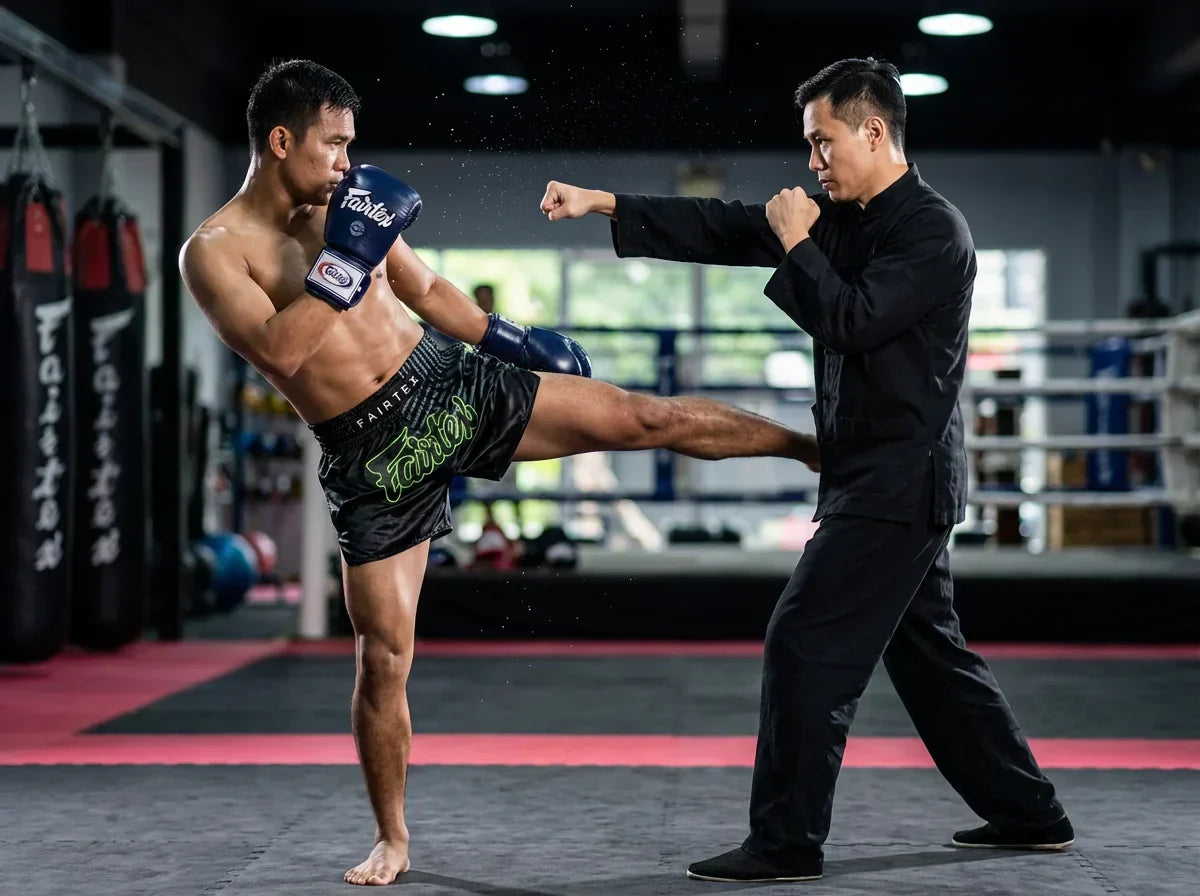
Muay Thai VS. Wing Chun
You’re on round four of sparring, gloves slick with sweat. Your partner switches from a Thai guard to a narrow, centerline stance and starts feeding fast chain punches at your chest and face. You fire a sharp teep (push kick) to the hip, angle off, and chop a low kick as they square up. Muay Thai vs Wing Chun in a gym? It feels like two different languages trying to talk over each other.
People love to argue wing chun vs muay thai online. That’s fun, but real answers live in the gym and on the mats. This breakdown gives you the practical differences between Muay Thai and Wing Chun, how each system builds skills, where each shines, and how to train smart if you cross over. You’ll see what carries into fighting—ring, sparring, or self-defense—and you’ll get drills and safety guidance you can use right away.
If you’re setting up your training kit from scratch, here’s our complete guide to the best Muay Thai gear for beginners and intermediate athletes.
Table of Contents
Wing Chun vs Muay Thai: Fundamentals
Two arts, two operating systems. Muay Thai is the “Art of Eight Limbs,” live-tested under pressure with chok (punches), ti sok (elbows), ti khao (knees), and tae (kicks), plus the chern (clinch). Wing Chun is a close-range system centered on the “centerline theory,” economy of motion, structure, and forward pressure. One thrives in the ring under IFMA/WMC rule sets. The other focuses on interception, trapping, and rapid finishing in tight quarters.
Structure and Stance
Wing Chun keeps a narrow, rooted stance with the hips square to the target, hands along the centerline, and short steps. The goal is to intercept and crash—chain punch, trap, elbow. Muay Thai stands more bladed or square depending on style, shoulders high, chin tucked, lead hand ready to parry and post, rear hand loaded. You’ll see weight more centered for checking kicks and marching forward. Thai stance supports power kicking, balanced knees, and strong base in the clinch.
Range and Priorities
Wing Chun lives in the pocket. It wants to eliminate the mid-range where big kicks happen and move to a range where it can feel and control your structure. Muay Thai controls long and mid-range—teep to measure, low kick to break posture, step-in elbow and knee when you close. In modern Thai scoring, balance, effect, and ring control matter; you’ll see fighters prioritize clean impact and posture disruption. In Wing Chun, the priority is linear dominance—hit the centerline, disrupt their structure, finish quickly.
Technical Breakdown: Tools, Defense, and Range

Now to the nuts and bolts. The difference between Muay Thai and Wing Chun shows up in what you throw, how you move, and how you handle pressure. Picture the same opponent at three distances and watch how each art solves the problem.
Striking Tools
Muay Thai emphasizes heavy, rotational power: roundhouse tae with the shin, rear straight chok, tight ti sok cut-in elbows, and vertical ti khao from the clinch. Wing Chun fires linear strikes—vertical-fist chain punches, straight blasts, palm strikes, bil sao/pak sao to open lines, and short, snappy elbows at close range. Thai kicks can shut down mobility and sap will; Wing Chun’s straight-line flurries overwhelm when you let someone crash the pocket unchecked.
Footwork and Guard
Thai footwork is efficient and stance-stable: small steps, checks, switch steps, and angle-offs after the teep or low kick. The guard is high, with active parries and frames. Wing Chun footwork is narrower with stepping that maintains centerline access—advancing triangle steps, slight pivots to keep your hips squared. The guard is forward and probing, hands ready to touch and feel. That tactile feedback is the engine for trapping and entries.
Clinch and Infighting
Muay Thai’s chern (clinch) is a full subsystem—neck ties, collar ties, bicep ties, inside hand fights, off-balancing, knees, elbows. You’ll learn posture, frames, pummeling, and turns. Wing Chun’s close range is about trapping and elbows rather than prolonged tie-ups. It doesn’t develop the same grappling-style control you need to survive a seasoned Thai clinch. If you end up chest-to-chest with a Thai fighter who knows turns and knees, you must break grips immediately or you’re getting folded by knees and dumped.
Defense and Intercepts
Thai defense blends checks, parries, long guard, head movement, and counters. A classic: parry the jab, low kick return; catch the body kick, sweep. Wing Chun’s defense is interception: pak sao/lop sao to occupy the punching hand, step-in to hit the centerline, sheer pressure forward. Against kicks, Wing Chun depends on jam-and-crash or angling inside the kick to kill the hip. Against a proper Thai round kick, this timing must be precise—eating shin on forearms hurts even with gloves and forearm conditioning.
Training Drills & Practice Methods

You want drills that respect each art’s DNA but prepare you for live pressure. If you cross-train, you’ll need to reconcile Wing Chun’s intercepts with Thai distance tools. Use these safely with a coach. Prioritize technique before intensity.
Drill 1: Intercept the Chain Punch with Teep and Angle
Goal: Stop forward pressure and regain mid-range. Partner A (Wing Chun role) advances with straight punches down the centerline. Partner B (Thai role) jabs to cue the advance, then fires a stiff lead or rear teep to the hip or solar plexus and steps 30–45° outside. Add a low kick to the lead leg as A re-sets. Rounds: 4×2 minutes, moderate pace. Coaching cues: heel up on the teep for extension, eyes on chest, land the foot and pivot immediately. Safety: A must keep speed safe; B must avoid teeping knees.
Drill 2: Crash the Kicker with Trapping Entry
Goal: Practice Wing Chun’s answer to the Thai kicker. Partner B throws predictable patterns: jab, low kick; jab, body kick. Partner A uses pak sao + straight punch on the jab timing to step inside, then elbows to close. When facing a body kick, A jams the hip with forward pressure and steps inside the arc to clinch. Rounds: 4×2 minutes. Coaching cues: A’s head off-center with the step; hands never leave the centerline. Safety: light kicks, shin guards, and agreed intensity.
If you’re new to sparring or checking kicks, our guide to the best Muay Thai shin guards covers how to choose proper protection for these drills.
Drill 3: Clinch Survival and Exit for Wing Chun Stylists
Goal: Build confidence against Thai clinch. Partner B establishes double collar tie; Partner A frames across the clavicles, posture up, steps to square hips, then digs inside ties to break one grip and pivots out. Add one ti khao on the exit for B at low power so A learns urgency. Rounds: 5×90 seconds. Cues: chin tucked, hips in, elbows inside the opponent’s forearms. Safety: neck and back awareness; no hard dumps without pads and coaching.
Real-World Applications: Ring vs Self-Defense
Different contexts, different answers. Ask “Wing Chun vs Muay Thai who would win?” and you’re really asking “under what rules and environment?” In a ring with full contact, rounds, and judges, Muay Thai’s kicking, clinch, and conditioning shine. Under IFMA and WMC standards, scoring rewards effect, balance, and ring control—areas where Thai training lives every day. Wing Chun isn’t built for ring scoring; it’s built to intercept and finish without playing the long game.
In tight spaces—doorways, stairwells, crowded bars—Wing Chun’s structure, centerline pressure, and hand-fighting can work well if you train it under realistic pressure, including resistant partners. The honest caveat: most people don’t put in enough alive, glove-on sparring in Wing Chun schools to translate the art under stress. Some do, and those practitioners are a handful. The best answer is cross-competency: learn to manage range with a teep, cut angles, and, if the pocket collapses, punch through the center and exit.
Experience story 1: We had a visiting Wing Chun practitioner who burst forward every exchange. Early rounds, he got teeped and turned. Once he drilled clinch survival and better head position on his entries, he started landing elbows inside. Mix of both worlds, and the sparring leveled up fast.
Experience story 2: A Thai-style puncher struggled with pak sao traps. He learned to keep his rear hand disciplined on return and to punch in combinations ending with a low kick. The trap windows vanished when he finished combinations on exits rather than planting his feet after one shot.
Experience story 3: In a hallway drill, the Thai fighter couldn’t set kicks. He used a stiff forearm frame and collar tie to post and knee, then turned the shoulder to create a step-out lane. Structure beat space constraints, not spinning techniques.
Common Mistakes & How to Fix Them
Cross-training exposes habits. Address them early and you’ll save months of frustration and a lot of shin pain.
Mistake 1: Squaring Up Against Kicks
Wing Chun stylists often stay too square at mid-range. That’s a low-kick buffet. Fix: adopt a slightly more bladed stance outside punching range, use the teep or a step-in punch to close the gap, and never linger mid-range without a plan.
Mistake 2: Chasing Traps in the Pocket
Against a disciplined Thai guard, fishing for lop/pak without controlling the feet gets you kneed or elbowed. Fix: earn your traps off the jab or after you pin the lead hand against the opponent’s body. Control the feet line first, then the hands.
Mistake 3: Throwing Power Before Balance
Thai fighters new to Wing Chun sometimes over-rotate and get jammed on entries. Fix: shorten your punches inside, keep elbows stacked under fists, and prioritize posture over knockout power when space is tight. If your balance goes, everything goes.

Scoring and Rules Translation: What Judges Actually Reward
People argue styles; judges score actions. If you want honest outcomes under lights, you need to know what counts. Here’s how modern IFMA/WMC-style judging reads your exchanges—and why some classic Wing Chun tactics need tweaks when gloves, rounds, and refs enter the picture.
IFMA/WMC Criteria in Plain English
Judges prioritize effective impact, balance, and ring control. Clean strikes that visibly affect posture or position score highest. Kicks to the body/arms that move the opponent, well-timed sweeps/dumps where you stay standing, and knees inside the chern (clinch) that disrupt balance all land well. Catching a kick and dumping scores if you remain balanced and the dump isn’t a foul (no spiking or dangerous head-first rotations). Flurries that don’t move the needle on posture read as low value.
Elbows, Knees, and Amateur Limits (2025)
Amateur IFMA: elbows are often permitted with pads; cuts are tightly monitored; some regional events still restrict elbows entirely. Knees to the head are commonly restricted in lower classes; body knees remain core scoring. Pro: full elbows and knees are standard under WMC and most stadia rules. Know your sanctioning body and class—train all tools, then adjust to the rule set on fight week.
Why Trapping Needs Translation with Gloves
Pak/lop sequences built barehand get crowded by 14–16 oz gloves. You can still hand-fight, but think “pin-and-hit” off the jab beat, not multi-beat trap chains. One-beat controls—pin the wrist to the chest, step the foot line, hit through the center—survive contact and read cleaner to judges than extended hand games that stall entries.
Bridging Guard and Centerline: Practical Adaptations That Hold Up
Keep the spirit of centerline pressure, but plug it into live Thai distance tools. You don’t abandon your art—you wire it for contact.
Adapting Traps for Glove Reality
Use a jab parry that becomes a chest pin. Parry their jab inward with your rear hand, roll your forearm to pin their glove to their sternum, step outside with your lead foot, and fire a short elbow (ti sok) or hook. Two beats, not five. Your other hand stays high to kill the counter. Reset angle immediately—no admiring your work.
Break the Straight Blast with the teep and Line Step
Chain punches hate hips that won’t yield. Drive a firm lead or rear teep to the hip crease, land outside at 30–45°, and tag the thigh with a low kick (tae) as they square. If they smother the kick, post the forearm on the collarbone and exit with a pivot. Keep eyes on the chest, not the hands.
Safe Clinch Entry from a Wing Chun Shell
Skip the straight crash. Touch the lead hand, step to the outside gate, collar tie with the near hand, biceps tie with the other, hips in. Now you’re in a Thai position you can learn to manage. If you lose head position, break immediately—don’t wrestle from bad posture or you’ll eat a vertical knee (ti khao).
Advanced Drills: Pressure, Constraints, and Pad Flow
Take what you’ve learned and turn the dial. These drills force the right habits without guessing. Light power, clean reps, honest feedback.
Wall Funnel Drill (Hallway Rules)
Simulates tight spaces where kicks are hard to set.
- Setup: Two partners between wall mats or cones, lane width 1–1.5 meters. A (Wing Chun role) presses; B (Thai role) manages frames and exits. 3×2 minutes each role.
- Execution: A advances with straight shots and pins. B uses forearm frame, short knee, shoulder turn, and step-out pivot. No head kicks or dumps; light knees.
- Common Mistakes: B trying big round kicks; A chasing head over hips; both forgetting posture.
- Progression: Add glove pins for A; add catch-and-knee for B; finish rounds with 10-second go-hard surges.
Pin-and-Hit Elbow Entry on Pads
Converts a pak-style touch into scoring elbows.
- Setup: Pad holder feeds jab-cross. Fighter wears elbow pads.
- Execution: Parry jab inward to chest pin, step outside, short horizontal ti sok, frame, pivot off. Repeat other side.
- Common Mistakes: Chasing the wrist, dropping the opposite hand, overstepping past the shoulder.
- Progression: Add low kick on exit; add second elbow if holder shells; add light clinch turn to knee.
Check–Teep–Low Kick Ladder
Builds mid-range discipline against pressure.
- Setup: Holder throws body kick; then marches with jabs.
- Execution: Check the kick, immediate rear teep to stop the march, angle, chop the inside or outside thigh.
- Common Mistakes: Dropping the check leg heavy, teeping knees, staying in center after the chop.
- Progression: Time the teep without the check; add catch-and-dump once balance is clean.
Frequently Asked Questions

What is Wing Chun? And what is “Wind Chun”?
Wing Chun is a Chinese close-range striking system focused on centerline theory, interception, trapping, and rapid, linear attacks. It emphasizes structure and economy of motion over wide swings and big steps. “What is Wind Chun” is usually a misspelling of Wing Chun. Quality training means lots of partner drills with resistance and, ideally, glove-on sparring to pressure test those entries and traps.
What’s the core difference between Muay Thai and Wing Chun?
Muay Thai is built for full-contact fighting with kicks, knees, elbows, punches, and the clinch, tested under IFMA/WMC standards. Wing Chun focuses on intercepting attacks, controlling the centerline, and finishing quickly at close range. Thai training invests heavy time in conditioning, clinch control, and live rounds. Wing Chun invests in tactile sensitivity, trapping mechanics, and straight-line pressure. Different engines for different roads.
Should I do Muay Thai or Wing Chun first?
Start with the environment you’ll train hard in. If you want ring-ready conditioning, clear progress metrics, and a broad striking base, begin with Muay Thai. If you’re fascinated by close-range hand fighting and structure, start with Wing Chun but make sure your gym does live, resistant sparring. Many athletes do 6–12 months of Thai first, then add Wing Chun to sharpen entries.
Wing Chun vs Muay Thai: who would win?
Under full Muay Thai rules, advantage Muay Thai—kicks, clinch, and scoring criteria favor it. In a tight, no-ring scenario with little space, a strong Wing Chun practitioner who trains against resistance can be very effective. The athlete, training quality, and context decide more than the label on the art.
Wing Chun vs Muay Thai: which is better?
“Better” depends on goals. Want competition, strong conditioning, and complete striking with clinch? Muay Thai. Want close-range intercepts, centerline control, and trapping? Wing Chun. If self-defense is your focus, add scenario training, stress drills, and clinch escapes regardless of art.
Can Wing Chun handle low kicks?
Yes, with training—but it’s not automatic. You need tactics to kill the kicker’s hip: step inside the arc, jam the stance, or preempt with straight shots. If you stay parked at mid-range, low kicks will rack up damage. Cross-train basic checks and hip turns from Thai to reduce risk.
How does Thai clinch change the fight?
The chern (clinch) adds a whole layer—off-balancing, knees, elbows, and dumps. Without clinch literacy, you’ll get tied up and drained. Spend time on posture, inside ties, foot position, and turns. IFMA emphasizes control and effective knees; train those criteria even if you don’t plan to compete.
Do I need gloves and shin guards for Wing Chun vs Muay Thai sparring?
Absolutely. If you’re sparring across styles, use 14–16 oz gloves, mouthguard, shin guards, and optionally elbow pads when drilling elbows. You want skill development, not injuries. Keep power honest and communicate with partners. Good gear and rules keep training partners coming back.
If you need help choosing one, here’s a breakdown of the best boxing mouth guard options for Muay Thai-style sparring intensity.
How long before I’m proficient?
Expect 3–6 months to feel comfortable with basics in either art, 12–24 months for solid intermediate skill, and a lifetime to refine. Progress depends on consistent sessions, quality coaching, and live reps. No shortcuts—just good reps, recovery, and smart progression.
Is Wing Chun effective for self-defense? Is Muay Thai?
Both can be, if you train them realistically. Wing Chun gives quick linear attacks and structural awareness; Muay Thai gives conditioning, distance control, and clinch survival. Add scenario work: verbal skills, de-escalation, multiple-opponent awareness, and exit strategies. A strong teep plus a strong frame wins a lot of ugly moments.
Key Takeaways
- Muay Thai controls range with kicks, knees, elbows, and the clinch; Wing Chun dominates the centerline at close range.
- Context decides outcomes—ring rules favor Thai, tight spaces reward clean Wing Chun entries.
- Cross-training works best with live, glove-on rounds and clear safety rules.
- Build balance and posture before power; technique wins long term.
Final Thoughts
Don’t get stuck in the “which is better” loop. Train for the fight in front of you. Use Muay Thai to own distance with the teep, break posture with low kicks, and control the chern. Use Wing Chun to crash sloppy entries, punch through the center, and exit on your terms. Put both under live pressure and your answers get honest fast.
Build a foundation: stance, balance, guard discipline. Add tools: kicks, checks, elbows, knees, trapping entries. Then test: pad rounds, partner drills, controlled sparring. You’ll feel what sticks. The warrior spirit is simple—show up, train smart, protect your partners, and keep learning. That’s how you win the long fight.
About This Training Approach
These concepts reflect traditional Thai methods and close-range striking principles pressure-tested in gyms worldwide. This training approach mirrors the ethos of established Thai camps, including those like Fairtex, where decades of structured padwork, clinch development, and fighter conditioning have produced champions since 1971. For rule frameworks and competition context, refer to IFMA and WMC guidelines for 2025 scoring and safety standards.
Last Updated: November 2025