
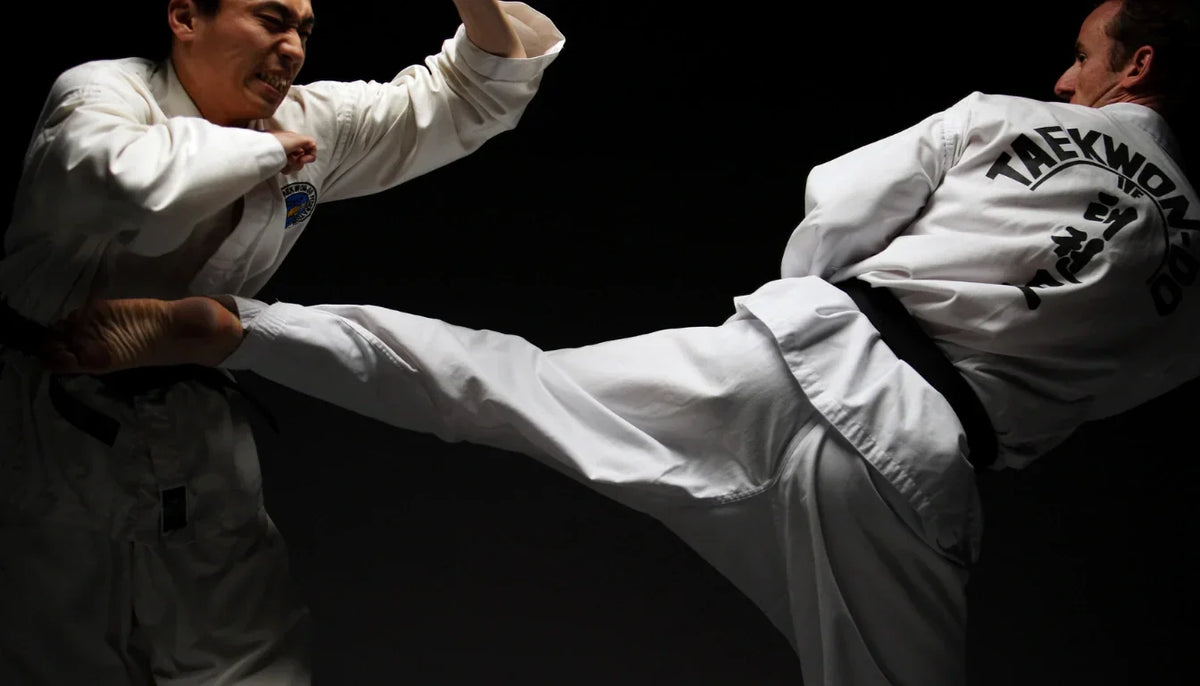
Muay Thai VS. Teakwando (Taekwondo vs Muay Thai)
Your first sparring round against a Taekwondo kicker feels like trying to catch a hummingbird. They’re bouncing, switching stances, flicking high kicks you barely see. Then you put them against a seasoned nak muay, and the pace changes. Less bounce, more pressure. A thudding *tae* (round kick) crashes into the arms, a stiff *teep* (push kick) stops the blitz, and the clinch closes any space for spinning tricks. Sound familiar?
This article breaks down taekwondo vs muay thai with the honesty you’d get from a training partner. You’ll learn what each art truly emphasizes, where they shine, where they struggle, and how to pick what fits your goals. We’ll talk technique, rules and scoring, conditioning, self-defense carryover, and realistic timelines—plus how to cross-train smart if you want the best of both.
Table of Contents
- Fundamentals: What Each Art Is
- The Big Differences That Actually Matter
- Technical Breakdown: Stance, Strikes, Clinch, Kicks
- How Rules and Scoring Shape Style
- Training Drills & Practice Methods
- Self-Defense & Real-World Context
- Which Should You Learn First?
- Common Mistakes & How to Fix Them
- Frequently Asked Questions
- Key Takeaways
- Final Thoughts
Fundamentals: What Each Art Is

Before picking sides in taekwondo vs muay thai, get clear on what each system is designed to do.
What is Muay Thai?
Muay Thai is Thailand’s “Art of Eight Limbs,” using punches (*chok*), kicks (*tae*), knees (*ti khao*), and elbows (*ti sok*), plus the clinch (*chern*). The stance is grounded, the power is rotational and brutal, and the rhythm is methodical. Traditional Thai scoring prioritizes effective, visible impact and balance. You’ll learn the *teep* (push kick) as a jab for your legs, the whip-like round kick that cuts through guards, and how to control posture in the clinch. Training is simple and hard: pad rounds, bag work, roadwork, sparring, and clinch—repeated thousands of times.
What is Taekwondo? (Often misspelled “Teakwando”)
Taekwondo, especially the Olympic World Taekwondo (WT) sport format, is a kicking-focused art built on speed, footwork, and scoring by clean contact on electronic hogus (chest protectors) and headgear. You’ll see bladed stances, fast chambering, and a buffet of spinning and jumping kicks. Hands are used but typically limited in sport WT (punches score to the body under strict criteria). Different federations exist; ITF tends to allow more hand techniques and patterns, while WT is the Olympic rule set with electronic scoring. Either way, Taekwondo specializes in dynamic leg attacks and distance play.
The Big Differences That Actually Matter

Forget style wars. Think outcomes. Here’s the difference between Muay Thai and “Teakwando” (Taekwondo) in ways that affect your training and sparring.
Range and Rhythm
Taekwondo thrives at long range with quick entries and exits. Muay Thai prefers mid-range pressure and close-range clinch. If you like darting in and out with fast kicks, Taekwondo fits. If you want to break balance and grind opponents down, Muay Thai suits your temperament.
Weapons and Targets
Taekwondo focuses overwhelmingly on kicks, especially to the body and head. Muay Thai uses all eight limbs, including low kicks to the thigh and shins, and legal clinch knees and elbows (depending on rules). More tools means more paths to score and finish for Muay Thai, while Taekwondo offers world-class leg dexterity and head-kick setups.
Contact and Power
Taekwondo sport rules limit sustained infighting, producing fast-touch exchanges. Muay Thai encourages sustained pressure and damage. Biomechanics research in combat sports shows Taekwondo kicks emphasize speed and angular velocity, while Muay Thai round kicks produce larger impulse through hip rotation and shin-to-body impact—more thud than tap.
Technical Breakdown

Let’s zoom into stance, striking tools, and transitions—where good fighters make real decisions in the ring.
Stance and Footwork
Taekwondo uses a bladed stance, weight light on the lead leg, heels often up, primed to chamber and fire kicks without telegraphing. The bounce is a feature, not a bug. In Muay Thai, you’ll stand more square, heels closer to the ground, ready to check kicks, step-and-teep, or pivot for the round kick. Footwork is purposeful, not jittery: cut the ring, set traps, then kick through the target. If you cross-train, learn to switch gears: bounce outside in TKD range, settle and pressure in MT range.
Hands: Punches (*chok*) and Elbows (*ti sok*)
WT Taekwondo punching is limited; it builds less boxing literacy under sport rules. Muay Thai trains complete hands: jab variations, cross mechanics, hooks, and uppercuts, plus elbow entries. A classic MT combo: jab to draw guard, cross to load hip, step and *tae* to the body or arms. Elbows turn clinch exchanges and tight breaks into fight-enders. If your background is TKD, build your jab-cross-hook with Dutch-style pad work so your kicks don’t live alone.
Kicks: Roundhouse vs. Chambered Whip
Taekwondo’s chambered roundhouse is fast, snappy, and great for point scoring and high shots. Spinning and jumping kicks punish predictable entries. Muay Thai’s *tae* is a hip-driven whip that crashes with the shin; you’ll learn to kick through the target, not to it. Low kicks aren’t emphasized in TKD, but they’re a pillar of Muay Thai. A trained Thai low kick can shut down that bouncy stance in one or two well-placed shots—ask anyone who’s eaten a properly timed inside leg kick on a switch step.
Clinch (*chern*) and Knees (*ti khao*)
Clinch is a no-go in WT Taekwondo. In Muay Thai, clinch wins fights. You’ll pummel for inside position, control posture, off-balance with foot sweeps, and land knees to body and head. Many TKD athletes crossing into MT struggle here. The answer? Daily clinch rounds. Start with 3x3-minute pummeling and posture control and build to 5x3 with knees at 50-70% power, focusing on balance and frames.
How Rules and Scoring Shape Style
Rules are the skeleton of a sport. They dictate which muscles athletes build.
Taekwondo (WT) Scoring
WT uses electronic scoring via sensor hogus and headgear. Body kicks and head kicks register on contact with set thresholds; spinning and jumping techniques can earn higher points. Punches score to the chest with clear impact under strict criteria. Clinching is broken quickly. This structure rewards speed, volume, and tactical footwork to trigger sensors.
Muay Thai Scoring
Professional Muay Thai under WMC and IFMA-influenced systems values effective aggression, balance, and visible impact. Clean body kicks that move an opponent or disrupt balance score highly, as do knees and elbows that land with authority. Leg kicks matter when they demonstrably affect posture or mobility. Clinch control and dumps that break balance are significant. Judges prefer techniques that show dominance and stability.
Why This Matters for Training
If your goal is Olympic-style TKD competition, train speed and deception with high kicking frequency. If you want ring-ready Muay Thai, train power, balance, and composure under pressure with full-body conditioning. If you plan to do both, periodize: spend blocks living in one rule set so you don’t confuse instincts when it counts.
Training Drills & Practice Methods
You get good at what you repeat. Here are practical drills for each art—and smart crossover work.
Drill 1: Muay Thai Low-Kick Pressure Series
Rounds: 5 x 3 minutes, 60 seconds rest. Pad holder cues entry with a jab. You respond: check, return inside low kick; or jab-cross, outside low kick; or teep, switch-step inside low kick. Focus on shin-to-target contact, hip rotation, and quick retraction. Add a balance cue: after each kick, the pad holder tries to nudge or sweep—your goal is to land and exit on base. This drill helps convert TKD bounce into MT stability while keeping your timing sharp.
Drill 2: Taekwondo Footwork and Head-Kick Trigger
Rounds: 6 x 2 minutes, 45 seconds rest. Use a partner with a belly pad and focus mitt. Pattern: bounce entry, feint low roundhouse chamber, switch in the air to head roundhouse or back kick if they step in. Work in twos and threes, light contact, 50% speed to build precision. Emphasize chamber height, hip snap, and immediate angle change after each kick. Finish each round with a 10-second sprint of fast double-roundhouse to head height.
Drill 3: Clinch Entry for TKD Crossovers
Rounds: 4 x 3 minutes. Start outside range with TKD bounce. Partner throws a light body kick; you catch, step in, secure inside collar tie and biceps control, and knee to the pad. Reset. Add frames and off-balances: step, pull, knee, turn. Keep posture tall, eyes up. Aim for 10 clean entries per round. This turns a common TKD habit—resetting after kicks—into a clinch initiation moment.
Drill 4: Mixed Rule Sparring (Controlled)
Rounds: 6 x 3 minutes. Alternate rounds: Round 1—TKD rules emphasis (light contact, kick scoring, quick breaks). Round 2—Muay Thai rules emphasis (leg kicks, clinch allowed). Keep power at 40-60%. The goal is adaptation: feel how your choices change with rules. Debrief after each pair of rounds: what did you land, what shut you down?
Self-Defense & Real-World Context
No ring, no ref. What carries over? Muay Thai’s elbows, knees, and clinch control are highly transferable in close quarters. The *teep* is a great distance tool. Leg kicks can cripple mobility fast. Taekwondo’s head-kick game is less practical under stress, but its footwork, balance, and fast body kicks can create space to disengage. The real key: situational awareness, de-escalation, and sprint-out fitness. Train for cardio under adrenaline—bag sprints and pad flurries with short rests mimic that dump better than cozy steady-state work.
Which Should You Learn First?
Ask yourself: What do you want in 12 months?
If you crave competition with acrobatic kicking and a sport environment that rewards speed and tactics, start with Taekwondo. You’ll build leg dexterity, coordination, and balance that few arts can match. If your goal is all-around striking for ring fights, MMA, or rugged self-defense carryover, begin with Muay Thai. You’ll learn hands, kicks, clinch, and body conditioning that translate widely.
Cross-training? Start with one for 6–12 months, then add the other. Mixing too early blurs instincts—like checking a kick when you should bounce, or bouncing when you should plant and kick through. Periodize your focus and you’ll keep the best of both.
Common Mistakes & How to Fix Them
I’ve seen this hundreds of times in the gym. The good news? Every one of these has a fix.
Mistake 1: TKD Bounce Inside MT Range
Problem: Staying light on the lead leg at elbow/knee range gets you dumped or low-kicked. Why it happens: Habit from point-fighting range. Fix: Practice “gear shift” entries—bounce outside, then plant the heels and square the hips before exchanging. Shadowbox 3x3 minutes focusing on the switch from bounce to plant with a teep, then low kick.
Mistake 2: MT Fighters Ignoring High-Kick Triggers
Problem: Marching forward with a high guard and heavy base invites head-kick counters. Why it happens: Overconfidence in shelling. Fix: Drill feint reads—partner shows hip chamber; you either step out 45°, frame, or intercept with a teep. Finish with a return low kick. Build that reflex with 5 minutes daily of chamber-read drills.
Mistake 3: Hands Down After Kicks
Problem: Both arts suffer from this—kicking and admiring your work. Why it happens: Balance focus overrides defense. Fix: Add a mandatory return: every kick must be followed by either a jab on landing or a check and pivot. Count it out loud on pads: “Kick—jab!”
Mistake 4: Neglecting Clinch for Cross-Trainers
Problem: TKD background, zero clinch literacy. Fix: 10 minutes daily of collar tie pummeling with posture checks. Goal: chin tucked, crown high, elbows in, hips heavy. Add 30 knees per round to build comfort.
Practical Rules Comparison (What Scores Right Now)

Rules shape your instincts. If you’re bouncing between dojang and ring, lock in what judges actually reward so your training lines up with reality.
World Taekwondo (WT) Points at a Glance
Modern WT uses electronic hogus/headgear with judges confirming actions. Typical scoring under current WT standards:
- Body kick: 2 points (clean contact on hogu)
- Turning/spinning body kick: 4 points
- Head kick: 3 points
- Turning/spinning head kick: 5 points
- Punch to body: 1 point (clear impact, shoulder behind the shot)
- Gam-jeom (penalty): −1 (step out, falling, grabbing, etc.)
Clinching is broken quickly; continuous infighting doesn’t get time to develop. Speed, clean sensor activation, and ringcraft to draw penalties are king.
Muay Thai Scoring Priorities
Under WMC/IFMA-influenced criteria, judges value techniques that show effect, balance, and dominance:
- Body kicks that move the opponent, disrupt posture, or clearly land with shin score highly.
- Knees and elbows with visible effect trump light touches.
- Clinch control and off-balances/dumps show superiority.
- Leg kicks matter more when they impair stance or movement.
- Clean defense (checks, parries, evasion) that makes strikes miss also scores.
No sensors, no “touch” points—impact and stability decide who’s ahead. Train to land with intent and stand tall after you score.
Shutting Down the TKD Blitz Without Eating Spinning Tricks
That first-step side kick and the sneaky spin are the TKD signatures. Here’s how to neutralize them and turn exchanges into Muay Thai fights.
Line Denial with the teep (push kick)
Beat the side-kick lane before it’s built. From a stable base, extend the lead teep straight down the center as they chamber. Heel to hip line, toes up, eyes on their chest. Don’t chase—post, make them reset, then step in behind a hard body tae (round kick).
Check-and-Chop vs. Double-Roundhouse
When they throw fast doubles upstairs, lift a high shield, absorb on the forearm/shin, and return immediately to the base leg. Turn your hip, connect with the lower third of your shin, and kick through—not to—the target. Don’t admire your block; the window is half a beat.
Catch to chern (clinch) Entry
If they angle in with a body kick, catch at the forearm/wrist, step outside, and lift your posture. Slide your rear hand to the neck tie, square your hips, and knee (ti khao) to the body pad or solar plexus. Off-balance before you knee—small circle step to make them light.
Spin Insurance: Frame, Pivot, Chop
See the shoulder wrap for the spin? Don’t retreat straight back. Frame with lead forearm on their chest, pivot 45° to their blind side, and smash the thigh or body as they complete the turn. Keep your right hand high to catch the heel if the spin shortens.
Safety Note
TKD athletes often kick with the instep. If you collide elbow-to-instep, injuries happen. Keep your elbow line inside your shield and favor shin checks to protect both partners during cross-training.
Equipment & Safety for Cross-Trainers
Different tools, different stresses. Set your gear and habits right so you can train hard without downtime.
Instep-to-Shin Transition
Coming from TKD? Retrain your contact point. Aim to land the Muay Thai round kick with the lower shin, not the foot. Start on a heavy bag: 3 rounds x 30 controlled kicks/side, focus on hip turn and toes pointed slightly down. Add light padwork before you try hard checks or sparring.
Shin Conditioning That Won’t Wreck You
- Weeks 1–2: 2 sessions/week, 60–80 light bag kicks/side.
- Weeks 3–4: 2–3 sessions/week, 100–120 moderate kicks/side + 20 light checks/side on a pad.
- Rule: Dull ache is okay; sharp pain/swelling means stop and recover.
Protective Kit Basics
- Muay Thai: 12–16 oz gloves (size by bodyweight), quality shin guards that cover high tibia, mouthguard, groin guard, elbow pads for sparring.
- Taekwondo: WT-approved hogu/headgear for comps, forearm/shin-instep guards, mouthguard, groin guard.
Daily fighters stress durability. Brands like Fairtex, crafting gear in Thailand for over 50 years, set the standard many gyms trust for pads and gloves used day in, day out.
4-Week Crossover Microcycle (Keep Instincts Clean)
Train in blocks so your body knows which language it’s speaking.
Weeks 1–2: Taekwondo Emphasis
- Mon: Footwork ladders + chamber speed (6 x 2-min), double/head kick precision (5 x 2-min)
- Wed: Side kick entries, back kick counters (6 x 2-min), light TKD spar (4 x 2-min)
- Fri: Mobility + hamstring/hip flexor strength, core anti-rotation
- Sat: Mixed drill day (see “Sensor-to-Impact Conversion” below)
Weeks 3–4: Muay Thai Emphasis
- Mon: Pads—teep lines, body kicks, low-kick endings (5 x 3-min)
- Wed: Clinch fundamentals (5 x 3-min), balance dumps
- Fri: Bag power rounds—body/leg kick volume (5 x 3-min), check-and-return reps
- Sat: Controlled MT spar (5 x 3-min, 40–60% power)
Strength: 2x/week posterior-chain focus (RDLs, split squats, Nordic curls). Evidence-based hamstring work lowers strain risk from high-kick volumes.
Applied Drills the Competitors Use (Dialed for Our Gym)
Plug these into pads or partner work. Keep power honest and eyes up.
Spin Punish Flow
Make the spin a liability, not a highlight.
- Setup: Holder cues a spin with a shoulder wrap.
- Execution: Frame with lead forearm, pivot 45° outside, chop low kick, step-in teep to chest, finish with body tae.
- Common Mistakes: Backing straight up; dropping rear hand; kicking before the pivot completes.
- Progression: Add a dump in clinch on the reset; final round go southpaw and repeat.
Side-Kick Neutralizer
Take the sting out of the first step.
- Setup: Partner launches lead side kick from a bladed stance.
- Execution: Step 45° outside with rear foot, parry heel across with rear hand, drop a calf kick to their base leg, then step into collar tie and knee (ti khao).
- Common Mistakes: Reaching past the heel; crossing your feet on the angle; swinging the kick without hip turn.
- Progression: Add a catch to dump if they switch to roundhouse.
Sensor-to-Impact Conversion
Teach a TKD kicker to land with Muay Thai effect.
- Setup: Heavy bag + belly pad on partner.
- Execution: 10 fast chambered body kicks (touch), 10 Muay Thai body kicks (thud). Alternate touch/thud for 3 sets/side.
- Common Mistakes: Same contact point for both; leaning back on MT kicks.
- Progression: Add jab-cross before thud; finish with check-and-return low kick.
Frequently Asked Questions
Is Muay Thai better than Taekwondo?
Better for what? For ring damage, clinch, and all-around striking, Muay Thai generally has more tools. For dynamic kicking, timing at range, and Olympic-style competition, Taekwondo shines. If your end goal is MMA or full-contact ring sports, Muay Thai tends to carry over more directly. If you want elite kicking and tournament circuits, Taekwondo offers a clear pathway. Pick based on your destination.
What’s the main difference between Muay Thai and Teakwando (Taekwondo)?
Taekwondo is kick-dominant with a bladed stance, fast entries, and point scoring via electronic gear (WT). Muay Thai uses eight limbs, heavy emphasis on low kicks, body kicks, elbows, knees, and clinch control. Taekwondo limits clinch and sustained infighting; Muay Thai embraces it. That core difference shapes how each art trains balance, power, and rhythm.
Should I learn Muay Thai or Teakwando first?
If you want a broad striking base for fighting or self-defense, start with Muay Thai. If you want acrobatic kicks and sport tournaments, start with Taekwondo. Cross-train later—6–12 months focusing on one art builds clean habits before you add the other. Many athletes do well starting Muay Thai first, then layering TKD kicking variety for surprise value.
Which art is better for self-defense?
Muay Thai’s elbows, knees, clinch control, and the *teep* translate well under pressure. Taekwondo’s footwork and quick body kicks help create space to exit. Both improve fitness and confidence. Add awareness, boundary setting, and sprint conditioning if self-defense is your priority. Remember: context and avoidance beat technique every time outside the gym.
How do Taekwondo kicks compare to Muay Thai kicks in power?
Taekwondo emphasizes speed and volume; kicks are chambered and snapped, excellent for head-height scoring. Muay Thai round kicks drive through the target with shin contact and big hip rotation, producing higher fight-stopping potential. Both can be powerful, but MT mechanics typically generate more thudding impact, especially to the legs and body.
Can I compete in both?
Yes, but periodize. Train in TKD blocks ahead of TKD tournaments to sharpen speed and accuracy under those rules. Do Muay Thai camps ahead of MT fights to rebuild pressure, low kicks, and clinch. Split focus too close to either event and your instincts will conflict—like bouncing into a low kick or checking instead of sliding out for a head kick.
What injuries are common in each art?
Taekwondo: hip flexor and hamstring strains from high volume kicking, ankle rolls from bladed stances, occasional head impact from spinning entries. Muay Thai: shin bruising, ankle sprains from checks and pivots, rib soreness from body kicks, neck fatigue from clinch. Warm up thoroughly, progress volume gradually, and use proper protective gear for both.
How long until I’m “fight ready”?
For Taekwondo tournaments, 6–12 months can get you into beginner brackets if you train consistently 3–4 days a week. For Muay Thai smokers or novice bouts, many need 9–18 months depending on athletic background and clinch development. Quality coaching and smart conditioning shave months off that timeline.
Will Taekwondo ruin my Muay Thai stance (or vice versa)?
Only if you mix habits randomly. Treat them like languages. When you’re in TKD mode, blade and bounce; when you’re in MT mode, plant and pressure. Shadowbox dedicated rounds in each “accent,” and you’ll gain versatility instead of confusion. Plenty of high-level strikers borrow from both without diluting either.
What equipment do I need to start?
Taekwondo: dobok, mouthguard, shin/instep guards, forearm guards, WT-approved hogu/headgear for competition. Muay Thai: gloves, wraps, shin guards, mouthguard, groin guard; elbow pads for sparring; optional headgear. Always choose gear that fits properly and is approved for your discipline’s rules.
Key Takeaways
- Taekwondo vs Muay Thai comes down to goals: speed and kicking sport vs. full striking with clinch and pressure.
- Rules shape style—train in blocks to keep instincts clean for each discipline.
- Cross-train smart: 6–12 months focused in one art before layering the other.
- Protect your body: warm up, progress volume, and respect recovery to avoid common injuries.
Final Thoughts
You don’t need a style war. You need clarity. If high-speed, tactical kicking gets you fired up, Taekwondo will keep you chasing new heights—literally. If you want a rugged striking game for ring fights or MMA, Muay Thai gives you a complete toolkit and the conditioning to use it under fire. Plenty of us have found value in both: TKD gives you the surprise angles; MT gives you the pressure and finish.
Pick your path, put in honest rounds, and track progress—bag numbers, pad rounds, sparring quality, and how your body feels over months, not days. Train with respect for both arts, honor their traditions, and keep your ego out of the way. That’s how you become dangerous and durable—one round at a time.
About This Training Approach
These observations reflect how rules and mechanics create distinct striking systems. Camps with deep Muay Thai roots have refined pressure, balance, and clinch over decades. Brands like Fairtex, developing fighters and equipment since 1971, exemplify that traditional Thai approach—technique first, then relentless repetition—to build world-class strikers across weight classes.
Sources and references include guidance from the World Muaythai Council (WMC), IFMA scoring principles, and World Taekwondo (WT) competition rules. For biomechanics and conditioning, see combat sports research in journals from 2020–2024 discussing kick velocity, impulse, and injury trends. Always follow your coach’s safety guidelines.
Last Updated: November 2025