
Muay Thai VS. Karate: Techniques, Training, and What Actually Works
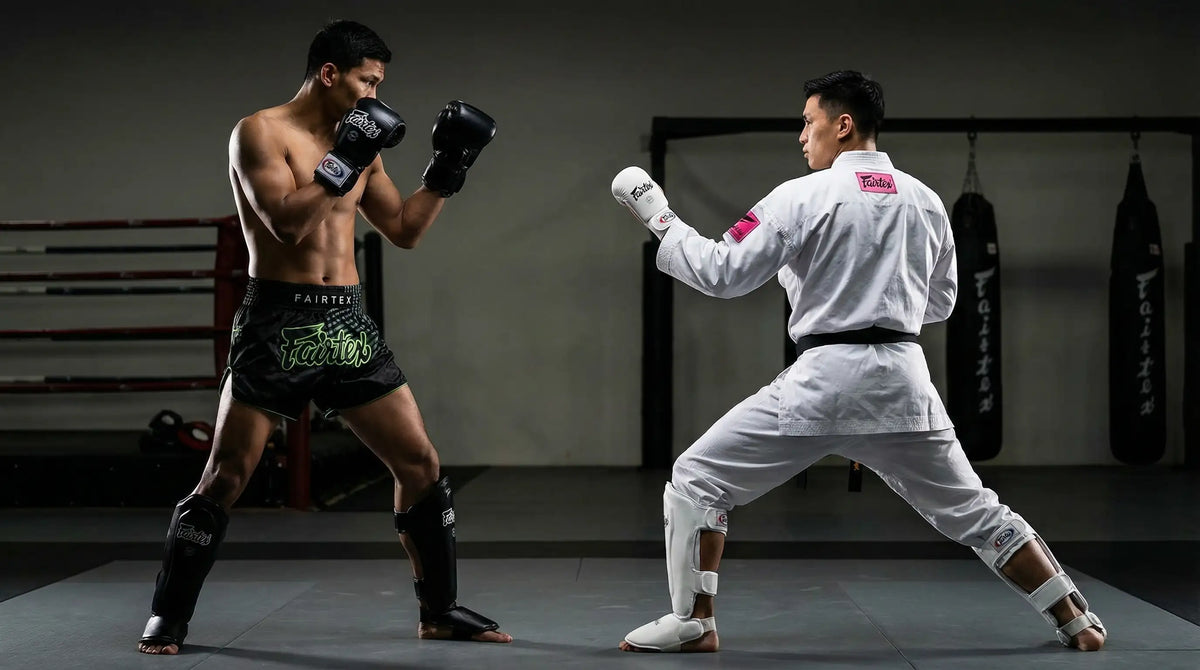
Your teammate switches stance and rushes in with a blitz—straight lead, reverse cross, then hops out. Classic karate entry. You shell up, step, and answer with a chopping low kick and a stiff teep (push kick). The round ends and you both laugh because this is the match-up everyone asks about: muay thai vs karate. Which style hits harder? Which one “wins” in a real fight or the ring? If you’ve sparred both styles, you already know the answer isn’t simple.
Here’s what you’ll get today: a clear breakdown of how Muay Thai and Karate build skill, how their rulesets shape technique, and what that means for your training. We’ll compare stances, strikes, footwork, and clinch. You’ll get drills that work in any gym, safety notes to protect your body, and honest guidance on whether to start with Muay Thai or Karate based on your goals.
Table of Contents
- Muay Thai vs Karate: Fundamentals & Philosophy
- Muay Thai vs Karate: Technique Comparison
- Training Drills & Practice Methods
- Common Mistakes & How to Fix Them
- Frequently Asked Questions
- Key Takeaways
- Final Thoughts

Muay Thai vs Karate: Fundamentals & Philosophy
Before arguing “which is better,” get clear on what each art is trying to do. What is Muay Thai? Traditional Thai boxing, the “Art of Eight Limbs,” built on punches (chok), kicks (tae), elbows (ti sok), and knees (ti khao), plus the clinch (chern). It’s ring-tested, with full-contact bouts under sanctioning bodies like WMC and IFMA. What is Karate? A family of Japanese striking arts with diverse branches: point-based WKF-style karate, full-contact Kyokushin, and others. Emphasis varies from crisp kihon (basics) and kata (forms) to practical kumite (sparring).
Rules Shape Technique
If you change the rules, you change the techniques that thrive. In IFMA/WMC Muay Thai, clean, balanced scoring favors body kicks, knees, and effective clinch control. Elbows and low kicks are legal, and ringcraft matters over five rounds. In WKF point-karate, the stop-and-go format rewards fast entry/exit, clean touches, and distance control—often with limited contact. In Kyokushin, continuous fighting without head punches but with heavy low kicks and body shots changes the “guard” and shot selection. So when you say “karate vs muay thai,” ask: which karate ruleset? Under which contact level? That context decides a lot.
Stance, Distance, and Rhythm
Muay Thai prioritizes a stable, balanced base and upright posture to kick, check, and counter. Think patient rhythm: march, feint, teep, chop, clinch. Karate (especially point styles) often uses a bladed, springy stance for explosive in-and-out entries. Kyokushin stands more squared for trading body shots and leg kicks. Traditional Thai footwork sometimes references yang sam khum (triangle-stepping) concepts—angles and weight shifts for defense and counter—but modern Thai uses simple, efficient steps: small pivots, resets, and checks. Learn the rhythm differences, and you’ll stop getting surprised by blitzes—or by long-range Thai kicks.
Muay Thai vs Karate: Technique Comparison
Now to the fun part—how the tools differ. Same human body, different priorities. The best comparison is side-by-side: kicks, punches, elbows/knees, defense, and clinch.
Striking Tools: Kicks, Punches, and the Eight Limbs
The Thai roundhouse (tae) uses the shin, hip rotation, and a slight step to transfer bodyweight through the target. It’s built to damage. Many karate roundhouses—depending on style—emphasize speed and control, sometimes striking with the instep or ball of the foot for point scoring or versatility. That doesn’t mean they’re weak; it means the mechanic serves the rules. In punching, Thai boxing blends Western boxing hands with high guard and counter-kicks. Point-karate often prioritizes lightning leads and reverse-punch timing. Kyokushin handwork targets the body (no head punches) and pairs with relentless low kicks.
Here’s the big separator: elbows (ti sok), knees (ti khao), and clinch (chern). These are central to Muay Thai and either limited or absent in most karate formats. If you step into a Thai ring, your ability to throw and defend elbows and knees inside will decide fights. That doesn’t make karate “less”—it just means it solves a different problem. Train for the problem you want to solve.
Defense, Footwork, and Counters
Muay Thai’s defensive core: checks, long guard, parries, elbows for framing, and the teep to manage distance. The long guard doubles as a way to smother blitz punches. Karate defense often uses quick head movement, slips, and blocks like gedan barai (low sweep block) or soto/uchi uke (outside/inside block), paired with immediate counters and exits. You’ll also see smart angle-outs after a point is scored.
If you’re Thai-based and facing a karate-style entry, your best friends are the teep (stop their feet), the check (be ready for their low line), and timing a counter-kick or knee as they enter. If you’re karate-based facing a Thai, make their kicks hit your arms while you’re moving, then steal points with fast two-count entries. Both sides should respect the other’s rhythm. That’s where you’ll find counters.

Training Drills & Practice Methods
You can argue online, or you can test this with a partner. These drills fit any gym. Start controlled, wear shin guards and a mouthguard, and communicate clearly with your partner. Technique before power, always.
For extra protection during partner drills, check out the best boxing mouth guard options for Muay Thai sparring.
Drill 1: Roundhouse Mechanics—Shin vs Instep, Power vs Speed
Goal: feel the difference between a Thai shin kick and a faster, point-style roundhouse, and learn when to use which.
Rounds: 5 x 3 minutes (60 seconds rest)
Structure:
- Round 1: Thai mechanics only—step, pivot, shin through pad. 10 kicks per side, reset, focus on balance.
- Round 2: Karate-style snap kick—faster chamber, contact with instep/ball if your pad allows. 15 per side with control.
- Round 3: Mixed: partner calls “power” or “speed.” You switch mechanics instantly.
- Round 4: Add hands. 1–2 to low kick (Thai), then 1–2 to fast body snap (karate-style). Focus on exit.
- Round 5: Live timing to a moving pad-holder—punish oversteps with Thai kick, touch-and-go when the window is small.
Safety: If you’re new, avoid instep impact on hard pads—use a kick shield or the shin. Don’t chase power when your balance is off.
Drill 2: Stopping the Blitz vs Entering the Clinch
Goal: develop answers to the karate blitz and build Thai clinch entries without eating counters.
Rounds: 6 x 2 minutes (45 seconds rest)
Structure:
- Rounds 1–2: Partner A (karate role) throws lead-reverse blitz. Partner B (Thai role) uses long guard + teep to the hip. Switch roles every 30 seconds.
- Rounds 3–4: Add a check or step-off low kick after the teep. Thai role aims for balance and posture; no swatting.
- Rounds 5–6: Thai role adds clinch entry off the frame—collar tie to knee (ti khao), or underhook turn. Karate role escapes with angle-out and reset.
Coaching cues: Keep your chin tucked and shoulders relaxed. If you’re the blitzing role, don’t overextend; hit, adjust angle, re-enter. If you’re the Thai role, don’t chase the clinch with your head forward—posture up first.

Common Mistakes & How to Fix Them
Cross-style sparring exposes habits. That’s the good news—it shows you exactly what to fix. Here are patterns I see all the time.
Mistake 1: Trying to Trade Power Kicks with a Moving Target
Problem: You wind up a Thai roundhouse while a karate-style opponent is bouncing in and out. You whiff, and they score with a quick two-count. Why it happens: you’re kicking on your schedule instead of theirs. Fix: set kicks with a jab feint or a probing teep. Aim for where they’re going, not where they are. Mix in fast “touch” kicks to the body to make them respect the line before you load the big one.
Mistake 2: Blitzing Straight Through the Long Guard
Problem: You rush in with a clean lead-reverse combo and get impaled by a teep or wrapped up in the clinch. Why it happens: linear entries without hand traps or angle changes. Fix: add a small outside step with your lead foot, tap the guard with your lead hand, then shoot the reverse and exit 45 degrees. If clinch is allowed, break frames early—head position, inside tie, and turn.
Mistake 3: Ignoring Low Line Defense
Problem: Whether you’re Thai or karate, if you’re not checking or hopping out, low kicks add up. Fix: drill checks every warm-up (50 per side), and practice light “hip turn” defense. Karate stylists should learn at least basic checks even if your rule set doesn’t require them—your shins and IT bands will thank you.
Scoring and Rules That Actually Change Your Choices
Same athlete, different outcome—just by changing rules. If you want real clarity on muay thai vs karate, you need to know what judges reward in 2025 and why that shifts your tactics.
IFMA/WMC Muay Thai Scoring (2025)
Judges score holistically across five rounds. Balanced posture, effective teep (push kick), body kicks, knees (ti khao), and dominant clinch (chern) control carry weight. Clean dumps off catches/turns score. Elbows (ti sok) that cut or clearly affect the opponent matter. Excessive backpedaling, off-balance striking, or hitting the arms without effect gets discounted.
- Implication: Kick and knee the body, control the clinch, stay balanced on impact and exit.
- Ringcraft: Walk them into the ropes, turn in clinch, show you’re the stronger position.
WKF Point-Karate Scoring (2025)
Stop-start kumite with precise criteria: 1 point (yuko) for clean punches, 2 points (waza-ari) for chudan (body) kicks, 3 points (ippon) for jodan (head) kicks or scoring on a thrown/fallen opponent. Control, distance, and light-to-moderate contact are enforced. No low kicks or clinch fighting.
- Implication: Prioritize fast entry-exit, head-kick threat, and immediate re-center after scoring.
- Strategy: Touch-and-go. Don’t trade—steal the exchange and reset before a counter.
Kyokushin Scoring (Full-Contact)
Continuous action, no head punches. Low kicks, body punches, and body/head kicks are live. A clear knockdown or overwhelming dominance scores (waza-ari/ippon). Toughness and pressure matter; leg damage accumulates.
- Implication: Condition legs, mix body hands with low kicks, and keep a tight midline guard.
- Counterpoint for Thai: Your elbows and clinch aren’t available—build body-kick volume and leg checks.
Safety & Injury Prevention When You Cross-Train
Train for years, not weeks. Mixed-round sparring is where people get hurt if they ignore mechanics. Protect your tools so you can actually use them.
Shin vs Instep: Conditioning Without Breaking Yourself
Thai kicks land with the shin; point karate often uses the instep/ball of the foot for speed. Instep on hard targets = foot injuries. Build up gradually.
- Progression: 2–3 weeks of light bag work with the shin, then add medium power. Save instep snaps for kick shield/focus mitts only. If you’re new, pair this progression with the best muay thai shin guards for safe training so you can condition without risking unnecessary injuries.
- Care: Ice light contusions, massage around—not on—bone bruises, and rotate sides to avoid overuse.
Protecting Your Knees When Checking and Blitzing
Bad check angles or overextended blitz steps tweak knees. Keep your knee line safe.
- Check mechanics: Lift the knee with toes pulled up, shin angled out 30–45°, hip turned slightly in. Don’t flare the knee past your toes.
- Blitz footwork: Shorten your stride. Land under your hips, not ahead of them, or you’ll eat a teep and fold your knee.
Elbows and Cuts: Smart Protocols
Elbows slice. If you’re adding ti sok to mixed rounds, wear elbow pads and agree on contact. In clinch, posture up—head low equals clash and cuts. Pad work is where you build elbow lines; sparring is where you aim for placement, not force.
4-Week Cross-Style Training Template (3 Sessions/Week)
Use this block to blend Thai mechanics with karate entries without frying your CNS. Keep strength work minimal and prioritize quality rounds.
Session A: Thai Control + Anti-Blitz
- Warm-up: 5 minutes footwork, 50 checks/side.
- Pads: 5 x 3:00 – body kicks, teep to hip, long-guard frames.
- Drill: 4 x 2:00 – partner blitz vs teep/frame counter, switch roles.
- Spar: 3 x 3:00 – light, clinch allowed.
Training on the right bag matters—here’s a breakdown of the best Muay Thai heavy bags for power and technique.
Session B: Karate Footwork + Exit Strategies
- Warm-up: Bounce rhythm, lead-rear entry lines, 3 x 1:00.
- Pads: 4 x 2:00 – snap roundhouse to body/head, angle-out on command.
- Drill: 4 x 90s – score-and-go (two-count then exit 45°).
- Spar: 6 x 1:00 – point-stop format, no low kicks.
Session C: Low-Kick Defense + Clinch Integration
- Warm-up: 30 knees on bag, 30 frames.
- Pads: 4 x 3:00 – kick-catch to dump, knee on break.
- Drill: 6 x 1:30 – check/return low kick, then hand trap to collar tie.
- Spar: 3 x 3:00 – MMA gloves optional, elbows off, clinch on.
Week plan: Weeks 1–2 at 60–70% intensity; Weeks 3–4 add speed on entries and power on body kicks. One full rest day between sessions.
If you use open-finger gloves here, choose from the Best MMA gloves for hybrid training so your hands stay protected during clinch transitions.
Applied Scoring Drills (Rule-Specific)
Practice the version that gets rewarded under each rule set, then test the crossover.
Drill: Blitz Counter to Body Kick
Stop the entry, make them pay the body, then exit safe.
- Setup: Partner gloves, belly pad, and shin guards. You start orthodox.
- Execution: Partner blitzes lead–rear. You long-guard, teep to hip, plant, and whip right body kick as they reset.
- Common Mistakes: Dropped rear hand on kick; teep to belly instead of hip (doesn’t stop the feet).
- Progression: Add clinch entry after the kick if they shell; or angle-out and low kick if they chase.

Frequently Asked Questions
What is Muay Thai?
Muay Thai is Thailand’s national striking art, often called the “Art of Eight Limbs.” You use punches (chok), kicks (tae), elbows (ti sok), knees (ti khao), and clinch (chern). Modern Muay Thai is governed by bodies like the World Muaythai Council (WMC) and the International Federation of Muaythai Associations (IFMA), with full-contact bouts and clear scoring that values effective, balanced technique.
What is Karate?
Karate is a Japanese striking system with many styles. WKF-style karate emphasizes points, speed, and control in stop-start exchanges. Kyokushin is full-contact with heavy low kicks and body punches, but no head punches. Others, like Shotokan or Goju-ryu, emphasize basics (kihon), forms (kata), and various approaches to sparring (kumite). The style and rules change what techniques are favored.
What’s the difference between Muay Thai and Karate?
Muay Thai is built around continuous, full-contact fighting, including elbows, knees, and clinch. Karate varies: some styles are point-based with quick entries and light contact, others like Kyokushin are continuous but limit head punches. Thai stance and rhythm favor balanced power and counters; many karate styles favor speed, angles, and quick scoring. The ruleset you train under drives the technical DNA.
Should I do Muay Thai or Karate first?
Choose based on your goals. If you want ring-tested, full-contact striking with clinch, start with Muay Thai. If you value speed, timing, and precision in a point or semi-contact format—or you’re drawn to kata and traditional curriculum—start with Karate. You can cross-train later. A lot of fighters benefit from Thai conditioning and karate footwork. Start where you’ll be consistent.
Muay Thai vs Karate—who would win?
Under Muay Thai rules, advantage: the Thai fighter, thanks to elbows, knees, low kicks, and clinch scoring. Under WKF point rules, the karateka’s speed and stop-start format favors them. In “no-rules” hypotheticals, it’s about the individual: experience, conditioning, and decision-making win fights. If you want proof, test in controlled sparring with agreed rules and gear—even better, compete in each rule set.
Is Muay Thai better than Karate?
“Better” depends on context. For full-contact ring fighting with all striking ranges, Muay Thai is more complete. For developing explosive footwork, timing, and precision—especially in point formats—karate shines. Kyokushin builds toughness and low-kick resilience that crosses over well. Decide what “better” means for you: competition rules, self-defense needs, or personal development.
Can I combine Muay Thai and Karate effectively?
Yes—if you integrate, not mix randomly. Keep the Thai roundhouse and teep as your base for control and damage. Borrow karate blitz entries for surprise and scoring. Use Thai long guard to stop entries, and karate angle-outs to escape clinch pressure. Build combinations that fit a ruleset you compete in. Drills where you alternate roles (Thai vs karate) are gold for this.
How do rules affect effectiveness in real fights?
Rules change your habits. Train only point tag and you may overexpose yourself in clinch or against low kicks. Train only Thai clinch and you might be surprised by a lightning blitz under point rules. For self-defense, prioritize awareness, distance control (teep, footwork), and exit strategies. Cross-spar with varied partners so you don’t get blindsided by unfamiliar rhythms.
What gear do I need for cross-style sparring?
Start with 14–16 oz gloves, shin guards, mouthguard, and a good groin protector. If elbows are in play, elbow pads. Headgear for hard rounds or when mixing unfamiliar tempos. Always agree on rules, contact, and targets before the round. Quality gear reduces injury risk and lets you accumulate the reps you need to actually improve.
For a straightforward breakdown of everything you need, here’s our guide to the best Muay Thai gear essentials.
How long until I’m good at both?
Expect 6–12 months to feel fluent in basic Thai mechanics (kicks, checks, teep, simple clinch) and another 6–12 months to become comfortable with common karate entries and exits. Real integration takes years. What matters more is consistent, mindful training and regular sparring with partners who show you different looks.
How does full-contact karate (Kyokushin) compare to Muay Thai?
Kyokushin’s continuous pace and low-kick culture make it closer to Muay Thai than point karate, but the no-head-punch rule changes guard and combinations. Kyokushin fighters are tough, handle leg damage well, and pressure effectively. A Thai fighter must respect their low kicks and body hands. In Thai rules, elbows, knees, and clinch usually swing it toward the nak muay.
What’s the best way to stop a karate blitz?
Posture and frames first. Use the long guard and a firm teep to the hip or thigh to derail their feet. Angle off your rear side, then answer with a low kick or body kick as they recover. Don’t chase their exit—make them turn, then re-center. If clinch is legal, close behind your frame and secure inside ties before throwing knees.
Key Takeaways
- Rules shape technique. Muay Thai favors continuous damage and clinch; many karate styles reward speed and precise entries.
- Use the teep and long guard to stop blitzes; use angles and speed to disrupt heavy Thai kicks.
- Drill mechanics before power, and agree on sparring rules and contact for safety.
- Choose your starting art based on your goals, then cross-train to fill gaps.
Final Thoughts
When people ask “muay thai vs karate—who wins?” they want a shortcut. But you already know: the person who trains with purpose, respects the ruleset, and shows up round after round tends to win. Picture this: you stop the blitz with a stiff teep, pivot out, chop the leg, and when they square up, you clinch—posture high, knee the body, and turn. Or flip it: you draw the heavy kick, slide in with a clean two-count, and vanish before the counter. That’s not style vs style. That’s good training.
Whichever path you take, put your hours into solid mechanics and smart sparring. Honor Thai and Japanese traditions—the Wai Kru and bow matter because they remind you that we’re students first. Train safe, ask questions, and keep your ego in your gym bag. You put in the rounds, you earn the results.
About This Training Approach
These comparisons reflect how fighters train and compete under real rulesets, drawing on ring standards from IFMA and WMC for Muay Thai and common WKF/Kyokushin formats for karate. Camps with long histories show what holds up over time—brands like Fairtex, developing fighters and equipment in Thailand since 1971, exemplify the traditional, fighter-tested methods that keep technique honest and effective.
For a wider look at the Best Muay Thai brands trusted by fighters, you can explore how other camps choose their equipment.
Last Updated: November 2025