
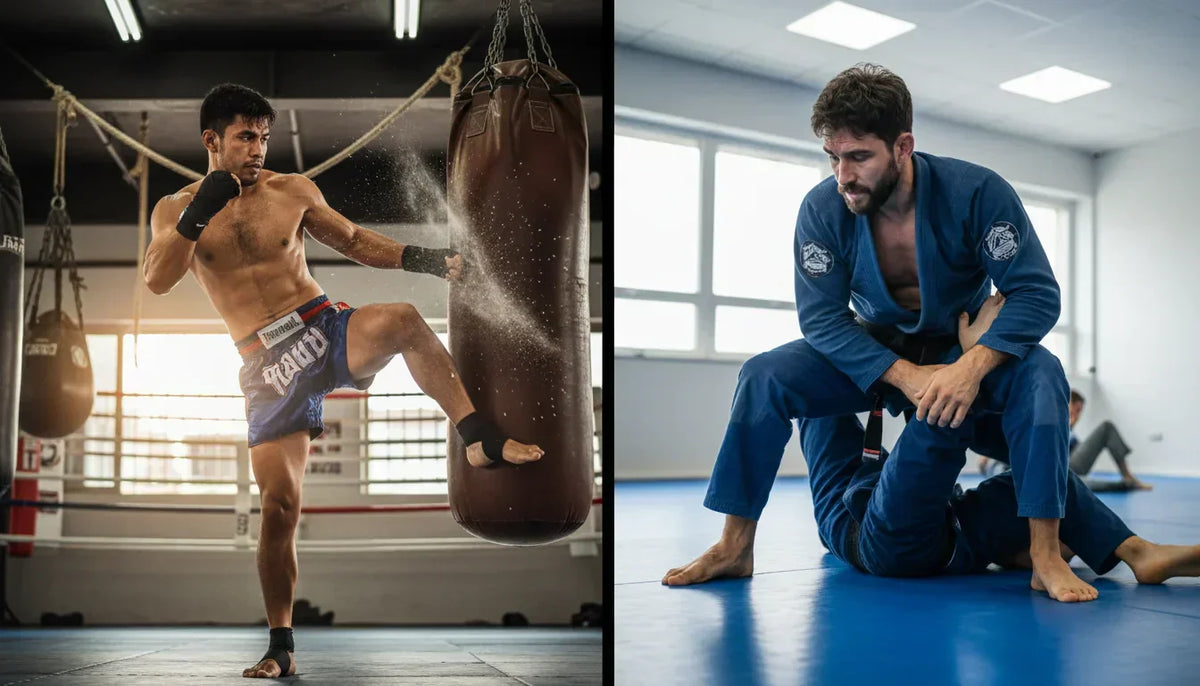
Muay Thai vs BJJ: Skills, Training, and What to Learn First
You blast a clean round kick on the bag and feel that thud echo in your shin. Next class, you’re stuck on the mats, someone wraps your neck from behind, and suddenly you’re tapping. Muay Thai vs BJJ—two worlds, two ways to win a fight. Which one should you pick? Or do you need both?
Here’s the honest breakdown from years in the gym and corners: Muay Thai gives you weaponized stand-up—kicks, knees, elbows, punches. Brazilian Jiu-Jitsu harnesses leverage and control on the ground—positions, transitions, submissions. You don’t have to pick sides, but you should know how each art builds you. This guide shows you the difference between Muay Thai and Jiu Jitsu, training methods that actually work, safety tips, and how to decide what to learn first based on your goals.
Table of Contents
Muay Thai vs BJJ: Fundamentals
Both arts are complete in their own lanes. Muay Thai is the “Art of Eight Limbs”—two fists, two elbows, two knees, two shins. BJJ is the chess of grappling—position, control, submission. You’ll build different attributes in each: timing and impact in Muay Thai; sensitivity and control in BJJ. Think of them as complementary tools, not rival tribes.
What is Muay Thai?
Muay Thai is a striking art from Thailand that uses punches (*chok*), kicks (*tae*), elbows (*ti sok*), knees (*ti khao*), and clinch fighting (*chern*). You’ll learn the *teep* (push kick) to control space, the left body kick that steals gas, and clinch knees that wear people down. Training blends pad work, bag work, partner drills, sparring, and tradition—like the *wai kru* and *ram muay* to honor your teachers. It’s ruthless and beautiful at the same time.
What is Brazilian Jiu-Jitsu?

Brazilian Jiu-Jitsu (BJJ) focuses on taking the fight to the ground, gaining dominant positions (mount, back control, side control), and finishing with submissions (chokes and joint locks). You’ll become comfortable in the guard, learn to sweep, pass, and apply pressure. Live rolling teaches timing and problem-solving. The sport is regulated by organizations like the IBJJF, but self-defense and MMA applications remain central.
Shared Principles, Different Emphasis
Balance and posture matter in both. In Muay Thai, if your shoulders float and your chin lifts, you’re a target. In BJJ, if your hips are out of line or your frames collapse, you get smashed. Muay Thai builds striking structure and range control; BJJ builds base, frames, and leverage. Both demand patience, reps, and humility.
Technical Breakdown: Stand-Up, Clinch, Ground

Let’s map how each art solves the same fight problems: how to control distance, how to impose your game, and how to stay safe. If you’re deciding between Brazilian Jiu Jitsu vs Muay Thai, this is where the technical differences get real.
Distance Control: Teep vs Takedown Entry
From striking range, Muay Thai uses the *teep* (push kick) as a jab for your leg. Think of it like an arm bar to the chest—stopping power without overcommitment. Cues: stand tall, heel leads the line, hips drive through, retract fast. A BJJ player looking to shoot needs the opposite—level change and penetration step timed under your strikes. Good strikers hide the *teep* behind a jab or feint. Good grapplers use hand-fighting and angle to get you squared, then shoot to the lead leg when your weight is heavy.
Clinch: Thai Position vs Body Lock
Muay Thai clinch (*chern*) favors posture breaking, head control, and knees. Hands fight for inside position; you’re swimming for neck ties, elbows sneaking in. BJJ clinch for takedowns prefers body locks, underhooks, and trips. If you’re a Thai fighter: head position low on chest, elbows tight, off-balance with pulls and bumps, knee when your base is set. If you’re a grappler: win underhooks, connect hands, step to outside corner, and finish with foot sweeps or a knee tap. Different goals, similar hand fights.
Ground Survival for Strikers
If you’re a Muay Thai athlete, your ground plan should be simple and repeatable: prevent the takedown if possible; if taken down, protect your neck and arms, establish frames, and get back up. From bottom, prioritize guard retention, frame at the hips and neck, and create a technical stand-up. Safety cues: no posting palms when you fall (wrists), chin tucked, elbows close, don’t bench press your opponent.
Closing Distance for Grapplers Against Strikers
If you’re a BJJ player facing a striker, your entries must respect the *chok*, *tae*, and *teep*. Hands high, eyes on chest, don’t shoot from too far. Use jabs and feints to cover your level change, time your shot as the kick retracts, or clinch off caught kicks. The wall is your friend: press, pummel, and chain wrestle—knee tap, outside trip, and reap to mat returns.
Damage vs Control: Two Ways to Win
Muay Thai scores with visible effect—hard kicks, balanced knees, clean elbows. In BJJ, you “win” by controlling and finishing. If you’re crossing over, remember this: in Muay Thai, your hips generate power; in BJJ, your hips generate control. Learn to switch gears. Your hips are your engine in both arts.
Training Drills & Practice Methods

You improve what you drill under light stress, then test under heavier stress. Whether you choose Muay Thai or BJJ first, build habits that scale from solo work to partner drilling to live rounds.
Drill 1: Anti-Shoot Teep Series for Strikers
Rounds: 5 x 3 minutes. Partner starts at kicking range. You work: lead *teep* to body, rear *teep* to thigh, jab-to-*teep*, and feint-*teep*. Add a sprawl reaction: anytime partner level changes hard, sprawl with hips heavy, post at shoulders, circle out, then reset. Coaching cues: don’t lean back past your hips, retract *teep* fast, eyes on chest not eyes. Goal: make the *teep* a reflex that disrupts entries.
Drill 2: Wall Wrestling for BJJ Against Strikers
Rounds: 6 x 2 minutes. Start with over-under on the wall. Grappler: head position under chin, knee pinches on far leg, chain attempts—knee tap to outside trip to body lock mat return. Striker: pummel for underhooks, head turn, frame at collar bone, hip-heist to exit. Add light knees for striker when posture is broken (control, no impact). Goal: safe clinch literacy for both.
Drill 3: Technical Stand-Up Under Strikes (Controlled)
Rounds: 4 x 3 minutes. Bottom player frames at hips/shoulder, scoots to create space, posts on one hand (fingers turned out), opposite foot under hip, stands while shielding head. Top partner simulates light “tag strikes” with open hands. Focus on keeping your chin tucked, elbows tight, and eyes up. Goal: habit of getting up without giving your back or your neck.
Drill 4: Clinch Knees vs Body Lock Entries
Rounds: 5 x 2 minutes. Start in over-under. Striker wins inside tie with one hand behind the head, pulls to break posture, and lands controlled knee with the opposite side. Grappler counters by swimming for double underhooks and stepping to outside corner for a trip. Rotate roles every 30 seconds. Goal: timing—when to knee and when to pummel.
Drill 5: Kick-Catch to Takedown
Rounds: 5 x 3 minutes. Striker throws body kick (*tae kwang*). Grappler catches on forearms, clamps elbows, steps off-line, and runs the pipe to outside trip. Striker’s response: re-chamber fast, turn the hip down, post on shoulder to recover stance. This drill teaches both sides the reality of mixed exchanges.
Common Mistakes & How to Fix Them
I’ve seen these errors a hundred times—made most of them myself. Clean these up and you’ll save months of frustration and a few bruises along the way.
Striker Panic on the Ground
Problem: a Muay Thai fighter gets taken down and tries to bench-press the top player or turn belly-down. Why it happens: no frames, no plan. Fix: drill guard retention, frames at hips/neck, and technical stand-up every week. Set a rule—protect neck, elbows tight, never give both wrists.
Grappler Shooting From the Parking Lot
Problem: a BJJ player shoots from too far and eats a knee or uppercut. Why it happens: no setup, no angle. Fix: jab-hand fight-feint, then level change; enter on the retraction of the kick or after you draw the guard high with a punch. Add wall entries to your training twice a week.
Overcommitting to Power in Muay Thai
Problem: trying to knock out the bag every session. Why it happens: ego and impatience. Fix: technique before power. On the *teep*, focus on line and retraction; on the body kick, shin alignment and hip whip; on elbows, step-in balance. Power comes when mechanics are clean.
Ignoring the Clinch
Problem: strikers skip clinch, grapplers skip stand-up. Why it matters: the exchange happens here. Fix: dedicate one day weekly to clinch literacy—pummeling, head position, knees, and trips. It’s the bridge between arts.
Self-Defense Reality: Single, Multiple, and Weapons

Gym rounds are clean. Real life isn’t. If you’re choosing between Muay Thai and BJJ for self-defense, you need priorities that work when the floor is concrete and friends might be behind you.
Stay Up, Stay Moving: Priorities for Real Encounters
Your first job is distance and vision. Use the teep (push kick) and stiff-arm frames to keep space, circle to the open side, and exit. If grabbed, snap to a short clinch—head position under their chin, elbows tight—knee the thigh once to break balance, then disengage. Don’t chase. Create a lane and leave.
Multiple Attackers: Why Ground Is a Bad Bet
On the ground, you can’t see or sprint. If you fall, protect your neck, frame, and technical stand up immediately—eyes up, elbows tight. Use the teep like a jab for your legs to keep people off while you move. Your goal isn’t a finish; it’s an exit.
Weapon Unknown: Clinch and Exit Protocol
Assume a weapon you can’t see. Avoid extended tie-ups. If hands connect on your waist for a body lock, wedge a forearm across the collarbone, lower your level, step your hips back, and shove off to reset range. Talk if it defuses the moment; run if it’s open. Pride heals slower than punctures.
If You Want Both: 12-Week Cross-Training Plan
You can build both skill sets without burning out. Stack smart, not heavy. Here’s a workable path that respects recovery and skill transfer.
Weeks 1–4: Build Bases
- Weekly Split: 2 Muay Thai (pad + bag focus), 2 BJJ (fundamentals + positional escapes), 1 optional mobility/roadwork.
- Focus: Muay Thai stance, teep, body kick; BJJ technical stand-up, guard retention, bridge-and-roll.
- Rule: Technical pace only. No hard sparring or full rounds yet.
Weeks 5–8: Build the Bridge
- Weekly Split: 2 Muay Thai, 2 BJJ, 1 integrated day (wall wrestling + clinch).
- Focus: Muay Thai clinch entries and posture; BJJ takedown entries against a strike threat (hand-fight to level change).
- Live Work: Add situational rounds: clinch-only, wall starts, escape rounds.
Weeks 9–12: Pressure-Test and Deload
- Weekly Split: 1 hard Muay Thai day, 1 hard BJJ day, 1 mixed situational, 1 easy technical day.
- Focus: Chain reactions—teep to sprawl, kick-catch to outside trip, clinch knee to pummel exit.
- Deload: Every 4th week drop intensity 30–40% and increase drilling quality.
Safety & Injury Prevention You’ll Actually Use
Train long enough to get good. That means habits that keep you fresh and on the mats.
Head, Shins, and Skin
- Head: Keep sparring light until mechanics are clean. Fewer big rounds, more focused rounds. If you see stars, stop and get evaluated.
- Shins: Condition 2–3x/week with controlled bag rounds. Start with 30–40 light body kicks per side, add 10 weekly. No bone-on-bone conditioning.
- Skin: Shower within an hour after BJJ. Wash gi/rashguard every session. Cover any cuts. If you suspect ringworm/staph, sit out and see a clinician.
Tap Hierarchy and Partner Communication
Tap early to chokes and joints. Add a verbal tap and foot tap for safety. On the feet, call “light” or “touch only” before rounds. If a partner won’t respect that, switch partners. Your ego is not your coach.
Neck, Elbows, Wrists: Problem Zones
- Neck (BJJ): Keep chin tucked, avoid yanking out of guillotines—hand fight and posture first.
- Elbows (BJJ): Don’t straighten arms under pressure. Frame with forearms, not locked elbows.
- Wrists/Ankles (Muay Thai): Wrap hands every session; learn proper foot pivot to protect ankles on kicks and knees.
Progression, Ranking, and Measuring Growth
Both arts have clear paths—just different yardsticks. Know how you’re judged so you can train accordingly.
BJJ Belt Path vs Muay Thai Experience Path
BJJ uses belts and stripes based on technical breadth, timing, and rolling performance. Expect 1–2 years to blue with steady training. Muay Thai tracks experience by rounds—pad work quality, sparring composure, clinch literacy, and eventually fights. No belts, just skill and ringcraft.
First-Year Milestones
- Muay Thai: Solid jab-cross, reliable teep, balanced body kick, basic checks, controlled clinch knees.
- BJJ: Technical stand-up, two escapes from mount/side, one guard you trust, 2–3 high-percentage submissions.
- Shared: Breath control, partner communication, and consistent training logs.
Frequently Asked Questions
What’s the core difference between Muay Thai and Jiu Jitsu?
Muay Thai is a striking art using eight limbs—punches, kicks, elbows, knees—with clinch fighting and stand-up dominance. Brazilian Jiu-Jitsu emphasizes taking the fight to the ground, achieving dominant positions, and finishing with submissions. One prioritizes damage and ring control; the other prioritizes control and finishes. They complement each other in MMA and self-defense. The “right” one depends on your goals, timeline, and body type.
Is Muay Thai better than Jiu Jitsu for self-defense?
It depends on the scenario. Against a single unarmed attacker at striking range, Muay Thai’s *teep*, body kick, and clinch knees can stop the threat fast. Against a grappler who closes distance, basic BJJ (position, escape, stand-up) can save you. The best blend: learn to strike, keep distance, and if taken down, protect yourself and get up. Awareness and exit strategy beat any single art.
Should I learn Muay Thai or BJJ first?
Choose based on your immediate goal. Want striking confidence sooner and a killer workout? Start Muay Thai. Want control in close quarters and comfort on the ground? Start BJJ. If you plan to do both, begin with the one you’ll train 2-3 times per week consistently for 12 weeks. Consistency builds the base; then cross-train.
How long before I’m competent in each?
With 2-3 sessions per week, many athletes feel functional in basic Muay Thai (jab, cross, body kick, *teep*, simple defense) in 3-6 months. In BJJ, expect 6-12 months to feel confident with escapes, guard retention, and a few high-percentage submissions. Real mastery takes years in both. Focus on steady rounds, not the calendar.
What if I’m worried about injuries?
Smart training reduces risk. Warm up properly, prioritize technique, and keep sparring/rolling intensity appropriate for your level. In Muay Thai, protect your shins and wrists; in BJJ, protect your neck and elbows. Tap early, communicate with partners, and see a medical professional for persistent pain. Both arts can be trained safely with good coaching.
How does scoring differ in sport competition?
In Muay Thai, judges value effective techniques that display balance, control, and impact—body kicks, knees, elbows, and ring dominance (per WMC/IFMA guidelines). In sport BJJ (e.g., IBJJF), points reward positional progress (takedown, guard pass, mount, back), with the submission finishing the fight. Different incentives shape different habits—know your rule set.
Can Muay Thai help my BJJ, and vice versa?
Absolutely. Muay Thai footwork and timing improve your entries and stance management in BJJ-based MMA or self-defense. BJJ improves your clinch understanding, balance, and posture awareness for Muay Thai. Even if you compete in only one, some cross-training makes you harder to solve.
What gear do I need to start safely?
Muay Thai: 14-16 oz gloves, hand wraps, shin guards, mouthguard, and breathable clothing. BJJ: gi (if training gi), rashguard/shorts for no-gi, mouthguard. Keep gear clean—wipe down after every session, and replace worn-out protective equipment. Proper fit matters for safety and comfort.
How often should I spar or roll as a beginner?
Begin with technical sparring/positional rolling 1-2 times per week. Keep intensity at “learning pace.” Hard rounds are for later. You’ll get more out of five thoughtful rounds than ten ego rounds. Mix in drilling and situational rounds—e.g., clinch-only in Muay Thai, escape rounds in BJJ.
What are realistic goals for the first 90 days?
Muay Thai: crisp jab-cross, reliable *teep*, balanced body kick, cover-and-counter defense, basic clinch posture. BJJ: safe falling, technical stand-up, solid side control escape, guard retention, and one submission from closed guard. Track sessions, not just “wins.” Improvement is consistent reps, not just highlights.
Stay Up, Stay Moving: Priorities for Real Encounters
Your first job is distance and vision. Use the teep (push kick) and stiff-arm frames to keep space, circle to the open side, and exit. If grabbed, snap to a short clinch—head position under their chin, elbows tight—knee the thigh once to break balance, then disengage. Don’t chase. Create a lane and leave.
Multiple Attackers: Why Ground Is a Bad Bet
On the ground, you can’t see or sprint. If you fall, protect your neck, frame, and technical stand up immediately—eyes up, elbows tight. Use the teep like a jab for your legs to keep people off while you move. Your goal isn’t a finish; it’s an exit.
Weapon Unknown: Clinch and Exit Protocol
Assume a weapon you can’t see. Avoid extended tie-ups. If hands connect on your waist for a body lock, wedge a forearm across the collarbone, lower your level, step your hips back, and shove off to reset range. Talk if it defuses the moment; run if it’s open. Pride heals slower than punctures.
Tap Hierarchy and Partner Communication
Tap early to chokes and joints. Add a verbal tap and foot tap for safety. On the feet, call “light” or “touch only” before rounds. If a partner won’t respect that, switch partners. Your ego is not your coach.
BJJ Belt Path vs Muay Thai Experience Path
BJJ uses belts and stripes based on technical breadth, timing, and rolling performance. Expect 1–2 years to blue with steady training. Muay Thai tracks experience by rounds—pad work quality, sparring composure, clinch literacy, and eventually fights. No belts, just skill and ringcraft.
3-Round Mixed Template (Striker vs Grappler)
When you’re ready to blend, use this simple three-round flow to pressure-test without chaos.
Fighter Example: Demetrious Johnson vs. Rodtang (Mixed Rules)
ONE’s mixed-rules bout highlighted the truth we train for: in a pure Muay Thai round, Rodtang’s pressure and balance shined; when the rule set switched, Johnson’s timing on entries and submissions took over. Lesson for you—respect the phase you’re in, and build clean transitions between striking and grappling.
Frame-to-Exit vs Body Lock (Striker’s Protocol)
When a grappler connects hands around your waist, break their structure before you strike or flee.
Hygiene and Gear Maintenance
Wash gi/rashguards every session (cold water, full dry). Air out gloves and shin guards immediately; use glove dogs or newspaper to pull moisture. Wipe pads after class. Mouthguard gets a quick toothbrush scrub and air dry. Clean gear is safer gear—for you and your partners.
What’s the best base for MMA: Muay Thai or BJJ?
Pick the base that matches your current weakness. If you’re uncomfortable getting hit or managing range, start Muay Thai to build stance, footwork, and shot denial with the teep. If you freeze in tie-ups or panic on the mat, start BJJ to fix escapes, posture, and top control. Over 6–12 months, layer the other art and add wall wrestling. The athlete who can keep or change phases on demand wins most amateur MMA fights.
Is BJJ useless against multiple attackers?
No—but pinning yourself to the floor is a bad trade when there are extra feet and fists. Use BJJ’s frames, guard retention, and technical stand-up to get up, then switch to Muay Thai range tools—teep, low kick, and lateral footwork—to create space and leave. In self-defense, the “win” is exit and awareness, not a tap. Train your get-up every week until it’s reflex.
How do I avoid skin infections when cross-training?
Fast shower after class, clean clothes, and clean mats. Wash gi/rashguard after every session. Keep nails short, cover cuts, and don’t share towels. If you see a red ring or tender bump, stop training and get checked—ringworm and staph spread fast on crowded mats. Disinfect gloves and shin guards weekly, and let them dry fully between sessions. Partners will thank you.
Key Takeaways
- Muay Thai controls range and delivers damage; BJJ controls positions and finishes.
- Build anti-takedown habits for strikers and clean entries for grapplers.
- Drill clinch weekly—it’s the bridge between stand-up and ground.
- Train smart: technique first, appropriate intensity, and clear safety habits.
Final Thoughts
Muay Thai vs BJJ isn’t a rivalry; it’s a map. Pick the road that fits your goal this season. If you crave striking confidence and conditioning that leaves you grinning through sweat, start Muay Thai. If you want calm under chaos and the ability to turn strength against itself, start BJJ. Either way, show up, be coachable, and stack good reps. In six months, you won’t recognize your old self—and if you blend both arts over time, you’ll be dangerous in more places than your opponents expect. See you on the mats and in the ring.
About This Training Approach
These methods reflect how modern gyms blend striking and grappling while respecting each art’s roots. Traditional Thai boxing camps—such as Fairtex, developing fighters and equipment since 1971—emphasize sound fundamentals, hard-but-smart rounds, and clinch literacy. For sport standards and safety, refer to IFMA/WMC for Muay Thai competition practices and IBJJF for Brazilian Jiu-Jitsu rules and progression.
Last Updated: November 2025