
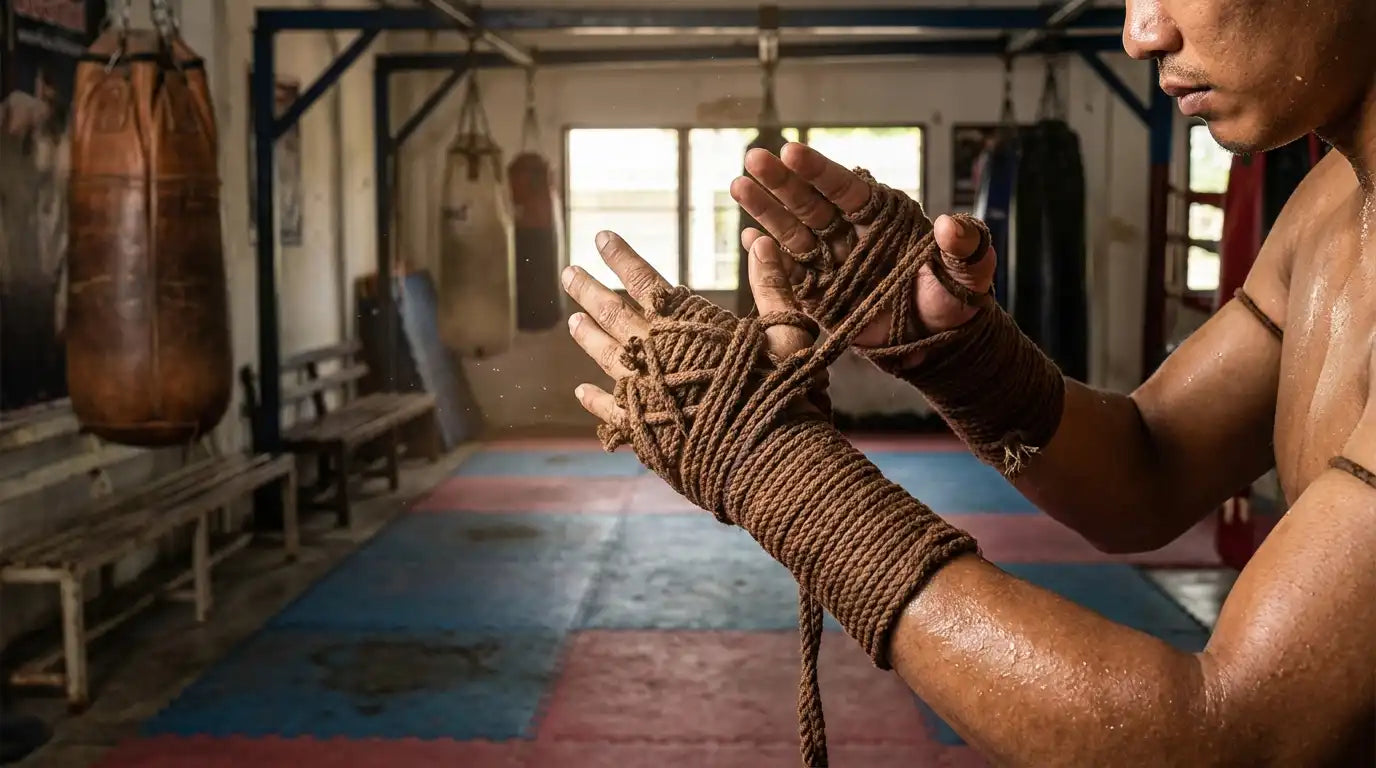
You see it when you walk into an old-school Thai gym or watch fight footage from the past: hands wrapped with rope, forearms taped up, knuckles looking like they were built for impact. Traditional muay thai rope hand wraps are not a costume piece. They are a practical answer to a real problem: how to stabilize the wrist, protect the small bones of the hand, and still keep the fist compact when you are hitting hard for rounds.
Here’s the thing, rope wraps are not the same as modern cloth wraps. They can feel harsher, they can tighten fast, and if you do them wrong you can cut circulation or beat up your own skin before you ever touch pads. This guide breaks down what “Muay Thai ropes” actually mean, why fighters wear ropes on their arms, and how to think about rope versus cotton wraps for training.
What Are Traditional Muay Thai Rope Hand Wraps?
Traditional Muay Thai rope wraps are exactly what they sound like: rope, twine, or cord wrapped tightly around the hand and wrist to reinforce structure. In Thailand, you will hear “rope” used loosely, sometimes it means actual rope, sometimes it means a more rugged wrap job with tape and stiff material.
Now, when it comes to modern gyms, most day-to-day training uses cotton or elastic wraps because they are consistent, reusable, and easier on your skin. Rope wrapping is more of a traditional practice and a special-use method. The goal is the same as any wrap job: keep the wrist stacked, protect the knuckles, and stop the hand from spreading inside the glove.
What people mean by “muay thai ropes” today
In online searches, “muay thai ropes” can mean a few different things: traditional rope hand wraps, forearm wraps, or even confusion with a training skipping rope. If you mean rope wraps for your hands, you are talking about a stiffer, less forgiving wrap style than cloth.
The main risk with rope wraps
Rope does not stretch like a good cotton wrap. That means you can lock your wrist in place, but you can also over-tighten fast. Consider this, if your fingers start tingling or your hand turns pale, you are not “wrapped like a warrior,” you are wrapped wrong.
Why Do Muay Thai Fighters Wear Ropes on Arms?
The reason is not mystery or tradition for tradition’s sake. Fighters wrap hands and sometimes forearms because impact travels up the chain. A clean cross that lands on a hard guard can shock the knuckles, twist the wrist, and irritate the forearm tendons all in one shot.
The reality is that wraps are about alignment and load management. Rope-style wrapping can increase stiffness through the wrist and back of the hand. That stiffness can feel powerful when you are hitting pads, but it demands good technique. If your punch is structurally weak, stiff wraps can hide the mistake until your elbow or shoulder starts complaining.
Stability in the wrist and carpal bones
Most fighters overlook how often the wrist bends slightly on hooks and uppercuts, especially late in rounds. Rope wrapping can help reduce that bend. The tradeoff is comfort and safety margin.
Knuckle protection and skin management
Old-school rope wrap jobs often include extra layering over the knuckles. That reduces abrasion inside gloves and can make the knuckle surface feel “tighter.” Still, your skin is your skin. Rope can rub and create hot spots faster than soft cotton if you do not pad properly.
Rope Wraps vs Cloth Hand Wraps: What Changes in Your Punch
You can punch hard with either system, but they change how your hand behaves. Rope wraps tend to create a more rigid fist. Cloth wraps, especially quality cotton, give support while still allowing normal hand movement and blood flow.
From years of gym experience, the biggest difference shows up in fatigue. When your forearms are pumped and your form gets lazy, cloth wraps forgive small errors. Rope wraps punish them. That is why rope wrapping is usually not the best daily option for beginners, and even advanced fighters should treat it as a specific tool.
Control and “feel” inside the glove
Cloth wraps let you fine-tune pressure across knuckles, thumb, and wrist. Rope can feel like one hard brace. If the brace is slightly misaligned, every punch reminds you.
Injury risk, both ways
Tighter is not always safer. A wrap job that is too stiff can shift stress up the arm. A wrap job that is too loose lets your wrist collapse. The right answer is the one that keeps your wrist straight at impact while still letting you open and close your hand comfortably between exchanges.
Why most gyms standardize on cotton wraps
For consistent training across pads, bagwork, and sparring, cotton wraps are the practical standard. For example, Fairtex Handwraps (HW2) are made from soft, flexible cotton and come in 120-inch and 180-inch lengths, which is enough range to wrap light or heavy depending on your hands and your glove fit.
If you want to browse wrap options, start in the Hand Wraps collection and then match length to what your coach wants for your style of wrapping.
How to Wrap Muay Thai Hand Ropes Safely (Coach Checklist)
I am not going to give you a “copy this exact rope wrap pattern” and pretend it is universal. Hand anatomy is different, glove fit is different, and rope thickness changes everything. What I can give you is the safety checklist that keeps your hands healthy.

Here’s the thing, the wrap job should support your structure, not replace it. You still need correct fist formation, stacked wrist, and clean contact on the first two knuckles.
Safety checklist before you hit anything
- Open and close your hand 10 times. Your fingers should not tingle or go numb.
- Make a fist and check wrist alignment. Your wrist should feel supported, not forced into flexion or extension.
- Rotate your wrist slowly. You should feel stable, not pinched.
- Check your thumb. It should be secure but not trapped.
- Put the glove on and shadowbox for 1 minute. If you feel rubbing or hot spots, fix it before you add power.
Common mistakes that wreck hands
Most problems come from two errors: wrapping too tight at the wrist, or creating uneven pressure across the knuckles. Rope also tends to “bite” into the skin where it crosses itself. If you insist on rope, you need a smart base layer or padding strategy, and you need to re-check circulation between rounds.
Safer alternative for daily training
For most fighters, a quality cotton wrap or elastic wrap gets you 95 percent of the benefit with far less downside. Fairtex HW4 Elastic Hand Wraps use a polyester and rubber blend and include ventilation holes, so you can get a firmer, more form-fitting wrap without going full rope-stiff.
When Rope Wraps Make Sense (and When They Do Not)
Rope hand wraps belong in a narrow lane. If you are using them because they “look traditional,” you are starting from the wrong place. Use them only when the goal matches the tool.
Consider this, your hands have to last through years of rounds. Being tough is good. Being able to train tomorrow is better.
Situations where rope-style wrapping can be useful
If you are doing controlled, technical pad rounds with a coach who understands the wrap job, stiffer wrapping can help you feel a cleaner line through the wrist on straight punches. Some fighters also like the locked-in sensation for heavy bag work, but only if the glove fit is correct and the knuckles are protected.
Situations where you should skip it
If you are sparring, drilling clinch entries, catching kicks, or doing anything that requires frequent hand opening and grip fighting, rope stiffness becomes a liability. It can also make it harder to safely post, frame, or catch yourself, which is a real injury risk.
Gear Pairing: Wraps, Gloves, and Wrist Support That Works
Wraps do not work alone. They work inside a glove, and glove fit changes everything. A glove that is too tight forces you to wrap thinner than you should. A glove that is too roomy lets your hand shift and creates friction.
What most fighters overlook is that glove wrist closure matters as much as the wrap. If your glove locks the wrist well, you can often wrap for knuckle protection and comfort, not just for stiffness.
Wrap length basics (practical, not complicated)
- 120-inch wraps: lighter, faster, good for smaller hands or tighter gloves.
- 180-inch wraps: more material for wrist reinforcement and knuckle padding.
Build a consistent setup
If you are choosing gloves and wraps together, use a proven glove model and then wrap to match the internal space. The Muay Thai Gloves collection is the right place to start when you want a training glove that fits wraps properly and holds up through daily rounds.
A Fairtex perspective, without the hype
Fairtex has been in the fight game since 1971, and the reason fighters keep coming back is simple: equipment that survives real gym work. When you are wrapping hands every day, small quality details matter, like cotton that stays soft, stitching that does not scratch, and material that keeps its shape after washing. If you want to compare wrap types, browse the Hand Wraps collection, then pressure test your setup in bag rounds before you take it into hard sparring.
If you are building a full kit, you can also explore Muay Thai Equipment so your wraps, gloves, and protection all match the same training purpose.
What Rope Wrapping Does to Clinch, Guard, and Defense
Most people think about wraps only when they punch. In Muay Thai, your hands also frame, post, swim inside, pummel for position, and catch strikes. Rope-style wrapping changes all of that because it changes how easily you can open your hand and how much your wrist can “give” when you absorb contact.

That matters for safety. The stiffer your wrap job, the more you need to be honest about what the session is. Pad rounds and bagwork are one thing. Clinch rounds and sparring are another.
Clinch grip and hand fighting
In clinch, you need to open and close your hands constantly to fight for inside control, snap the head, and swim your arms back to position. Rope stiffness can make you grip with your whole forearm instead of your hands. That sounds tough, but it can also mean you fatigue faster and you lose fine control on the tie.
High guard and blocking
When you block punches, your glove and forearms absorb impact and your wrist angle changes slightly with each contact. A very rigid wrap can make that angle feel “stuck,” which can lead to jammed wrists when you are catching hooks on the glove. The goal is still the same: keep the wrist stacked behind the knuckles, but leave yourself enough mobility to defend naturally.
Posting, framing, and falling safely
Even in controlled training, you will slip, get bumped off balance, or need to post your hand on the ropes or the floor. If your wrap job keeps your hand locked shut, your ability to post safely goes down. If you insist on rope-style wrapping, keep it out of sparring and clinch-heavy rounds unless your coach is guiding the session and you have tested it safely first.
Skin, Sweat, and Hygiene: How to Care for Your Hands After Rope Wrap Sessions
Rope wraps can be rough on the skin, especially if you train in heat, sweat a lot, or have gloves that already fit tight. If you want to experiment with rope, you need to treat hand care like part of training, not like an afterthought.
Check for hot spots immediately
Right after your round, look at your knuckles and the back of your hand where the rope crosses itself. If you see a red line that feels “sharp,” do not ignore it. That is usually the spot that turns into a blister on the next session. Fix the wrap pattern, add a base layer, or stop using rope until the skin calms down.
Clean and dry matters more than you think
Sweat trapped under stiff material softens the skin and makes rubbing worse. After training, wash your hands, dry them fully, and let your gloves air out. If you train back-to-back days, this is how you avoid the small skin tears that can turn into missed sessions.
Maintain your wraps like you maintain your body
Cloth wraps are easy to wash and re-use. That is a real advantage for daily training. Fairtex Handwraps (HW2) are cotton, so they are a straightforward option when you want something you can clean regularly and keep consistent session to session. If you want a firmer fit without the harshness, Fairtex HW4 Elastic Hand Wraps can give you that tighter feel while still being made for repeat use.
Rope Wrap Materials and Thickness: What to Look For Before You Wrap
Not all rope is the same. That is part of why rope wrapping is risky for beginners. Thickness, texture, and how the material “bites” into itself changes the pressure points on your hand.

If you are going to wrap with rope, choose the most forgiving setup you can, then build stiffness only if you have a reason and you have tested it under control.
Texture and friction
Rough fibers create more friction. More friction means more heat and more skin irritation, especially over the knuckles and between the thumb and index finger. A smoother material reduces rubbing, but it can also slip if your wrap job is sloppy. That is why the wrap pattern and tension matter as much as the material.
Thickness and pressure distribution
Thin rope creates sharp pressure. Thick rope spreads pressure but can take up too much space inside the glove. If your glove fit becomes tight, you end up fighting your own gear, and that is when people crank the wrap tighter and cut circulation. Your goal is even pressure, not maximum tightness.
Be honest about the “why”
If your goal is consistent wrist support and knuckle coverage in a glove, cotton wraps and elastic wraps solve that problem with more safety margin. Rope wrapping is a specific practice, not a daily default. If you cannot explain why you need it, you probably do not.
Frequently Asked Questions
What are muay thai rope hand wraps?
Muay Thai rope hand wraps are a traditional method of wrapping the hands and wrists using rope or cord to create a stiff, supportive structure. The goal is to stabilize the wrist and reinforce the fist for impact. Rope is less forgiving than cotton wraps, so tightness and placement matter a lot. If you get numbness, tingling, or hot spots, your wrap job needs to be adjusted immediately.
Why do Muay Thai fighters wear ropes on their arms?
Fighters wrap hands and sometimes forearms to manage impact and support alignment. When you punch, force travels through knuckles, wrist, and forearm. A tighter, more rigid wrap can reduce wrist movement and help keep the fist compact. The downside is that overly stiff wraps can reduce mobility and increase pressure points, so it should be used with intention, not just for tradition.
Are rope wraps better than cloth hand wraps?
Not universally. Rope wraps can feel more rigid and “locked in,” which some fighters like for specific pad or bag sessions. Cloth wraps, especially quality cotton or elastic wraps, are usually better for day-to-day training because they are more comfortable, adjustable, and consistent. For most gyms, cloth wraps are the practical standard because they balance support and circulation while protecting knuckles and skin.
Can I use traditional rope wraps for sparring?
It is usually not recommended. Sparring involves more hand opening, catching, framing, and clinch work, and stiff wrapping can make those movements awkward or unsafe. Sparring also requires good control and comfort inside the glove, so cotton wraps are typically the better choice. If your coach specifically wants a stiffer wrap style, keep it moderate and always prioritize safety and partner protection.
Do rope wraps protect your knuckles more?
They can, but only if the wrap job includes smart knuckle padding and does not create friction. Rope can also rub the skin faster than cotton if it crosses itself on the knuckle line. Knuckle protection is not just “more hardness,” it is even pressure distribution. If your knuckles feel sharp pressure on one spot, adjust the wrap pattern or switch to a softer wrap material.
What wrap length should I use for Muay Thai?
Most fighters use either 120-inch or 180-inch wraps. A 120-inch wrap is quicker and works well for smaller hands or tight gloves. A 180-inch wrap gives you more material to reinforce the wrist and build knuckle padding, which many fighters prefer for heavier bagwork. Glove fit matters, so test your wraps inside your gloves and make sure you can still make a comfortable fist.
What is the safest alternative to rope hand wraps?
A quality cotton wrap or elastic wrap is the safest daily option for most fighters. Cotton gives support without excessive stiffness, and elastic wraps can mold to your hand while still allowing normal movement. If you want a firmer feel, choose elastic wraps with good breathability and avoid over-tightening. Your goal is stable alignment at impact, not cutting off circulation.
How do I know if my wraps are too tight?
Watch for numbness, tingling, cold fingers, or a throbbing sensation under the wrap. Another easy test is opening and closing your hand repeatedly. If your hand feels like it is fighting the wrap just to move, loosen it. Between rounds, check your fingertips for color and sensation. A wrap job should feel secure and supportive, not painful or restrictive.
Can rope wraps cause forearm pump or numb hands faster?
They can. A stiff wrap job can limit normal swelling in the hand and forearm during hard rounds. If the rope compresses the wrist or the back of the hand too much, you can get faster forearm pump, numb fingers, or a “dead hand” feeling. The fix is not to tough it out. Reduce tension, change where the rope crosses, and re-check your hand between rounds.
What should I do if rope wraps rub my knuckles raw?
Stop and address it immediately. Rope rubbing usually comes from friction where the rope crosses itself, uneven pressure on the knuckle line, or gloves that are too tight for the wrap thickness. Let the skin heal, then adjust the wrap job to spread pressure evenly. For daily training, switch to cotton wraps like Fairtex Handwraps (HW2) or use an elastic option like Fairtex HW4 Elastic Hand Wraps to reduce irritation while keeping support.
Do rope wraps change how I clinch?
Yes. Rope stiffness can make it harder to open and close your hands for pummeling and grip fighting. That can lead to faster fatigue and less control in the tie. If your session includes a lot of clinch, rope-style wrapping is usually the wrong tool.
What is the difference between “Muay Thai ropes” and a skipping rope?
“Muay Thai ropes” is sometimes used as slang for rope-style hand wraps. It also gets mixed up with jump rope searches. If you mean conditioning, that is a separate tool entirely. Fairtex makes a Muay Thai Heavy Skipping Rope for cardio and coordination, but that has nothing to do with wrapping your hands for punching.
Key Takeaways
- Traditional rope wraps can add stiffness and support, but they have less safety margin than cotton wraps.
- The main purpose is wrist alignment and fist structure, not aesthetics.
- Rope-style wrapping can create pressure points fast, always check circulation before training.
- For most fighters, cotton or elastic wraps are the best daily choice for comfort and consistency.
- Wrap choice should match glove fit and training type, especially for sparring versus bagwork.
Conclusion
Traditional Muay Thai rope hand wraps are part of the culture, but they are also a very specific tool. Used correctly, they can reinforce wrist structure and tighten up your fist feel. Used carelessly, they can numb your hand, irritate your skin, and shift stress into places you do not want it.
If you are curious about rope wraps, start by understanding the purpose, then pressure test the idea in controlled pad rounds before you ever go hard. For most training days, stick with reliable cotton or elastic wraps and focus on clean mechanics. When your hands feel good, you train with confidence, and you show up consistent. If you want to compare wrap styles or build a solid kit, explore the Hand Wraps collection and pair it with gloves that fit your wrap job.