
MMA Gloves for Heavy Bag (Can You Use Them?)
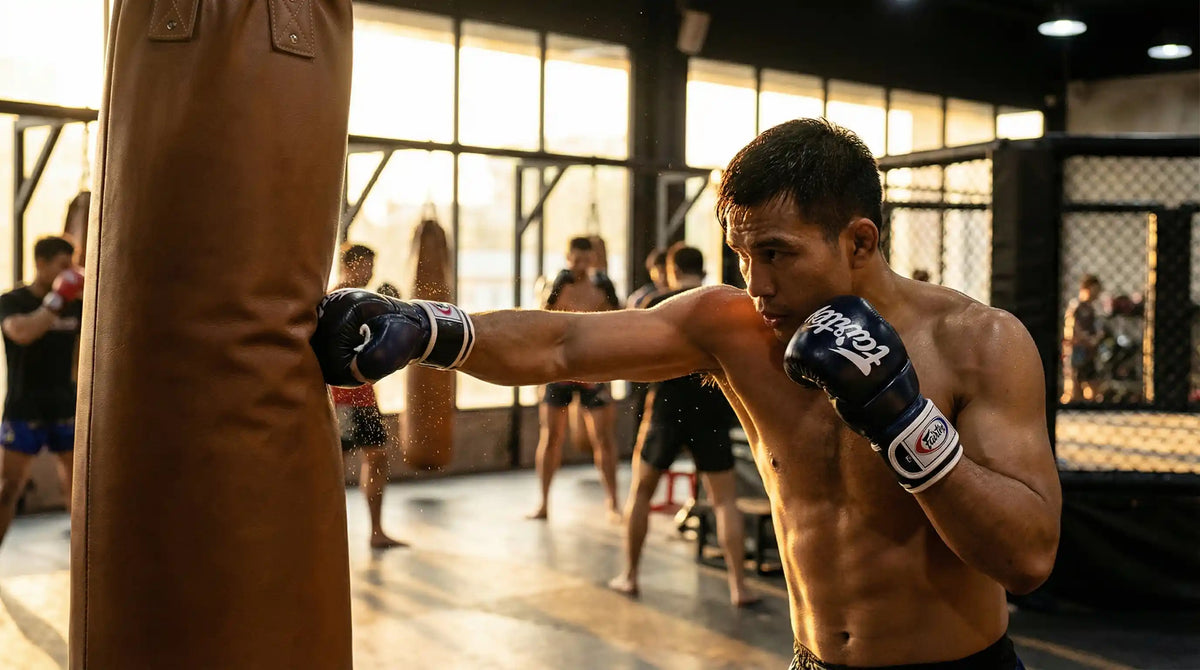
The bag is swinging, your coach calls for a hard 10-round finisher, and you reach into your gear bag. You see your MMA gloves and think, “Perfect. I want to feel my knuckles and work my straight punches.” Then the first heavy cross lands a little off-center, your wrist bends a hair, and you feel that sting travel up your forearm. Here’s the thing: the heavy bag does not forgive small mistakes. It magnifies them.
At Fairtex, every piece of equipment is handcrafted in Thailand using Grade A materials and tested by professional fighters. It is quality you can feel from the first round. If you are deciding on MMA gloves for bag work, this guide will help you train hard without sacrificing your hands.

Why the heavy bag is different from pads and sparring
Most fighters think “impact is impact.” Not true. The heavy bag is a dead target that pushes back. Focus mitts and Thai pads give a little, and a good pad holder meets your punch. Sparring partners move, roll, and absorb in a way that spreads contact.
On the bag, your hand structure has to be perfect every time: knuckles lined up, wrist straight, forearm behind the shot. If your glove has less padding and less wrist support, your margin for error shrinks fast.
Bag density changes everything
A soft bag lets you sink your fist in and develop timing. A dense, overstuffed bag feels closer to punching a wall. That is where “mma gloves on heavy bag” becomes risky, especially late in a session when your shoulders are tired and your punches get sloppy.
Volume matters more than power
One clean shot in MMA gloves might feel fine. Two hundred shots in a session is different. The reality is that heavy bag training is often high volume, and small impacts add up at the knuckles and the wrists.
Can you use MMA gloves on a punching bag?
Yes, you can use MMA gloves for a punching bag, but it depends on your goal and how you train. If your goal is conditioning and skill with controlled power, MMA gloves can work. If your goal is hard power rounds, building maximum punch output, or “punching through the bag,” you are usually better off with boxing gloves.
Consider this: MMA gloves are designed to let you grapple, clinch, pummel, and fight for underhooks. That means open fingers, less padding over the knuckles, and typically less wrist stabilization than traditional boxing gloves.
What MMA gloves do well on the bag
MMA gloves help you feel alignment. You get feedback on whether you are landing with the first two knuckles and keeping your wrist straight. They also let you mix in clinch drills, wall-work pummeling, or transitions to takedown entries without changing gloves.
What MMA gloves do poorly on the bag
They do not protect your knuckles and metacarpals like a 14 oz or 16 oz boxing glove. They also do not distribute shock the same way, which matters when you are tired and start clipping the bag with a slightly turned fist.
The real risks: knuckles, wrists, and long-term wear
What most fighters overlook is that heavy bag injuries often start as “minor annoyance.” A bruised knuckle. A tender wrist. A little swelling that makes wrapping your hands feel tight. Then it becomes a training limiter.
Knuckle bruising and skin splits
With less padding, you are more likely to bruise the second and third knuckles, especially on jabs and straight rights that land a fraction off line. The bag’s rough cover can also chew up your skin if your wraps are sloppy or your glove fit is loose.
Wrist extension and twisting
On a hard cross or hook, if your wrist collapses even slightly, you load the smaller structures of the wrist and hand. MMA gloves usually have a shorter cuff than boxing gloves, so you must supply more stabilization with wrapping and mechanics.
Elbow and shoulder compensation
If your hand hurts, you unconsciously change how you punch. You shorten the shot, you “push” instead of snap, or you flare the elbow. That is how a hand problem turns into an elbow or shoulder problem.

When MMA gloves for heavy bag actually make sense
From years of gym experience, I look at MMA gloves on the bag as a tool, not a default. They are useful when you are training MMA-specific sequences and you want realism.
MMA-specific rounds and mixed skill work
If your round is “jab-cross, level change, clinch, knees,” MMA gloves are practical. You can punch, hand fight, and practice frames without taking gloves off. Pair that with solid hand wraps and clean mechanics, and you can get good work in.
Technical boxing days with controlled power
Use MMA gloves for technical rounds: accuracy, rhythm, head movement into counters, and footwork. Keep power at 60 to 75 percent, and focus on snapping the punch back to guard.
Rehab, return-to-punching phases, or lighter bags
If you are coming back from an injury, sometimes lighter contact with MMA gloves on a softer bag helps you rebuild alignment. But you have to be honest. If you are still chasing power, switch to boxing gloves.
Better options: MMA heavy bag gloves vs boxing gloves
If you search “best mma gloves for heavy bag,” you will see fighters split into two camps. One group wants realism and hand dexterity. The other wants protection and volume. The right answer is usually both, just on different days.
Now, when it comes to building your striking safely, a dedicated bag glove or a quality boxing glove is the more forgiving choice. Fairtex boxing gloves are known for a secure hand compartment and balanced padding that lets you punch hard without feeling like your hands are floating.
Option A: Use MMA gloves for skill, boxing gloves for power
This is the simple, pro-style setup. Do 2 to 3 rounds in MMA gloves for MMA combos and clinch transitions. Then put on boxing gloves for your hard rounds and high-volume conditioning.
If you want a solid all-around glove for bag work, explore boxing gloves and choose a weight that matches your intent. Many fighters use 14 oz for bag and pads, and 16 oz when they want extra protection or they have a history of hand issues.
Option B: If you insist on MMA gloves, choose more support
Not all MMA gloves feel the same. Look for a snug, tight-fit hand compartment, dense knuckle padding that does not bottom out, and a closure that locks the wrist. Loose gloves are where you get twist, friction, and bad alignment.
Why padding technology matters
This is why Fairtex developed the three-layer foam system. You get superior shock absorption that protects your hands round after round, built on over 50 years of Thai craftsmanship. That matters on the heavy bag, where the impact is repetitive and unforgiving.
Do not ignore the bag itself
A worn bag with hard clumps inside can wreck your hands no matter what you wear. If your gym bag feels lumpy or overstuffed, rotate to a different station, or use a cleaner surface like a well-packed punching bag that matches your training goals.
How to hit the bag safely if you use MMA gloves
If you are going to use heavy bag MMA gloves, you need to tighten up your process. The glove will not save you. Your fundamentals will.
Wrap like you mean it
Your wraps are your wrist brace and your knuckle shield. Keep the wrist section tight, build a firm knuckle pad, and anchor the wrap across the back of the hand so your wrist stays stacked behind the punch. If your wraps loosen mid-session, stop and fix them. Do not “push through” and hope it holds.
Pick the right punches for MMA gloves
Think straight punches and clean, short hooks that land with a tight wrist. Wild overhands and long, swinging hooks are where wrists fold and knuckles scrape.
Control your intensity
Use a simple rule: if you are hitting hard enough that your glove is rebounding and your wrist is having to “catch” the impact, you are too heavy for MMA gloves. Save that power for boxing gloves.
Program your rounds like a fighter
Try this structure once a week:
- Rounds 1 to 2: MMA gloves, technical boxing and exits (60 to 70 percent)
- Rounds 3 to 5: boxing gloves, power and conditioning (80 to 90 percent)
- Rounds 6 to 7: MMA gloves, punch to clinch, dirty boxing, frames
Fairtex equipment is used by world champions at the Fairtex Training Center in Pattaya and trusted by ONE Championship athletes competing on the global stage. The common thread with high-level fighters is not “tough hands.” It is smart structure and consistent mechanics.

Frequently Asked Questions
Are MMA gloves good for punching bags?
They can be good for light to moderate bag work where you want realism, hand dexterity, and feedback on alignment. For hard power rounds and high-volume conditioning, MMA gloves are usually not the best tool because knuckle padding and wrist support are limited. If your hands are often sore after bag work, switch to boxing gloves for your heavy rounds and use MMA gloves for technical rounds.
Can I use MMA gloves on a punching bag every day?
You can, but it is not the smartest long-term plan if you are doing hard rounds. Daily heavy bag sessions create repetitive impact, and your knuckles and wrists will pay for it. A better approach is alternating: MMA gloves for MMA-specific rounds, then boxing gloves for your power and conditioning work. That way you build realistic skills without constantly stressing your hands.
What is the best MMA gloves for heavy bag work?
The best MMA heavy bag gloves are the ones that fit tight, keep your wrist stable, and have dense knuckle padding that does not shift. Avoid loose hand compartments and flimsy closures. Your glove should feel locked in when you make a fist and throw a straight right. For a deeper breakdown of what to look for across models, read our Best MMA Gloves 2025 guide.
Should I wear hand wraps with MMA gloves on the heavy bag?
Yes. Wraps are non-negotiable if you plan to punch the bag in MMA gloves. They protect the small bones of the hand, stabilize the wrist, and reduce friction that causes skin splits. Use a firm knuckle pad and give extra attention to the wrist section. If you want guidance on wrap styles and lengths, check our best boxing hand wraps article.
Is it better to use boxing gloves or MMA gloves for a punching bag?
For most fighters, boxing gloves are better for the punching bag because they offer more padding, better shock distribution, and more wrist support. That means you can train harder and longer with less risk. MMA gloves are better when your round includes clinching, hand fighting, or MMA transitions. Many serious athletes use both in the same session, depending on the round’s purpose.
Can I use 16 oz boxing gloves for MMA bag work?
Yes, and it is a great way to protect your hands while you build punching mechanics and conditioning. You will not be able to grapple in them, but for pure bag striking they are forgiving and let you push your pace. If you are unsure which boxing glove style fits your training, see How to Choose Fairtex Boxing Gloves.
Why do my wrists hurt when I hit the bag in MMA gloves?
Usually it is a mix of mechanics and support. Your wrist may be slightly extended at impact, your fist may be landing off the main knuckles, or your wrap job is not locking the wrist. MMA gloves also tend to have shorter cuffs, so they expose weak positions faster. Slow your power down, fix alignment on straight punches, and add tighter wrist wrapping before you ramp intensity up again.
Do MMA gloves damage a heavy bag faster than boxing gloves?
Not usually. Bag wear is more about the bag cover, seam quality, and how clean your gear is. That said, exposed stitching, rough hook-and-loop edges, or poor-quality materials can scuff a bag surface over time. Keep your gloves clean, trim nails if you use open-finger gloves, and avoid dragging your knuckles across the bag on missed punches.
Key Takeaways
- You can use MMA gloves for heavy bag work, but they are best for technical and MMA-specific rounds, not maximum power.
- The heavy bag magnifies small alignment mistakes, so knuckles and wrists take more stress in lighter gloves.
- Use wraps every time, keep intensity controlled, and prioritize straight punches if you use MMA gloves on a punching bag.
- For most fighters, boxing gloves are the safer choice for hard rounds and high-volume conditioning.
- Rotate tools: MMA gloves for realism, boxing gloves for protection and longevity.
Conclusion
MMA gloves for heavy bag training are not “wrong.” They are just specific. If your session is built around MMA combinations, clinch entries, and realistic hand fighting, they make sense. If your session is built around hard power, long punch counts, and conditioning fatigue, boxing gloves will keep you healthier and more consistent.
The goal is simple: protect your hands so you can train tomorrow. Rotate your gloves based on the round, wrap your hands like a professional, and treat bag work like skill practice, not a toughness test.
Explore Fairtex’s MMA gloves collection, handcrafted in Thailand for fighters who demand professional quality.
Last updated: February 2026