
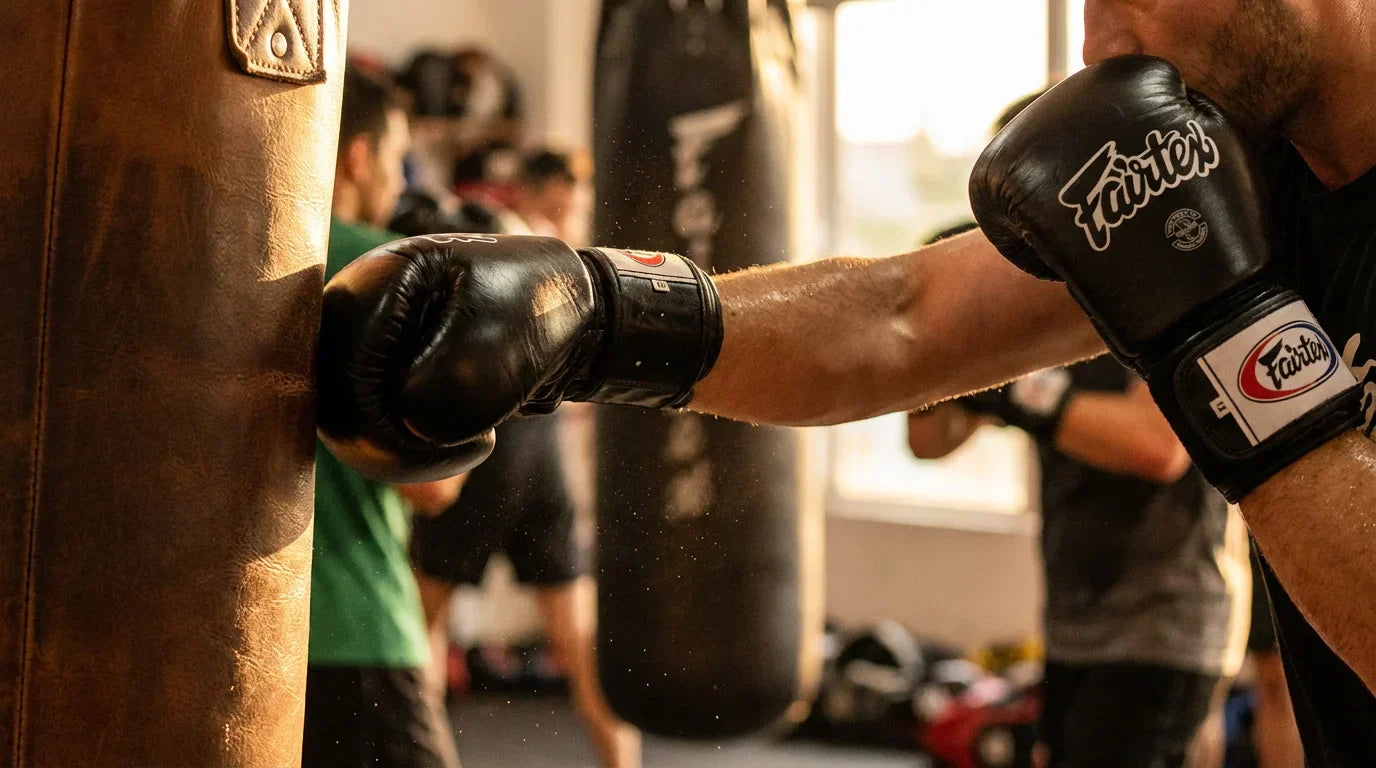
How to Break In Boxing Gloves (Softening & Fit)
The first hard round in new gloves usually tells you everything. Your knuckles feel like they are sitting too high, your fingers fight the padding, and the wrist feels stiff enough to mess with your straight punches. You hit the bag anyway, because that is what fighters do, but you know something is off: the gloves have not learned your hands yet.
Here’s the thing: breaking in gloves is not about “beating them up.” It is about shaping the hand compartment, settling the padding, and confirming the fit so your wrists, knuckles, and thumbs stay protected during boxing gloves training. Do it right and your gloves start to feel like an extension of your guard. Do it wrong and you end up with sore knuckles, sprained wrists, or padding that breaks down too fast.
At Fairtex, every piece of equipment is handcrafted in Thailand using Grade A materials and tested by professional fighters. It is quality you can feel from the first round.
What “breaking in” really means for boxing training gloves
When fighters say “these gloves are stiff,” they usually mean two things: the wrist and cuff are rigid, and the hand compartment has not shaped to the way they make a fist. Breaking in is the process of getting the glove to move with you, not against you.
Good training boxing gloves should do three jobs at the same time: protect your knuckles on impact, support your wrist when you land straight punches and hooks, and stay stable so the glove does not twist when you parry or clinch. If the glove is fighting your hand, your technique changes. You start landing with the wrong knuckles, your wrist angle drifts, and your shoulders tense up.
Consider this: the best break-in is controlled. You want the padding to settle evenly, the liner to adapt to your wraps, and the thumb position to feel natural. You do not want crushed foam, warped wrists, or a glove that becomes “soft” because the protective structure failed.
Why some gloves feel stiffer out of the box
Higher-quality gloves often feel firmer at first because the materials are denser and the structure is built to last. Better foam, stronger stitching, and a more supportive wrist can feel less forgiving on day one, but that is part of professional-grade protection.
This is why Fairtex developed the three-layer foam system. You get superior shock absorption that protects your hands round after round, built on over 50 years of Thai craftsmanship.
How should boxing gloves fit before you break them in?
If the glove does not fit, you cannot “break it in” into the right size. You can only break it down. Fit comes first, then softening and shaping.

Quick fit check in the gym
Put on your hand wraps the way you actually train. Slide your hand in and make a relaxed fist, then a tight fist. You should feel snug contact around the back of the hand and palm without numbness or tingling.
The reality is: a proper tight-fit glove will feel close at first, but it should not pinch your knuckles or fold your fingertips. If your fingers cannot reach the end of the compartment, or you feel pressure directly on the top knuckles when you close your fist, that is a sizing or shape mismatch.
Signs your gloves fit correctly
- Your wrist stays aligned when you throw a firm jab and cross on the bag
- Your fist closes fully without cramping
- Your thumb sits naturally and does not bend awkwardly
- The glove does not twist when you turn over on hooks
- With wraps on, you feel snug but not compressed
Common fit problems that break-in will not fix
What most fighters overlook is that some discomfort is not “new glove stiffness.” If the glove is too small, you will jam your knuckles and irritate your finger joints. If it is too big, your hand slides and your wrist takes the hit.
If you feel any of these, stop and reassess:
- Numb fingers within 2–3 minutes of wearing the gloves
- Hot spots on a single knuckle, especially the middle knuckles
- Thumb pressure that forces your thumb inward
- Wrist bending on straight punches even with wraps
A safe step-by-step method to break in boxing gloves
If you want a clean break-in, treat it like skill work. Controlled reps. Good wraps. The right surfaces. Your goal is to shape the glove while keeping the padding structure intact.

Step 1: Wrap your hands the same way every time
Consistency matters. If you switch between thin wraps and thick wraps every session, the glove never settles to one shape. Use wraps that support your wrists and lock your knuckles in place.
For most boxing gloves training, a classic wrap pattern with solid knuckle coverage and a firm wrist lock is the move. It also helps the liner “learn” the size you actually fight and spar with.
Step 2: Start with light contact and high volume
Don’t go straight into power shots. Begin with 2–3 rounds of shadowboxing in gloves, focusing on closing your fist, turning punches over, and feeling wrist alignment. Then do light bag work where you stay around 50–60 percent power.
From years of gym experience, this is the fastest way to soften the glove naturally. The padding warms up, the leather flexes, and the hand compartment starts shaping without you crushing the foam.
Step 3: Use the right tools, bag and pads
A heavy bag with a hard core will punish stiff gloves and stiff wrists. If you have the option, break in gloves on a well-stuffed bag or on Thai pads and focus mitts first. Pads give you feedback without forcing your knuckles to eat every mistake.
Once the gloves start to flex at the knuckle line and the wrist feels stable, then you can add harder bag rounds.
Step 4: Air them out correctly after every session
Breaking in includes sweat management. If you leave damp gloves in your gym bag, the liner stays wet, the glove stays stiff, and the odor builds fast. Open the gloves wide, wipe them down, and let them dry in moving air.
How to soften gloves without damaging padding or leather
Most “hacks” you see online make gloves feel softer by damaging the structure. That softness comes at a cost: less protection, more bottoming out, and shorter glove life. There is a smart way to speed things up, and a dumb way.

The safe ways to speed up the break-in
These methods keep the glove’s shape and padding integrity:
- Shadowboxing in gloves: 10–15 minutes daily to build flex in the wrist and knuckle line
- Light bag rounds: controlled straight punches, then add hooks and uppercuts
- Hand flexing: open and close your fist inside the glove for 2–3 sets of 30 reps
- Proper drying: keeps the liner crisp and prevents stiffness from trapped moisture
Methods to avoid (they break gloves down, not in)
The reality is: if you wreck the foam, you cannot rebuild it. Avoid these:
- Microwaves, ovens, hair dryers: heat can crack coatings, warp foam, and damage glue
- Soaking or spraying alcohol inside: dries liners and can harden materials over time
- Freezing gloves: moisture expands and can stress seams and foam structure
- Smashing gloves with bats or weights: creates dead spots and uneven padding
- Overstuffing with towels: can stretch the hand compartment and distort fit
Leather vs microfiber break-in feel
Genuine leather typically breaks in with a classic “give” over time. It starts firm, then becomes supple while still holding structure. Microfiber tends to feel consistent and is easier to wipe down, which many fighters like for frequent boxing gloves training.
Either way, the break-in should come from training reps, not from forcing the glove into shapes it was not built to hold.
A practical 2-week boxing gloves training break-in plan
If you just bought new boxing training gloves, you do not need a complicated process. You need a plan that respects your hands and the glove’s padding.
Week 1: Shape and wrist alignment
Keep your intensity controlled. Focus on clean mechanics and high-quality contact.
- Session A: 3 rounds shadowboxing in gloves, 3 rounds light bag, 2 rounds pad work
- Session B: 2 rounds shadowboxing, 4 rounds light bag, 2 rounds double-end bag
- Session C: pads and technical drills, keep power under 70 percent
Pay attention to where you feel pressure. If your index and middle knuckles are not landing cleanly, adjust your wrap job and fist formation before you increase power.
Week 2: Add impact, keep control
Now you can start leaning into your shots, especially if the knuckle line flexes naturally and the wrist feels locked in.
- Session A: 2 rounds shadowboxing, 4 rounds bag with 2 power rounds, 2 rounds pads
- Session B: bag intervals, 6 rounds total, last 2 rounds moderate power
- Session C: technical sparring or partner drills, focus on control and defense
Fairtex equipment is used by world champions at the Fairtex Training Center in Pattaya and trusted by ONE Championship athletes competing on the global stage. That same expectation applies to you: clean technique first, then intensity.
When your gloves are fully broken in
You will feel it: your fist closes naturally, your wrist stays stacked, and the glove rebounds instead of feeling stiff. On impact, the padding absorbs without bottoming out, and your hands feel protected at the end of a hard session.
Break-in mistakes that ruin gloves or hurt your hands
New gloves can trick you. They feel protective, so you throw harder than your wrists are ready for. Or they feel stiff, so you try to “soften” them in ways that destroy the padding. Both paths end the same way: sore hands and shortened glove life.
Going heavy on the bag too soon
Stiff gloves plus max power is a wrist injury recipe. Your punch lands slightly off, the glove does not flex yet, and your wrist eats the torque. Build up to power rounds after the glove starts moving with your hand.
Using the wrong gloves for the job
Training boxing gloves are not all meant for the same work. Some are better for bag and pad sessions, others for sparring. If you use a compact glove for hard sparring, your partner takes more impact, and you may get turned away at serious gyms.
Match the glove to the session, then break it in doing that job. Models like the Fairtex BGV1 are a classic all-around training option, while other fits and profiles suit different hands and training priorities.
Skipping wraps because the gloves “feel fine”
Wraps are not optional if you care about longevity in the sport. They stabilize the small bones of the hand and help your gloves break in evenly. If you train without wraps early, the glove molds to an unstable fist and you will pay for it later.

Not drying gloves between sessions
Moisture changes everything. A damp glove feels softer for the wrong reasons and it breaks down faster. It also becomes a bacteria factory. Drying is part of performance, not just hygiene.
Frequently Asked Questions
How long does it take to break in boxing gloves?
Most quality gloves take about 5–15 training sessions to feel fully natural, depending on how often you train and how stiff the wrist and knuckle line are out of the box. If you do controlled boxing gloves training with wraps and a mix of shadowboxing, pads, and light bag rounds, you can usually get a comfortable fit within two weeks. Avoid “shortcuts” that crush foam, because that only makes gloves feel soft by reducing protection.
How should boxing gloves fit when they are new?
New gloves should feel snug with your wraps on, with no numbness and no sharp pressure points on a single knuckle. You should be able to close a full fist and keep your wrist aligned on straight punches. A tight-fit glove can feel close at first, but it should not force your fingers to curl awkwardly or jam your knuckles upward. If the glove twists easily when you punch, it is likely too roomy.
Can I break in boxing training gloves without hitting anything?
You can start the break-in with shadowboxing and hand flexing, and that helps a lot with wrist stiffness and hand compartment feel. Still, impact is part of the process because it settles the foam and teaches the glove how to rebound. If you want a low-risk approach, do several sessions of glove shadowboxing, then move to pads and a well-stuffed bag before you add heavier bag rounds.
Should I use 12 oz, 14 oz, or 16 oz training boxing gloves to break them in?
Choose the glove weight for your training goal, not for break-in. Many fighters use 14 oz for general training and 16 oz for sparring, but gym rules and body size matter. Heavier gloves can feel more stable and protective, while lighter gloves can feel faster but may transmit more impact to your hands. Whatever weight you choose, break them in with wraps and controlled contact so the fit stays consistent.
Is it normal for new gloves to hurt my knuckles?
Mild pressure that fades as the glove warms up can be normal, especially with firmer padding. Sharp pain, bruising, or a “hot spot” on one knuckle is not normal. That usually means your wraps are too thin over the knuckles, your fist is not aligned, or the glove shape does not match your hand. Do not try to punch through it. Fix the wrap job, slow down, and reassess fit.
What is the fastest safe way to soften boxing gloves?
The fastest safe approach is high-volume, low-intensity work. Shadowbox in gloves, then do light bag rounds and pad rounds with good mechanics. That warms the materials, builds natural flex at the knuckle line, and shapes the liner to your wraps. Avoid heat, soaking, and smashing methods because they can warp foam and reduce protection. Soft gloves are only good when the padding is still doing its job.
How do I keep my gloves from smelling while breaking them in?
Dry them immediately after training. Wipe the exterior, open the gloves wide, and let them air-dry in a cool, ventilated spot. Do not leave them closed inside your gym bag overnight. If you train often, rotate between two pairs so each pair fully dries. Clean gear is part of being a good partner in the gym, especially during steady boxing gloves training weeks.
Do Fairtex gloves need a long break-in period?
Fairtex gloves are built with a supportive structure, so some fighters feel firmness at first, especially around the wrist and knuckle line. With consistent wraps and controlled bag and pad work, they typically break in smoothly and keep their shape over time. Models like BGV1, BGV14, BGV19, BGV9, and BGV16 each have their own fit and profile, so the “feel on day one” can differ by model and by hand shape.
Key Takeaways
- Breaking in gloves means shaping fit and flex through controlled training, not crushing the foam.
- If the glove does not fit correctly with wraps, break-in will not fix the size mismatch.
- Start with shadowboxing, pads, and light bag rounds before adding power rounds.
- Avoid heat, soaking, freezing, or smashing methods that damage padding and shorten glove life.
- Drying and hygiene are part of performance, especially during frequent boxing gloves training.
Conclusion
When you learn how to break in boxing gloves the right way, your hands thank you for it. Your wrist stays stacked, your knuckles land clean, and you can focus on timing and technique instead of fighting your gear. Keep the process simple: consistent wraps, controlled contact, and steady rounds that let the glove flex naturally. That is how you get a comfortable fit without sacrificing protection.
Quality gloves also reward patience. When the padding is built to protect and last, it should not collapse in a few sessions. Break them in with intention, keep them dry, and your gloves stay reliable through months of boxing training and hard gym work.
Explore Fairtex's complete collection of combat sports equipment, handcrafted in Thailand for fighters who demand professional quality.
Last updated: January 2026