
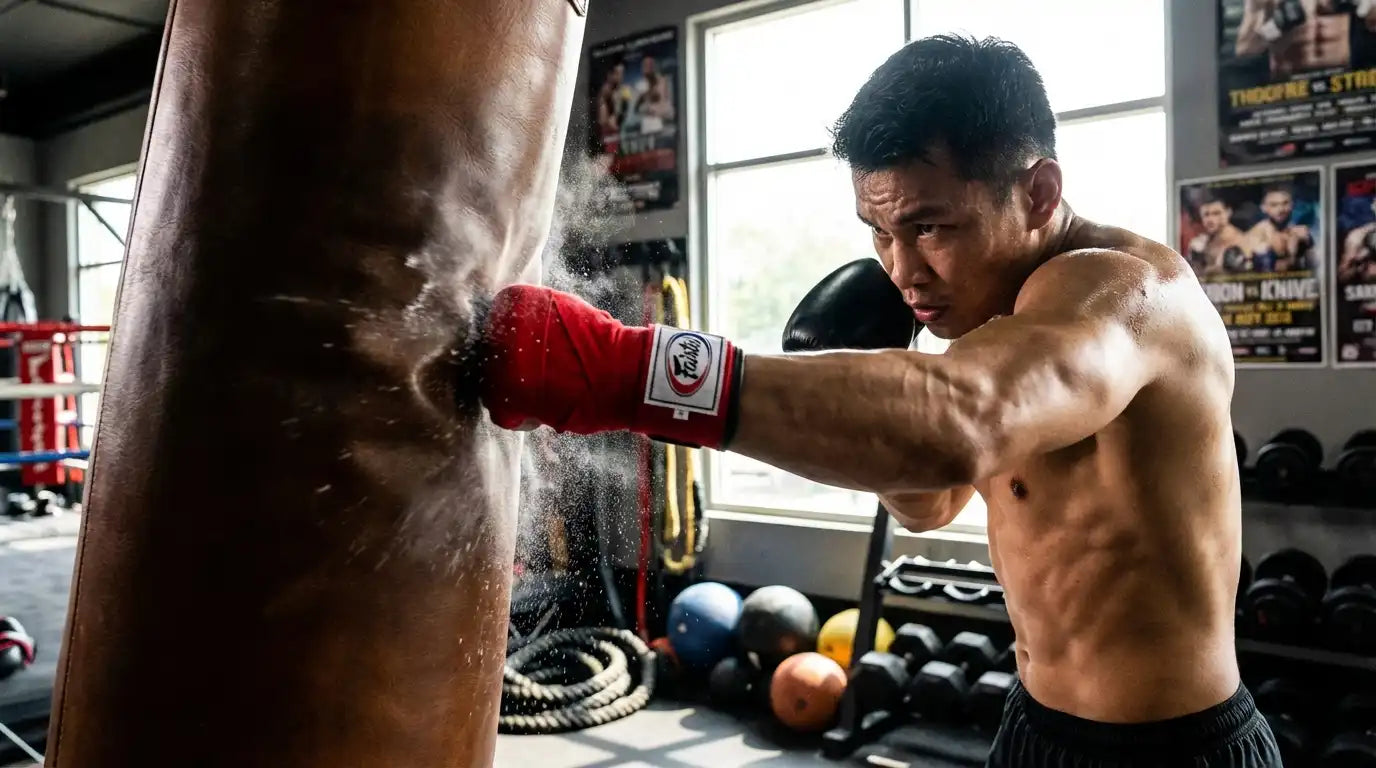
You see it every week in the gym. Someone walks in, slips their hands straight into gloves, and heads to the heavy bag like it is no big deal. Three rounds later, they are shaking out their wrists, flexing their fingers, and wondering why their knuckles feel “off.” The glove padding helped, but it did not stabilize the bones in the hand or keep the wrist stacked when the shots got tired and sloppy.
Here’s the thing: hand wraps are not a fashion accessory. They are basic structure and insurance. If you box, hit bags, or train MMA, wraps can be the difference between steady progress and nagging hand pain that keeps you from punching at all.
This article breaks down when wraps are truly necessary, when you can get away without them, and how to choose the right style for boxing gloves, bag work, and MMA gloves.
What hand wraps actually do (and what they do not)
When you make a fist and punch, your hand is a stack of small bones that want to shift on impact. Your wrist is the hinge that either stays aligned or collapses. Wraps are there to keep those pieces tight and connected.
They support your wrist, knuckles, and hand structure
Good wrapping does three main jobs: it reinforces the wrist so your hand stays stacked, it compresses and supports the knuckles so they do not spread, and it fills dead space inside the glove so your fist lands more consistently.
Wraps do not make bad punching safe. If you land with your wrist bent or you slap the bag, you can still get hurt. But wraps reduce the damage from small errors that happen when you are tired, new, or going hard.
They also protect your gloves from sweat
What most fighters overlook is hygiene. Wraps absorb a lot of sweat that would otherwise soak into your glove lining. That matters if you train often because sweaty gloves break down faster and smell worse, even if the outer leather is still in great shape.
Do you wear hand wraps under boxing gloves?
Yes, in most real training settings, you should wear hand wraps under boxing gloves. If you are asking “do you need hand wraps under boxing gloves,” the safer default is still yes.
When wraps are basically non-negotiable
Consider this: if your session includes heavy bag power rounds, hard pad rounds, or sparring with real pace, wraps are part of your standard kit. Your gloves provide padding, but padding without stability is how you end up with sore wrists and tender knuckles.
From years of gym experience, the injuries that show up most often are not dramatic breaks. They are the annoying ones: jammed knuckles, wrist strains, and thumb irritation that stop you from throwing straight punches.
When you might skip wraps (and why it still has a cost)
If you are doing light technical boxing, shadowboxing, or very controlled touch work on a soft bag, you can sometimes skip wraps. The reality is that most people do not stay “light” once the music is on and the rounds start counting.
If you skip wraps, recognize the trade-off: less time wrapping, but less protection and more sweat in the gloves. If you are training multiple days per week, that trade-off catches up fast.
Bag work rules: heavy bag, pads, and bare-minimum setups
The bag does not hit back, but it also does not move like a person. That makes it a sneaky way to injure your hands, especially if your glove weight is light or your bag is packed hard.
Can you hit a heavy bag with just hand wraps?
You can, but it is not the best plan. Hand wraps alone give structure, but they do not provide enough external padding for repeated impact. On a heavy bag, that usually turns into skin irritation on the knuckles, sore metacarpals, and thumb rubbing if your wrapping is rushed.
If you are in a pinch and only have wraps, keep the volume low, focus on clean alignment, and do not chase power. If your goal is real bag conditioning, gloves plus wraps is the smart setup.
Bag gloves vs boxing gloves: wraps still matter
Some fighters switch to smaller bag gloves because they like the feedback and speed. Now, when it comes to smaller gloves, wraps matter even more. Less glove padding means your hand structure has to be tighter to handle the same impact.
If your wrists hurt on the bag, check these first
- Are you landing with the first two knuckles on straight punches?
- Is your wrist stacked, or is it flexing on contact?
- Are your wraps too loose, or are they cutting off circulation?
- Are your gloves too big inside, creating extra movement?
MMA gloves: do MMA fighters wear hand wraps?
Yes. MMA fighters commonly wrap their hands for training, and in many competitions they will use regulated hand wraps and tape with a coach helping. The glove is open-finger and usually has less padding than boxing gloves, so your hand takes more of the impact.
Do you wear hand wraps under MMA gloves?
For striking-heavy MMA training, you usually should. In MMA gloves, the wrist support is not the same as a big boxing glove cuff. Wraps help keep the wrist stable when you are throwing hard crosses, hooking off angles, or punching in transitions where your stance is not perfect.
Grappling and clinch considerations
Here’s the thing: thick wraps can change your grip and feel clumsy when you pummel, hand fight, or work submissions. Many MMA fighters use lighter wraps, quick wraps, or a modified wrap that supports the wrist and knuckles without building a huge “cast.”
If your session is mostly grappling with a little striking, go lighter. If it is mostly striking, wrap like a striker.
Choosing wrap length and wrap type for your training
Your wraps should match your hands and your session. Too little wrap means you miss support. Too much wrap done poorly means bulky hands and poor fist closure inside the glove.
Wrap length: 120 vs 180 inches
As a rule, 180-inch wraps are the standard for most adult training because they let you cover the wrist and knuckles with enough layers. 120-inch wraps can work for smaller hands or for minimal wraps under tight gloves, but you have less room for error.
Fairtex offers cotton wraps like Fairtex Handwraps – HW2 (available in 120-inch and 180-inch lengths) and elastic wraps like Fairtex HW4 Elastic Hand Wraps (180-inch). Elastic blends can feel easier to get a snug fit, while cotton wraps give a classic, consistent wrap that many gyms prefer.
Quick wraps vs traditional wraps
If you are short on time, quick wraps are useful. Fairtex HW3 Quick Wraps include a padded sponge on the backhand and are designed to be easy to wear, which is great for busy classes or quick bag sessions.
The reality is that traditional wraps still win for custom support. You can add more wrist reinforcement, build a better knuckle pad, and adjust the wrap to your hand shape and any old injuries.
Where to start if you want one reliable option
If you want a simple place to browse, start with the Hand Wraps collection and match it to your glove type. For boxing glove selection, the Boxing Gloves collection helps you compare training options, and the MMA Gloves collection is the right lane for open-finger needs.
A note on brand quality, without the hype
From years of gym experience, wraps that stretch out, fray quickly, or use weak hook-and-loop closures become a safety problem. They loosen mid-round, your wrist starts moving, and you compensate with tension. That tension is where injuries sneak in.
Fairtex has been building fight gear since 1971, and the stuff is made for daily gym use, not just to look good in a photo. If you want to explore wrap options that are built for real rounds, start with Fairtex wraps like HW2 cotton, HW4 elastic, and HW3 quick wraps, then choose based on how you train and how much support your wrists need.
Common wrap mistakes that cause pain
Most hand wrap problems are not the wrap. It is the wrap job.

Too tight in the wrong places
If your fingers go numb or your hand feels cold, you wrapped too tight, usually across the palm or too many passes around the knuckles without checking circulation. Tight does not always mean supportive. Support should feel snug and stable, not like a tourniquet.
Too loose at the wrist
What most fighters overlook is wrist stacking. If your wrist wrap is loose, your hand can still fold back on impact. That is why some people “feel fine” for the first round, then the wrist starts barking when they throw harder or fatigue hits.
Bulky wraps that ruin fist closure
If you cannot close your fist fully inside the glove, your knuckles will land awkward and your thumb can rub. This is common when you build too much knuckle padding and forget to keep the wrap smooth and flat.
Dirty wraps and skin issues
Wraps that stay damp in your bag get funky fast. Skin irritation, small cuts, and rash are more likely when wraps are not cleaned and dried properly.
If you are using tape in training, keep it clean and skin-friendly. Fairtex makes Fairtex Boxing Tape with latex-free hotmelt adhesive designed for residue-free removal, which helps if your skin gets irritated easily.
How to wrap your hands for boxing (simple structure that works)
You do not need a fancy wrap pattern to get real protection. You need a consistent wrap that does three things: locks the wrist, supports the knuckles, and keeps the hand bones connected without killing your circulation.

If you are new, use one wrap method for a few weeks and get it tight and clean. Switching patterns every session is how you end up with random hot spots and a different glove fit every time.
A basic wrap order you can repeat every session
- Start at the wrist and get a solid base. A few passes here matters more than most people think.
- Go to the knuckles and build a smooth knuckle pad. Keep the wrap flat with no twists.
- Connect the hand bones by crossing the back of the hand and the palm. This helps keep the fist tight on impact.
- Loop between fingers if you like it, but do not overdo it. Too much bulk between fingers can mess with fist closure.
- Finish by locking the wrist again so the last layer is wrist support, not just leftover wrap.
Two fast checks before you put gloves on
- Make a hard fist and hold it for five seconds. Your fist should close fully without pain, pinching, or finger numbness.
- Flex your wrist forward and back. It should feel supported and “stacked,” not loose. You should still be able to move, just not collapse.
If you have a sore knuckle or a cranky wrist
If you are dealing with a tender knuckle, the answer is not always “more knuckle padding.” Sometimes it is alignment, glove fit, and a cleaner fist. That said, you can add one or two extra smooth knuckle passes and spend more wrap on the wrist, especially for heavy bag rounds.
If pain is sharp, swelling is obvious, or you cannot grip normally, stop punching and get it checked. Wraps are support, not a substitute for recovery.
Wraps, glove fit, and sizing: make sure your gloves still fit right
A lot of “wrap pain” is actually glove fit. Wraps change the volume of your hand, and that changes how the glove sits on your knuckles and wrist. If your glove is too tight with wraps, your fingers get cramped and circulation gets cut. If it is too loose, your hand slides and your knuckles take uneven pressure.
Always try gloves on with wraps
Do not test glove fit with bare hands and assume it will be fine once you wrap. Put wraps on first, then put the glove on, then make a real fist. Your knuckles should sit in the right spot, your fingers should not feel jammed, and you should be able to close your fist clean.
Fit signs you should not ignore
- Your hand goes numb halfway through the round: glove or wraps are too tight.
- Your knuckles feel like they are “floating” inside the glove: glove is too roomy or wraps are too thin and loose.
- Your wrist feels unsupported even with wraps: wrist strap is not snug enough, or your wrap is not finishing with a strong wrist lock.
A practical glove weight reminder for training
Most gyms steer fighters toward heavier gloves for sparring because more padding helps protect partners. Bag work can be done with a range of glove weights, but going too light too soon is a common reason beginners beat up their hands. If you want a deeper breakdown, the glove type and training purpose matters just as much as the number on the label.
Care and cleaning: keep wraps and gloves from getting gross
Wraps and gloves get sweaty. If you do not handle that, the gear breaks down faster and your hands are more likely to deal with skin issues. The fix is simple, but you have to be consistent.

Hand wrap care after training
- Unroll your wraps as soon as you get home. Do not leave them balled up in your bag.
- Air dry them fully before you roll them back up.
- Wash regularly. If you train a lot, do not wait until they smell. Clean wraps also wrap better because the fabric lays flatter.
Glove care basics that actually work
- Wipe the outside down if it is dirty, then air the gloves out after every session.
- Open the gloves as much as possible so the inside dries. Wet glove lining is where the stink starts.
- If your wraps are soaked every session, that is normal. That is the point. It keeps more sweat out of the gloves.
When it is time to replace wraps
Replace wraps when they are stretched out and you cannot keep a snug wrist lock, when the fabric is thinning over the knuckles, or when the closure is failing. A wrap that comes loose mid-round is not a small issue. It is a safety issue.
Frequently Asked Questions
Do you need hand wraps for boxing?
For most boxing training, yes. Wraps stabilize your wrist, support your knuckles, and help keep your hand bones tight on impact. If you are doing light technical work you might skip them sometimes, but bag rounds, pad rounds, and sparring are where wraps earn their place. They also absorb sweat and help your gloves last longer, which matters if you train regularly.
Do you wear hand wraps under boxing gloves?
Yes, hand wraps are designed to go under boxing gloves. The glove padding protects you and your partner, but the wrap supports your wrist and hand structure inside the glove. Without wraps, your hand can slide around more, especially once you start sweating, and that extra movement increases the chance of jammed knuckles or a tweaked wrist during hard rounds.
Do you need hand wraps under boxing gloves if the gloves are high quality?
High-quality gloves help a lot, but they do not replace wraps. Even with great padding, your wrist can still bend and your knuckles can still take uneven pressure if your hand is not stabilized. Think of it like this: gloves are impact absorption, wraps are structural support. Using both is the normal standard in serious gyms.
Are hand wraps necessary for boxing beginners?
They are strongly recommended. Beginners are still learning alignment, distance, and how to land clean punches without slapping or bending the wrist. Wraps reduce the consequences of small technique errors while you build skill. They also help you get used to a consistent feel inside the glove, which improves fist closure and punch mechanics over time.
Can you hit a heavy bag with just hand wraps?
You can, but it should be a short-term workaround, not your normal approach. Wraps alone provide support but not enough padding for repeated heavy bag impact, especially on harder bags. If you must do it, keep the power down and focus on perfect alignment. For real bag training, use wraps plus proper gloves.
Do you wear hand wraps under MMA gloves?
Often, yes, especially if your session includes serious striking. MMA gloves usually have less padding and less wrist structure than boxing gloves, so wraps help keep the wrist stable and the knuckles supported. If you are doing grappling-heavy training, lighter wraps or quick wraps can be a better compromise so you can still grip and hand fight.
Do MMA fighters wear hand wraps in competition?
In many competitions, fighters use regulated hand wraps and tape, applied within the rules and typically done by a coach. The goal is to protect the hands while still allowing a functional glove fit. The exact rules vary by organization, so always check your specific amateur or pro rule set before assuming what is allowed.
What wrap length should I use, 120 or 180 inches?
Most adult fighters do best with 180-inch wraps because they allow enough material to support the wrist and build a solid knuckle layer. 120-inch wraps can work for smaller hands, youth training, or minimal wrapping under tight gloves, but you have less flexibility. If you are unsure, 180 inches is the safer starting point for boxing and bag work.
How tight should hand wraps be?
Snug and stable, not crushing. You should be able to make a full fist without pain, and your fingers should not go numb during rounds. A good test is to wrap, make a hard fist for a few seconds, then open your hand. If your fingertips tingle or your hand feels cold, loosen the wrap and re-do it.
Do you wash boxing hand wraps after every use?
If you train hard and your wraps are soaked, washing them often is a good idea. At minimum, you should fully air dry them after every session. Clean wraps also lay flatter and wrap better, which means more consistent support and fewer hot spots inside the glove.
What if my gloves feel too tight with wraps on?
First, make sure you are not over-padding the knuckles with a bulky wrap job. Keep the wrap flat and smooth. If the glove still feels cramped and your fingers go numb, the glove is likely too small for your wrapped hand. A glove that only fits bare-handed is not a good training fit because wraps are part of the normal setup.
Are quick wraps as good as traditional hand wraps?
Quick wraps are convenient and can be useful for light bag work and classes. Traditional wraps are still the better choice when you want custom wrist support, a cleaner knuckle pad, and a more secure fit for hard rounds. If you are doing heavy bag power or sparring, traditional wraps are the safer default.
Key Takeaways
- Wraps provide structure for your wrist and knuckles, gloves provide padding. You usually want both.
- For heavy bag work, wraps plus gloves is the smart standard. Wraps alone are a short-term workaround.
- MMA fighters commonly use wraps for striking training, but may go lighter for grappling-heavy sessions.
- Most adults should start with 180-inch wraps for better coverage and adjust from there.
- Bad wrapping causes problems. Aim for snug support, full circulation, and a clean fist closure.
Conclusion
If you are serious about training, hand wraps are one of the simplest ways to protect your hands and keep your punches consistent. They are not about punching harder, they are about punching longer, week after week, without your wrists and knuckles getting beat up. When fatigue hits, wraps help keep your mechanics together.
Now, when it comes to choosing wraps, focus on the kind of training you actually do. Heavy bag power and boxing sparring call for full support. MMA sessions that mix grappling and striking may need a lighter setup.
If you want to compare options, explore the Hand Wraps collection, and pair them with the right glove type from our Boxing Gloves or MMA Gloves collections. Keep your hands healthy, and your training stays on schedule.