
What if a more powerful kick comes from staying balanced through impact, not simply swinging harder? If an attempt pulls you out of stance, it can be difficult to tell whether strength or technique is limiting you. A pad that is awkward to hold or position can also make each repetition less consistent. Choosing the best kick pads for power kicking starts with practice that lets both the kicker and holder work with control.
This guide explains how balance and force work together, then outlines drills to help you build repeatable power without sacrificing recovery. It also covers what to consider when choosing pads for controlled practice, including how size, handling, and holder comfort affect a session. With the right approach and equipment, each kick has a purpose: clean contact, committed force, and a stable return to stance. Fairtex offers kick pads for partner practice, but power starts with how you transfer force.
Best Kick Pads for Power Kicking Start With Balance, Not Force
Power in a kick isn’t measured by how hard you swing. It’s the force you deliver with clean contact and enough control to return to stance. If a kick leaves you falling, hopping, or taking extra steps to reset, the movement has outrun your balance. That isn’t useful power.
Kick pads give you a target for coached, controlled practice, but they can’t supply sound mechanics. Technique, conditioning, and coaching shape the kick; pads give you a partner-held target to practise against. The Fairtex kick pad range supports partner drills, while the quality of each repetition still comes from your movement.
What does a balanced power kick look and feel like?
You start from a stable base, turn the hip in coordination with the kick, and make accurate contact without reaching for the target. On a roundhouse, the supporting foot turns as the hips rotate, while your torso stays organized instead of tipping off line. After impact, your guard returns and you can recover to a stance ready for the next action. The best kick pads for power kicking are part of that practice, not a substitute for control.
Why does balance disappear when you kick harder?
Trying to add force too quickly can rush your rotation. You may lean away, reach beyond your base, or let the kicking leg carry your body past the target. Those adjustments make recovery less reliable. Slow the repetition down: coordinate the movement, make deliberate contact, then reset cleanly. Add speed or power only while you can maintain your posture and return to stance consistently.
How Technique Transfers Force Without Losing Your Stance
A strong kick is a chain of movement, not a single explosive swing. Start from a stable base, pivot the supporting foot comfortably, rotate the hip, make clean contact, then recover under control. Each phase sets up the next. If your supporting foot stays fixed or your torso moves ahead of your hips, force transfer can become less efficient and your return to stance may slow.
Repeatable power depends on coordinated movement and control. Your support leg, hips, and torso work together: the supporting leg allows a comfortable pivot, hip rotation drives the kick, and the torso stays organized enough to help direct force without tipping excessively. The right range of motion varies with the athlete, stance, and kick. There’s no single joint angle or rigid position that suits everyone.
How should the support foot, hip, and torso work together?
Think sequence, not isolated effort. Let the support foot turn naturally as the hip rotates, while keeping your posture composed and your balance over a base you can recover from. At contact, avoid reaching beyond your structure.
When should you focus on speed, strength, or technique?
Start with clean repetitions at a pace that lets you control the pivot, contact, and recovery. Add speed gradually, then build impact while keeping the same movement quality. If your torso leans far off line or your leg swings past the target, reduce the effort and reset. Strength work can support kicking, but it doesn’t replace technical coaching or focused pad practice.
For coached partner drills, use Muay Thai kick pads to practise controlled contact with a holder. The goal isn’t simply to hit harder; it’s to deliver force and return to position ready for the next strike.
A Step-by-Step Drill Progression for Stronger, Balanced Kicks
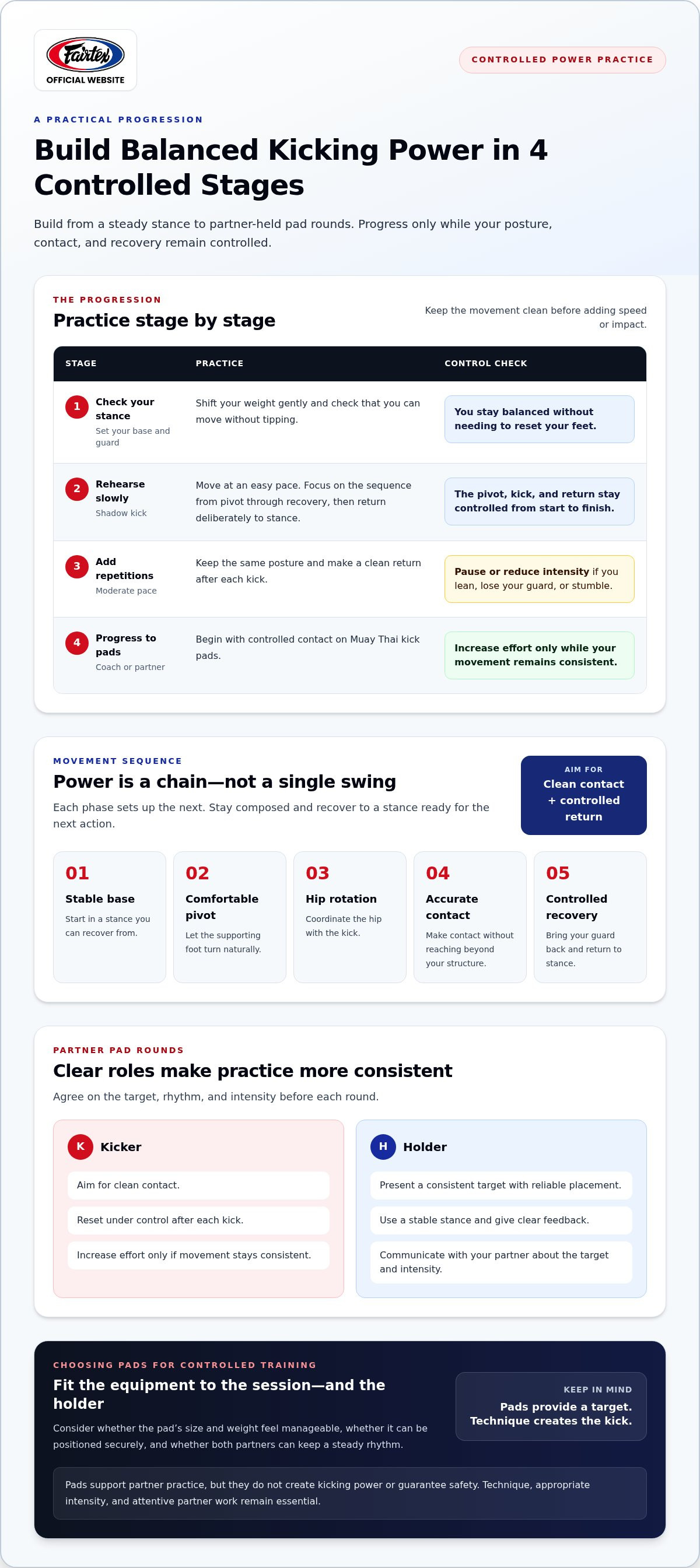
Build power through repeatable practice, not by jumping straight to maximum impact. Use this progression to keep technique, balance, and recovery at the center of each drill. Move on when the current stage stays controlled, and step back whenever your form starts to slip.
- Check your stance. Set your base and guard, then shift your weight gently. Confirm you can move without tipping or needing to reset your feet.
- Rehearse slowly in shadow. Perform the kick at an easy pace, focusing on the sequence from pivot through recovery. Return deliberately to stance after each repetition.
- Add controlled repetitions. Practise at a moderate pace, keeping the same posture and a clean return. If you start leaning, losing your guard, or stumbling, pause or reduce the intensity.
- Progress to pad rounds. Work with a coach or partner using Muay Thai kick pads. Begin with controlled contact, then increase effort only while your movement remains consistent.
Which drills build control before impact?
Slow shadow kicks let you feel the full movement without a target pulling you off line. Focus on a comfortable pivot, coordinated rotation, and a deliberate return to stance. Ask a coach or partner to watch your balance and recovery. If your posture changes from one repetition to the next, slow down and rebuild the movement before adding force.
How can pad rounds build power progressively?
Before each round, agree on the target, rhythm, and intensity. The holder should present a consistent target and give clear feedback; the kicker should aim for clean contact and a controlled reset. Increase intensity only when both partners can maintain safe, steady practice. The best kick pads for power kicking are training tools, but progress depends on communication and repeatable technique.
Set a controlled pace, get feedback, and build from there. Explore Fairtex Muay Thai kick pads for coached partner practice.
Choose Kick Pads That Support Controlled Power Training
The best kick pads for power kicking suit the drills you plan to do and the person holding them. Consider whether the size and weight feel manageable for the holder, whether the pads can be positioned securely, and whether both partners can maintain a steady rhythm. An awkward pad can interrupt practice, even when the kicker’s technique is sound.
For harder contact, the holder needs a stable stance, reliable placement, and clear communication with the kicker. Agree on the target and intensity before starting. Pads can support realistic training, but they don’t create kicking power or guarantee safety. Technique, appropriate intensity, and attentive partner work remain essential.
What should partners assess during a pad session?
Check that the holder can stay balanced and present a clear, consistent target. The kicker should make controlled contact without forcing the pad out of position. If either partner loses comfort, control, or reliable placement, pause and adjust the target, intensity, or drill. Good communication keeps the session productive for both people.
How do kick pads fit into a complete Muay Thai setup?
Choose equipment around the planned training rather than assuming one setup fits every athlete or session. Kick pads support partner striking drills; other equipment serves different needs. For broader context, use a complete Muay Thai gear guide alongside your coach’s guidance.
For coached pad work, explore the Fairtex Muay Thai kick pad collection. Fairtex also offers other equipment for partner practice, including belly pads and gloves.
Build Power You Can Repeat
Stronger kicking isn’t about sacrificing balance for impact. It comes from coordinated movement, clean contact, and a controlled return to stance. Build those qualities in stages, from deliberate technique practice to partner pad rounds, and increase intensity only while you can maintain control.
The best kick pads for power kicking suit your drills and feel manageable for the person holding them. Stable handling and clear communication help make partner practice more consistent, while coaching keeps technique at the center. Fairtex specializes in Muay Thai equipment and offers kick pads and other training gear for focused practice.
Choose your next training tool with purpose. Explore Fairtex Muay Thai kick pads and keep building force you can deliver with balance, control, and confidence.
Frequently Asked Questions
Can I kick harder without losing my balance?
Yes, by building force through coordinated movement rather than simply swinging harder. Practise slowly, focusing on a controlled pivot, rotation, clean contact, and a return to stance. Increase intensity only while your posture stays organized. Ask a coach or partner to watch for leaning, uncontrolled hopping, or delayed recovery. If those appear, reduce the effort and refine the movement before progressing.
How do you improve kicking power in Muay Thai?
Improve kicking power by practising the movement in stages: establish your stance, coordinate the support-foot pivot with hip rotation, make clean contact, then recover under control. Begin at a manageable pace and build intensity while preserving good form. Coached pad rounds help you apply technique to a target. Strength and conditioning can support your training, but they don’t replace technical practice or coaching.
Do kick pads make your kicks more powerful?
No. Kick pads provide a target for partner practice; they don’t create kicking power by themselves. Technique, timing, physical preparation, and consistent coaching all contribute to the strike. Choose pads suited to the drill and manageable for the holder to position securely. Before training, agree on the target and intensity so both partners understand the work and can keep practice controlled.
How should a beginner practise powerful kicks safely?
Start with controlled shadow kicks and focus on balance, posture, and a reliable return to stance before adding impact. Once you can repeat the movement consistently, practise with a partner holding pads. Agree on the target and intensity first, and ask a qualified coach to adapt drills and correct technique. Pause or reduce intensity if control, comfort, or communication breaks down.
What should I look for in kick pads for power training?
Look for pads suited to your planned drills, with size and weight that let the holder position them reliably. Consider whether the fit and feel work for both partners during repeated practice, and whether you can communicate clearly about targets and intensity. The best kick pads for power kicking support controlled training, but no pad alone improves technique, creates power, or guarantees safety.