
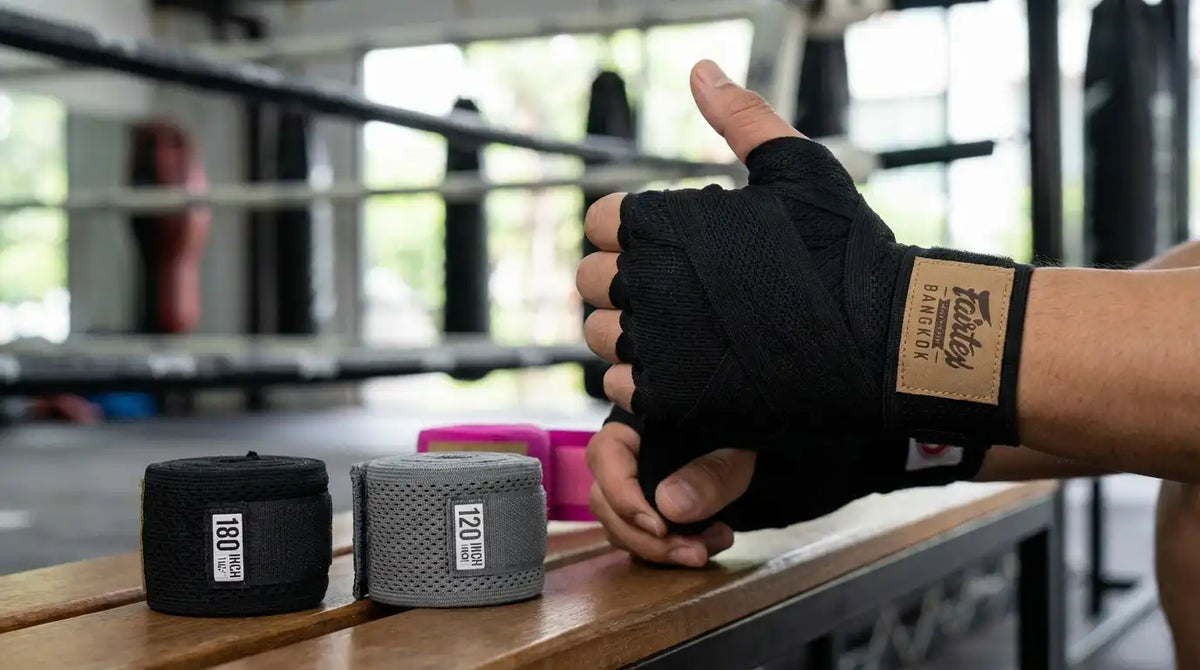
You have your gloves on the bench, you are already sweating from jump rope, and your partner is calling for rounds. Then you look down at your wraps and realize you are not sure if you should be using 120 or 180. That choice sounds small, but it changes how stable your wrist feels on impact, how protected your knuckles stay late in training, and how comfortable your hands are inside the glove.
Here’s the thing, “too short” usually shows up as loose wrists and hot spots on your knuckles, and “too long” shows up as bulky hands that fight your glove fit. This guide breaks down 120 vs 180 hand wraps in a practical way, based on how fighters actually wrap for boxing, Muay Thai, bagwork, and sparring. You will leave knowing exactly when 180 hand wraps are the better call, when 120 is enough, and how to adjust your wrap style so your hands feel locked in, not cramped.
What wrap length really changes
Hand wraps do three jobs: stabilize the wrist, stack the knuckles, and keep the small hand bones from shifting when you land hard. Length determines how much “structure” you can build, and where you can spend that structure.
Wrist support: the first place length gets spent
If your wrist is even slightly weak in extension or side-to-side movement, you will feel it on heavy bag rounds and on straight punches that land off-center. More length gives you more passes around the wrist, which is what turns the wrap into a brace. If you are throwing hard crosses, long hooks, or stiff jabs for volume, wrist stability is usually the deciding factor for 180 inch hand wraps.
Knuckle padding: protection without “overstuffing” the glove
Longer wraps let you add more layers across the knuckles, but smart fighters do not just pile fabric on the front of the fist. The goal is even coverage and a smooth surface so your glove fits clean. Consider this, if the wrap makes your hand feel like it is wedged inside the glove, your fist closure gets worse, and that can actually increase hand strain.
Thumb and hand “locking”: the part most fighters overlook
Some wrap methods use extra length to anchor the thumb and tighten the metacarpals (the long bones in your hand). That is a real benefit for bagwork and for fighters who get sore hands from long pad sessions. The reality is, if you never lock the hand and you only circle the wrist and knuckles, you might not need as much length.
120 vs 180: the quick decision guide
If you want the fastest answer, decide based on what you need to protect most: wrist, knuckles, or glove fit.
Simple sizing logic that works in real gyms
- Choose 180 hand wraps if you want more wrist support, you do lots of bagwork, your hands are larger, or you use a wrap style that locks the hand and thumb.
- Choose 120 hand wraps if you have smaller hands, you prefer minimal bulk, you use tight gloves, or you wrap mostly for light technique work and controlled sparring.
Glove fit is a real constraint, especially in boxing gloves
Now, when it comes to boxing gloves, the hand compartment can feel tighter than many Muay Thai gloves, depending on the model and padding shape. If your wraps add too much thickness, you end up fighting the glove every round. If you are not sure, do a test fit at home: wrap both hands, put your gloves on, and make a hard fist for 20 seconds. If your fingertips go numb or your knuckles feel jammed, you either need less bulk or a different wrapping pattern.
When 180 hand wraps are the right choice
Most fighters end up preferring 180 inch hand wraps because they are forgiving. You can wrap tight without running out of material, and you can adjust based on the session.
Heavy bag rounds and hard pad work
From years of gym experience, bagwork exposes bad alignment fast. You might feel “fine” in sparring, then the heavy bag punches back and your wrist tells the truth. With 180 hand wraps, you can add extra wrist turns and still build a clean knuckle pad. That usually means less soreness in the last two rounds when fatigue makes your technique a little sloppy.
Bigger hands, longer fingers, or wide wrists
If you have big hands, 120 can work, but it often forces compromises. You either choose wrist support and sacrifice knuckle layers, or you protect knuckles and accept a looser wrist. 180 gives you room to do both, which matters when you are throwing elbows in Muay Thai clinch entries or ripping hooks to the body in boxing.
Wrap styles that lock the hand and thumb
Any wrap pattern that includes thumb anchoring, cross-weaves between fingers, or extra passes over the back of the hand will eat up length. Those methods can be excellent for stabilization, but they demand enough wrap to finish with a secure wrist closure.
Fairtex wrap examples (real options you can actually choose)
If you want a classic cotton feel with choices in both lengths, Fairtex Handwraps (HW2) come in 120-inch and 180-inch sizes, made from soft, flexible cotton and made in Thailand: https://www.fairtex.com/products/handwraps. If you like a wrap that stretches and molds to your hand, Fairtex HW4 Elastic Hand Wraps are 180 inches and use a polyester and rubber blend with ventilation holes for breathability: https://www.fairtex.com/products/elastic-handwraps. You can also browse the full collection here: https://www.fairtex.com/collections/hand-wraps.
When 120 hand wraps make more sense
120 inch hand wraps are not “beginner wraps.” They are a tool for a certain feel: compact, fast, and less bulky inside the glove.
Smaller hands and tighter glove compartments
If you have smaller hands, extra fabric can bunch up around the palm and reduce your ability to close your fist. That matters for straight punches, where a clean fist and wrist line are everything. A well-wrapped 120 can feel sharp and responsive, especially if your gloves already have a snug hand compartment.
Technique sessions and lighter impact days
Consider this, not every training day is a power day. On days focused on footwork, timing, or light sparring, you may want just enough support to keep the wrist stable and protect the skin, without building a thick “cast.” 120 wraps can also be easier to put on quickly and easier to keep consistent, which matters when you are trying to build a pre-training routine you will actually stick to.
Minimalist wrap styles
If your wrap method is mostly wrist, knuckles, and a simple thumb loop, 120 can be plenty. The key is wrapping with tension and keeping the layers flat. If the wrap twists, even a 180 will not save your comfort.
Wrap styles that affect length (and why fighters get it wrong)
Two fighters can use the same 180 inch hand wraps and get completely different results. Length is only half the story, the other half is where you spend it.

The “all knuckles” mistake
What most fighters overlook is that your wrist is the foundation. If your wrist is unstable, your knuckles take the hit at bad angles. A smarter approach is balanced: enough wrist passes to feel braced, then enough knuckle layers to smooth impact, then a final wrist lock to finish.
Overdoing finger loops
Finger loops can help keep the knuckle pad from shifting, but too many loops can create pressure points between the fingers and restrict circulation. If you love finger loops, 180 gives you the length to do it without skipping wrist support, but keep the wraps flat and do not cinch between fingers like you are tying rope.
Session-based wrapping: use the same wraps, change the build
On bag days, spend more length on wrist and knuckles. On sparring days, spend less on knuckle bulk so your gloves fit comfortably and your hands stay relaxed. This is why many fighters settle on 180 inch hand wraps as their default, then adjust the pattern depending on intensity.
Choosing material and style: cotton vs elastic vs quick wraps
Length is the headline, but material changes the feel. A stiff wrap and a stretchy wrap behave differently at the same length.
Cotton wraps: consistent, classic, and easy to learn
Cotton wraps are stable and predictable. Fairtex Handwraps (HW2) are soft, flexible cotton and come in both 120-inch and 180-inch options, which is useful if you want to keep the same feel while experimenting with length: https://www.fairtex.com/products/handwraps.
Elastic wraps: more “mold,” but you must manage tightness
Elastic wraps like Fairtex HW4 Elastic Hand Wraps (180 inches) can contour to your hand and give a snug, athletic feel: https://www.fairtex.com/products/elastic-handwraps. The reality is, stretch can tempt you to wrap too tight. If your hands tingle mid-round, loosen up and rewrap. Support is good, cutting circulation is not.
Quick wraps: speed and convenience
If you are rushing between work and training and you still want basic coverage, quick wraps can help. Fairtex HW3 Quick Wraps include padded sponge on the backhand and a wrap-around thumb design: https://www.fairtex.com/products/quick-wraps. They are not a perfect replacement for a full wrap for hard bagwork, but they are practical for lighter sessions or as a backup in your gym bag.
Where wraps fit in your full kit
Wraps do their job best when your gloves fit correctly. If you are still sorting that out, these collections and guides help you match glove style to training: https://www.fairtex.com/collections/equipment-boxing-gloves, https://www.fairtex.com/collections/equipment-muay-thai-boxing-gloves, and https://www.fairtex.com/blogs/news/how-to-choose-the-best-fairtex-boxing-gloves-for-muay-thai-and-training.
Fairtex has been building fight gear in Thailand for decades, and you see that mindset even in small essentials like wraps: consistent materials, fight-tested practicality, and options that match how fighters actually train. If you want to explore what fits your routine, start by browsing the Hand Wraps collection and build from there based on your glove fit and training intensity.
How to choose 180 hand wraps by glove size and training focus
Wrap length is not just about your hand size. It is also about how much room your glove gives you and how much impact you are planning to take that day. This is where 180 hand wraps shine, because you can build support without guessing, as long as you keep the wrap flat and you do a quick fit check.
If your gloves feel snug
When your gloves have a tight hand compartment, the goal is support with minimal bulk. With 180 inch hand wraps, you can still get strong wrist stability by spending more length on clean wrist passes and less on thick knuckle stacks. Keep the knuckle pad smooth and wide, avoid bunching in the palm, and finish with a firm wrist lock. You are looking for a clean fist closure, not a stuffed hand.
If your gloves feel roomy
If you have more room inside the glove, you can afford extra structure across the knuckles and the back of the hand. That does not mean wrapping like a cast. It means building even layers that stay in place so your knuckles do not take sharp impact when you land slightly off-center. Roomy gloves plus 180 wraps is a good setup for hard bag rounds, long pad sessions, and high volume punching.
Match the wrap build to the session
- Heavy bag and hard pads: spend length on wrist stability first, then a smooth knuckle pad, then finish with a final wrist lock.
- Sparring and light technical work: keep knuckle layers thinner so your gloves fit comfortably and your hands stay relaxed for defense and clinch work.
- Sore hands or past wrist tweaks: use 180 inch hand wraps and prioritize wrist turns and back-of-hand anchoring so the wrap behaves like a brace, not just a knuckle cover.
If you want one simple rule that works for most fighters, choose 180 and learn how to “spend” the length based on glove fit and intensity. That gives you options day to day without changing your gear.
Common wrap problems and fixes (bulk, slipping, and sore knuckles)
Most wrap issues are not caused by the wrap length. They come from twisting fabric, uneven tension, or spending too much material in one place. Use these checks to troubleshoot fast.

If your wraps feel bulky inside the glove
Bulk usually comes from thick knuckle stacks and bunched fabric in the palm. Flatten the wrap every pass, keep the knuckle pad smooth (not tall), and avoid wrapping too many times across the same small spot. If you are using 180 inch hand wraps and you still feel cramped, reduce finger loops and move some length back to the wrist where it adds support without filling the glove.
If your wrap slips or loosens mid-round
Slipping happens when tension is inconsistent or the wrap is not anchored well early. Start with a firm wrist base, then keep each layer flat and snug. When you finish, your closure should land on the wrist and feel secure when you rotate and flex the wrist. If the wrap shifts when you open and close your fist, rewrap and tighten the early wrist turns.
If you get sore knuckles even with 180 hand wraps
Sore knuckles can be a technique and alignment problem, not just padding. Check that your knuckle pad is centered over the striking surface and that your wrist is stacked straight when you punch. If your wrap is thick on one side and thin on the other, your fist lands unevenly and the pressure concentrates. Build even layers, keep your fist closed while you lay the knuckle pad, then lock the wrist again before finishing.
If your hands tingle or your fingertips go numb
This is almost always a tension issue. Elastic wraps can make it easy to pull too hard, but cotton wraps can do it too if you crank down between finger loops. Rewrap looser, especially between fingers and around the base of the thumb. You want stability, not pressure. After wrapping, open and close your fist and check fingertip color and warmth before you put your gloves on.
Care and lifespan: how to wash hand wraps and when to replace them
Wraps live in a sweaty environment, so care is not optional. Clean wraps feel better, last longer, and help keep your gloves from turning into a bacteria trap.

How to wash hand wraps without turning them into knots
The simplest habit is to re-roll your wraps after every session so they do not turn into a tangled mess later. When you wash them, keep the closure secured so it does not grab other fabric. Use a gentle cycle with cold or warm water and let them air dry. High heat can shrink cotton and can wear elastic faster, so skip the dryer if you want your wraps to stay consistent in feel and length.
How often you should wash them
If you train hard and sweat a lot, washing every few sessions is realistic. If you are training daily, rotate multiple pairs so each set can fully dry between uses. Damp wraps get funky fast, and once the odor sets in, it is hard to get rid of completely.
When it is time to replace wraps
Replace wraps when the fabric thins out over the knuckles, the wrap loses its shape and starts twisting no matter how carefully you put it on, or the closure stops holding securely on the wrist. A worn wrap can feel “soft,” but it can also mean less structure where you need it most.
Frequently Asked Questions
Are 180 hand wraps better than 120?
Not automatically. 180 hand wraps are better when you need more wrist support, more knuckle layering, or you use a wrap style that locks the hand and thumb. 120 hand wraps can feel cleaner and less bulky, especially for smaller hands or tighter glove compartments. Pick based on what you feel failing first in training, wrist stability or glove comfort.
What length hand wraps should I get for boxing?
For boxing, 180 inch hand wraps are a common choice because bagwork and straight punching volume demand wrist support. If your gloves feel tight, or your hands are smaller, 120 can be enough with a good wrap pattern. Do a real test fit: wrap, glove on, make a firm fist, and check for numbness or pressure points.
What length hand wraps should I get for Muay Thai?
Muay Thai involves punching, clinch fighting, and often longer pad sessions, so 180 is usually the safer default for wrist stability. That said, if you prioritize a lighter feel for sparring and your gloves fit snug, 120 can work well. If you throw lots of hard elbows on pads, consider extra wrist support, which favors 180.
How long should boxing hand wraps be for heavy bag training?
For heavy bag training, you typically want enough length to secure the wrist and build a smooth knuckle pad, which points to 180 inch hand wraps. The bag is unforgiving, and fatigue makes your alignment slip late in rounds. More length lets you reinforce the wrist without sacrificing knuckle coverage, as long as you keep the wrap layers flat to avoid bulk.
Can 180 inch hand wraps be too long?
Yes. If you use all the length on thick knuckle layers, your glove fit can get cramped and your fist closure can suffer. The fix is not always switching to 120. Often you just need a cleaner wrap pattern, fewer finger loops, and fewer layers across the knuckles. Your hand should feel supported and natural, not stuffed.
Do elastic wraps change which length I should buy?
Elastic wraps can feel “longer” in practice because they stretch and contour to your hand. A 180 elastic wrap can give strong support with fewer bulky layers, but it also makes it easier to wrap too tight. Pay attention to circulation, your fingertips should stay warm and responsive. If you love a snug feel, elastic 180 can be a strong choice.
What if I am between 120 vs 180 hand wraps?
If you are truly unsure, choose 180 and learn to spend the length wisely. You can always wrap less bulky by reducing knuckle layers and minimizing finger loops, while still locking the wrist. It is harder to “create” more support with 120 once you run out of material. Most fighters can make 180 work for more training situations.
How tight should hand wraps be?
Tight enough to prevent shifting, but not so tight that your hand tingles or goes numb. After you wrap, open and close your fist several times, then rotate your wrist. You should feel stable, not restricted. During the first round, check your fingertips. If they feel cold or numb, rewrap looser. Protection should never come from cutting circulation.
Do you really need hand wraps if you already have good gloves?
Yes, if you are punching with real intent. Gloves provide padding, but wraps help stabilize the wrist and keep the small bones of the hand from shifting under impact. Even with quality gloves, wraps make your hand position more consistent round after round.
How many pairs of hand wraps should you own?
At minimum, own two pairs so you can rotate while one set dries after washing. If you train frequently, having three or more pairs makes it easier to keep your wraps clean and your glove interior drier.
Should you use 180 hand wraps for sparring?
You can, but build them for comfort. Sparring is where glove fit and relaxed hands matter. Use 180 inch hand wraps for wrist stability, but avoid overly thick knuckle stacks so your gloves do not feel cramped and your hands do not fatigue from fighting the fit.
How do I stop my hand wraps from smelling?
Do not leave them balled up in your bag. After training, unroll them to dry or re-roll them neatly, then wash them regularly and let them air dry fully before the next session. Rotating multiple pairs helps because each set gets enough time to dry out completely.
Key Takeaways
- Choose 180 hand wraps when wrist support, bagwork intensity, or larger hands demand more structure.
- Choose 120 hand wraps when you want minimal bulk, have smaller hands, or use tighter-fitting gloves.
- Wrap pattern matters as much as length, spend your wrap on wrist stability first, then knuckle smoothing.
- Elastic 180 wraps can feel snug and supportive, but do not wrap so tight that you lose circulation.
- Always test glove fit after wrapping, your fist should close comfortably without pressure points.
Conclusion
120 vs 180 is not a style debate, it is a support and fit decision. If your wrists get sore on the bag, if your punches start to wobble late in rounds, or if you like a wrap style that locks the hand, 180 inch hand wraps are usually the smarter pick. If your hands are smaller, your gloves run tight, or you want a cleaner, lighter feel for technique and sparring, 120 can be the right tool.
Now, when it comes to building a dependable training routine, consistency matters more than perfection. Pick a length, learn one wrap pattern you can repeat every time, and adjust it for hard days versus light days. If you want to compare options, explore the Fairtex Hand Wraps collection, then pair your wraps with gloves that fit your style through our Boxing Gloves or Muay Thai Gloves collections.