
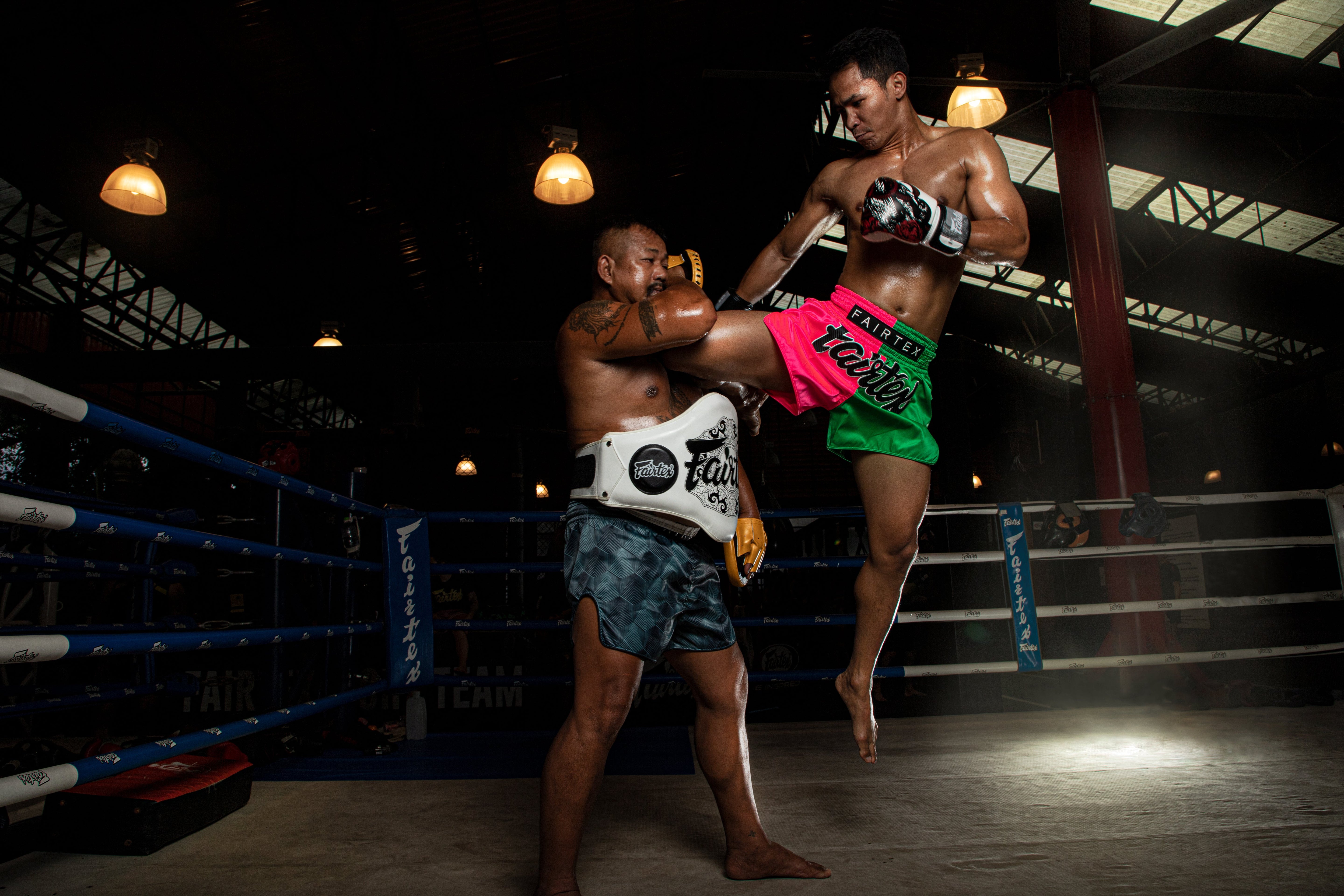
Thai pads are forearm-mounted targets held by a trainer for dynamic, mobile drilling. Kick pads is a broader term that usually includes larger, two-handed shields used for building raw power. Both protect the holder from impact, but they're built for different jobs, and using the wrong one leads to slipped straps, wrist strain, and gear that doesn't survive a real training camp.
This guide breaks down the structural differences, strap systems, foam composition, and weight distribution, so you can match the gear to your training style and keep it working long-term.
Table of Contents
-
Professional Maintenance: Breaking In and Cleaning Your Gear
-
The Fairtex Standard: Why Professional Fighters Choose Our Pads
Kick Pads vs. Thai Pads: Definitions and Core Differences
The confusion around kick pads vs. Thai pads usually comes down to how loosely the term "kick pad" gets used. Thai pads are precision tools: they strap directly to a trainer's forearms, creating a mobile target that moves the way a live opponent would. They're the standard for developing the rhythmic, high-intensity striking patterns Muay Thai is built on.
"Kick pads," by contrast, is often used as an umbrella term for large shields or square targets braced with two hands. These are excellent for raw power and conditioning work, but they don't offer the mobility needed for clinch and counter-striking drills. A heavy bag sits at the far end of that spectrum, a passive, stationary tool that absorbs force but teaches nothing about timing or distance.
The Evolution of the Thai Pad
Early pads were rectangular slabs of thick leather, heavy, and prone to soaking up sweat as a session went on. The shift to curved geometry changed that: by following the natural contour of the shin, a curved pad "catches" the kick instead of letting it slide, protecting the holder's positioning. More recently, gear has moved toward proprietary microfiber, which keeps the feel of cowhide while cutting weight and resisting the rot and cracking that leather suffers under constant sweat exposure.
When to Use Thai Pads Over Focus Mitts
Focus mitts are built for boxing's linear speed and precision; they're too small and lack the density to absorb a full leg strike. A proper kick needs the larger surface area of a Thai pad to spread that force across the holder's forearm; using mitts for kicks is a fast route to wrist hyperextension and elbow tendonitis. For full-body drilling, many gyms pair Thai pads with belly pads, letting a striker flow from punches to knees to low kicks without the holder resetting position.
Kick Pads vs. Thai Pads Comparison Table
| Thai Pads | Kick Pads / Shields | |
|---|---|---|
| Attachment | Forearm straps + handle | Held with both hands against chest/thigh |
| Best for | Combination drills, clinch work, roundhouse timing | Building raw power, conditioning |
| Mobility | High - mimics a live opponent | Low - stationary target |
| Surface options | Curved or flat | Typically flat, larger surface |
| Core density | High-density, engineered for torque | Very high-density, built for heavy power shots |
| Ideal user | Trainers running technical pad rounds | Coaches building fighter conditioning |
The Engineering of Impact: Anatomy of a Professional Pad
The real distinction between kick pads and Thai pads isn't cosmetic; it's in the internal build. A high-density foam core is the structural backbone, keeping the pad from folding or "bottoming out" under heavy use. That core is wrapped in a softer strike face, protecting the striker's shins from bone-on-bone contact while letting the pad hold its shape over years of use.
Cheap pads suffer from what's often called shock pass-through: when foam density is too low to absorb impact, that kinetic energy doesn't disappear; it travels straight into the holder's elbows and wrists, leading to chronic inflammation over time. Reinforced stitching at the handles and straps matters just as much, since those are the highest-stress points on the pad. Heavy-duty nylon threading and riveted handles keep the seams from failing mid-round.
Microfiber vs. Leather: Performance Comparison
| Microfiber | Leather | |
|---|---|---|
| Weight | Lighter, less shoulder fatigue | Heavier |
| Moisture resistance | High, resists odor and salt damage | Prone to cracking in humidity |
| Break-in | Faster | Slower, more traditional feel |
| Durability | Long-term in humid gyms | Shorter lifespan in high-sweat environments |
Ergonomic Handle and Strap Architecture
The balance of a pad is just as important as its padding. A well-balanced pad stays centered on the forearm without requiring the holder to grip the handle with excessive force. This reduces the isometric tension that causes forearm fatigue. You'll find single-strap systems offer more mobility for clinching, while double-strap systems provide a more secure fit for heavy power kicking. Padding on the back of the pad is a non-negotiable feature for professional use. It acts as a final buffer between the pad's rigid core and the holder's arm. If you're looking to protect your joints during high-volume sessions, consider our professional kick pads designed for elite impact management.
Flat vs. Curved Pads: Which Design Suits Your Style?
The choice between flat and curved surfaces is a strategic decision that dictates the rhythm of your training session. Curved pads have become the modern industry standard for a reason. They're engineered to "catch" the kick. The slight arc creates a natural pocket that traps the shin upon impact, preventing the leg from sliding up toward the trainer's shoulder or down toward their hip. This design is particularly effective for high-volume roundhouse drills. It allows the trainer to hold the pads with less isometric tension, as the pad's shape does much of the work in stabilizing the strike.
For those focused on pure speed, compact "Kiddie" pads offer a specialized solution. These are smaller, lighter versions of standard Thai pads. They aren't just for children; professional trainers use them for high-velocity accuracy drills. Because they weigh significantly less than standard-size pads, the holder can transition between high and low targets with much greater speed. This makes them ideal for mimicking the fast-paced, unpredictable nature of a live fight where targets appear and disappear in fractions of a second.
Professional Maintenance: Breaking In and Cleaning Your Gear
Gear longevity comes down to how it's treated in the first month. High-density foam is stiff on purpose, that stiffness signals quality, but it needs a methodical break-in to reach peak performance. Rush it, and you risk "bottoming out," where the internal foam layers separate and stop absorbing energy, making the pad both useless for protection and unsafe for the holder.
Watch for these signs of failure:
-
You can feel the striker's shin bone through the padding - the core has collapsed and is transferring shock rather than absorbing it.
-
"Dead spots" - patches that feel noticeably mushier than the rest of the surface.
The "First 500 Kicks" Break-In Protocol
-
Use low-power, technical strikes for the first several sessions to let the foam layers settle without stressing the core.
-
Manually flex leather straps and handles by hand to soften them into a secure fit.
-
If using microfiber, skip leather oils and conditioners — they clog synthetic pores and add dead weight without benefit.
Sanitization and Longevity
Bacteria ruins professional gear faster than heavy kicks. Sweat contains salts and acids that degrade foam and rot stitching. Establish a daily wipe-down procedure using non-corrosive, alcohol-free disinfectants. Alcohol-based cleaners are too harsh. They dry out both leather and microfiber, causing the material to crack. Trapped moisture is the primary driver of internal foam decay and permanent odors. You can apply the same hygiene principles found in our professional guide to cleaning shin guards to maintain your striking targets.
Proper storage is non-negotiable. Never leave damp gear in a closed gym bag. This creates a moisture trap that accelerates decay. Store pads in a cool, ventilated area away from direct sunlight. UV rays bleach the shell and weaken the fibers. If your current equipment has reached its limit, invest in a Muay Thai starter pack to ensure your training remains safe, effective, and professional.
The Fairtex Standard: Why Professional Fighters Choose Our Pads
Since 1971, the Wong family has maintained a singular focus: engineering equipment that survives the intensity of Thai gym culture. Fairtex gear is hand-made in Thailand, ensuring that every stitch and foam layer meets the requirements of elite combat sports.
The KPLC series has become the industry benchmark for a reason. These pads represent the pinnacle of trainer-first ergonomics. Every piece of equipment is tested and refined within the Fairtex Training Center by coaches who hold pads for eight hours a day. This direct feedback loop led to our proprietary microfiber technology. It outperforms traditional cowhide in every measurable category. It's lighter, which prevents the shoulder fatigue that ruins long sessions. It's also more durable, resisting the cracking and rot that typically plagues leather in high-humidity environments.
Building Your Professional Kit
Standardizing your equipment is the first step toward a professional training environment. For those just beginning their journey or gym owners looking to outfit a new class, integrating pads into a Muay Thai starter pack ensures all gear meets the same high-performance criteria. Consistency in padding density across your kit prevents training injuries and helps students develop a better "feel" for their strikes.
A complete training system requires more than just targets. Pairing your pads with elite Muay Thai shin guards allows for full-spectrum drills, including checks and counter-kicking, without risking bone-on-bone contact. This holistic approach to gear selection is what separates casual practitioners from dedicated martial artists. Experience the difference that fifty years of Thai heritage makes in your striking power. Explore the full range of Fairtex Muay Thai kick pads and upgrade your training to the professional standard.
Frequently Asked Questions
Are Muay Thai kick pads sold in pairs or individually?
Kick pads are sold in pairs. This guarantees matched weight, padding, and balance for both arms. Single pads are only available as replacements.
How do I choose between leather and microfiber kick pads?
Choose microfiber for lighter weight and better sweat/odor resistance, ideal for humid, high-volume gyms. Choose leather for a traditional feel and natural break-in.
How long do professional Muay Thai pads typically last?
Typically 1–3 years under high-volume use, depending on strike frequency and power. Replace them once the foam bottoms out or the handles loosen.
What is the best way to clean my Thai pads after a heavy session?
Wipe with a damp cloth and alcohol-free disinfectant after every session, then air-dry fully. Avoid alcohol-based cleaners and closed bags, trapped moisture causes odor and foam decay.