Sign-up today and get 10% off your next order of $100 or more! Don't miss out on exclusive deals and updates.
How to Clean Muay Thai Shin Guards: The Professional Maintenance Guide (2026)
Your gear is an extension of your craft. Whether it's your protective equipment or your high-performance 2XU training apparel, if it smells like a locker room floor, it is a...
Your gear is an extension of your craft. Whether it's your protective equipment or your high-performance 2XU training apparel, if it smells like a locker room floor, it is a liability, not an asset. Mastering how to clean muay thai shin guards is the difference between a professional kit that lasts years and a biohazard that ends up in the bin. You take your training seriously. Your equipment maintenance should reflect that same level of discipline and respect for the tradition of the sport.
We understand the frustration of persistent odors and the genuine risk of skin infections like staph or ringworm. You shouldn't have to choose between high-performance training and basic hygienic safety. This professional maintenance guide provides the exact techniques to eliminate bacteria, prevent material cracking, and keep your velcro straps sticking like new. We will break down material-specific protocols for genuine leather and Syntek, highlight the best specialized cleaners for 2026, and outline the daily rituals that double the lifespan of your equipment. It is time to treat your gear with the same precision you bring to the ring.
Key Takeaways
Neutralize biological risks by understanding how sweat and heat compromise your equipment's safety.
Tailor your care routine to specific materials like genuine leather or Syntek to prevent premature cracking.
Execute the "Golden Hour" ritual to ensure surface decontamination immediately following every session.
Discover how to clean muay thai shin guards using professional-grade deep cleaning techniques for permanent odor removal.
Preserve gear integrity through proper climate-controlled storage and shape-retention practices.
##Beyond the Odor: Why Shin Guard Hygiene is a Performance Requirement
The distinctive scent of a combat sports gym is often dismissed as a badge of hard work. It isn't. That "gym funk" is a biological warning sign. When you train, your shin guards absorb a cocktail of sweat, dead skin cells, and heat. This combination creates a perfect incubator for bacterial colonization. Within the dark, damp crevices of your gear, a microscopic bio-film begins to form. This isn't just about aesthetics or social etiquette. It is about maintaining the tools of your trade. Understanding how to clean muay thai shin guards is a prerequisite for anyone who respects the sport and their training partners.
Professionalism extends beyond your technique in the ring. It lives in how you treat your equipment. Stepping onto the mats with compromised, foul-smelling gear signals a lack of discipline. It suggests a disregard for the shared environment of the gym. Clean equipment provides a psychological edge. It fosters a mindset of precision and readiness. You don't see elite athletes competing in neglected kit. They understand that peak performance requires every variable, including hygiene, to be optimized.
The Bio-Hazard Factor in Combat Sports
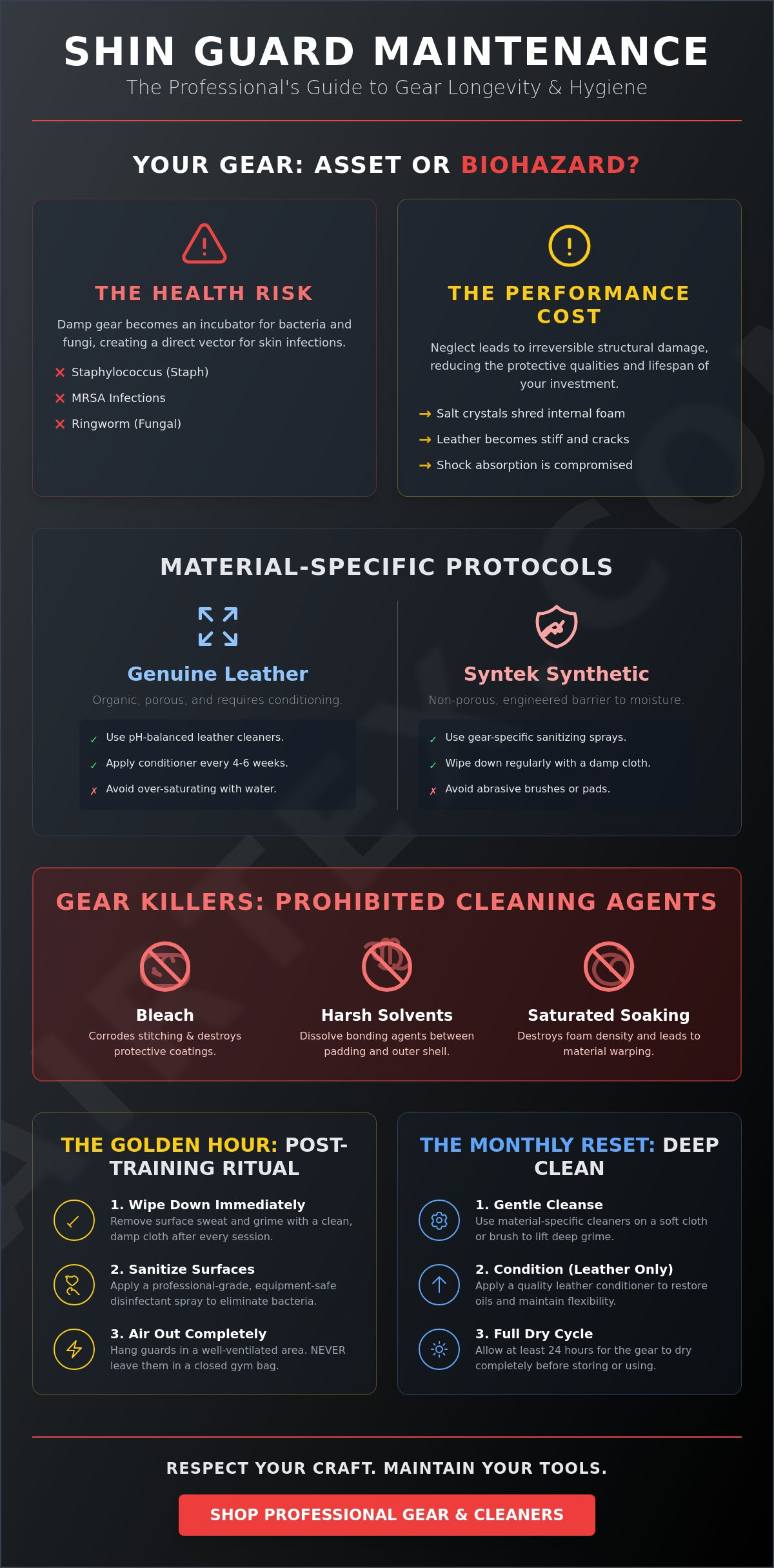
Damp equipment is a primary vector for infection. Pathogens like Staphylococcus aureus (staph), MRSA, and fungal infections such as ringworm thrive in the porous linings of protective gear. These are the silent enemies in the clinch. Because Muay Thai involves constant physical contact, your shin guards frequently touch your partner’s exposed skin. If your gear is a breeding ground for bacteria, you aren't just risking your own health; you are a liability to your entire gym. Fungal spores can survive for weeks in untreated foam, leading to recurring skin rashes that can sideline you for months.
How Neglect Destroys Your Investment
The damage caused by poor hygiene is structural. As sweat evaporates, the salt left behind doesn't just disappear. It crystallizes. These microscopic salt crystals act like sandpaper inside the material, shredding the internal foam padding and stripping the natural oils from leather. This leads to the dreaded "cardboard feel," where the guards become stiff, brittle, and lose their shock-absorbing properties. Once the internal padding breaks down, the protective integrity of the guard is gone. Moisture is the primary catalyst for structural gear failure. Learning how to clean muay thai shin guards properly prevents this chemical breakdown, ensuring your padding remains dense and your leather stays supple for years of high-impact use.
##Material Science: Caring for Leather vs. Syntek Shin Guards
High-performance gear requires a technical understanding of its composition. You cannot treat organic hide the same way you treat engineered microfibers. When considering how to clean muay thai shin guards, the primary distinction lies in porosity. Genuine leather is a traditional, organic material valued for its moldability and premium feel. However, its cellular structure is naturally absorbent. In high-moisture environments, this porosity is a double-edged sword. It breathes, but it also drinks sweat. This absorption leads to internal bacterial growth if not managed with precision.
Syntek technology represents the modern evolution of combat equipment. Developed specifically to withstand the grueling humidity of Thailand, Syntek is a high-density synthetic microfiber. Unlike leather, it is non-porous. It creates a barrier rather than a sponge. Syntek's microfiber structure is engineered to be non-capillary. This means it lacks the microscopic channels that draw moisture deep into the material's core. This structural difference is why your cleaning approach must pivot based on your gear's DNA. Leather requires conditioning to stay supple; synthetics require consistent sanitization to remain hygienic.
Before beginning any maintenance, recognize the "No-Go" list for all professional equipment:
Bleach: Corrodes the protective top-coat and weakens the tensile strength of the stitching.
Harsh Industrial Solvents: These chemicals dissolve the bonding agents between the outer material and the internal foam.
Saturated Soaking: Submerging your guards in water destroys the density of the shock-absorbing padding.
The Leather Maintenance Protocol
Leather demands a preservation mindset. Use only pH-balanced cleaners designed for natural hides. Harsh soaps strip the essential oils that keep the material flexible. Over-saturation is the primary enemy here. Water-logging causes the leather to swell and, upon drying, warp or shrink. This leads to permanent structural deformities and a compromised fit. Apply a premium leather conditioner every four to six weeks. This restores the moisture balance and prevents the surface from cracking under the stress of repeated impact. If you want to maintain a professional aesthetic, this step is non-negotiable.
Syntek and Synthetic Microfiber Care
Engineered synthetics offer superior resistance to liquid penetration. This makes the deep cleaning process more straightforward and efficient. You can use specialized antimicrobial sprays without fear of degrading the material’s finish. While Syntek resists odor better than untreated leather, it is not invincible. Bacteria can still thrive on the surface film if left in a closed gym bag. A strict drying routine is mandatory to maintain the material's integrity. If you are looking to upgrade to high-performance equipment, explore the latest professional shin guards designed for elite durability. Knowing how to clean muay thai shin guards made of Syntek ensures they remain a staple of your kit for years.
##The Post-Training Ritual: 5 Steps to Daily Freshness
Training ends when your gear is stored properly, not when the final bell rings. The first sixty minutes following a session, known as the "Golden Hour," determine the lifespan of your equipment. During this window, sweat remains in a liquid state. If you leave your guards in a dark, humid gym bag, you are essentially sealing them in a bacterial incubator. This environment facilitates the rapid breakdown of both synthetic and organic materials. Discipline in maintenance is as vital as discipline in the clinch.
A professional ritual requires a systematic approach. You aren't just cleaning; you are performing a technical reset. This process ensures that your investment remains a high-performance tool rather than a liability. Following a structured checklist prevents the accumulation of the biological risks discussed previously. It keeps the padding dense and the straps secure. Consistency is the hallmark of an elite practitioner.
Immediate Decontamination Steps
Begin by removing surface moisture immediately. Use high-quality disinfectant wipes or a clean microfiber cloth dampened with a mild, pH-neutral soap solution. Pay specific attention to the "inner channel." This is the area where your shin makes direct contact with the lining and where sweat concentration is highest. Always pull the cloth from the center toward the outer edges to prevent trapping contaminants within the reinforced stitching. This simple movement prevents bio-film buildup in the seams. Once the surface is clear, use a dry towel to blot the interior. Don't rub aggressively. Blotting pulls moisture out of the foam without compromising the material's texture. Mastering how to clean muay thai shin guards starts with these fundamental mechanical actions.
The Art of Air Drying
Ventilation is the final stage of the daily ritual. Never leave your gear compressed. Use the "Open-Strap" method. Fully undo all velcro enclosures and pull the straps back to expose the maximum surface area of the inner lining. This allows air to circulate through the padding. While some athletes use direct sunlight for UV sanitization, proceed with caution. Excessive UV exposure causes leather to become brittle and synthetics to fade. Limit sun exposure to twenty minutes, then move the gear to a cool, shaded area with high airflow. Using specialized gear hangers or a high-velocity fan can accelerate this process significantly. Knowing how to clean muay thai shin guards requires this level of attention to detail. Your gear represents your commitment to the sport. Treat it with the respect it deserves.
##Deep Cleaning and Odor Restoration: The Monthly Reset
Daily maintenance is the baseline. The monthly reset is the standard for professionals. Even with a perfect post-training ritual, microscopic residue accumulates over weeks of heavy sparring. You know it's time for a deep clean when a faint odor persists after drying or when the inner lining feels slightly tacky to the touch. Mastering how to clean muay thai shin guards at this level restores the material's original properties and ensures total sanitization. It's about reclaiming the integrity of your kit.
A 50/50 solution of distilled white vinegar and water is your most effective tool for heavy-duty restoration. Vinegar's acetic acid breaks down biological proteins without damaging the protective top-coat of your gear. For enhanced antimicrobial power, add five drops of tea tree or eucalyptus oil. These essential oils offer natural antifungal properties that many synthetic sprays lack. This combination neutralizes deep-seated "gym funk" at the molecular level rather than just masking it with artificial scents. Precision in your chemistry ensures the longevity of the material.
The Deep Soak (Without the Soak)
Never submerge your guards in a tub or washing machine. Saturation destroys the internal foam's ability to absorb impact and leads to permanent warping. Instead, apply your vinegar solution to a soft-bristled brush. Gently agitate the material grain in circular motions, focusing on high-friction areas where sweat pools. Wipe away the lifted grime immediately with a dry microfiber cloth. To eliminate any remaining moisture-driven scents, place baking soda sachets inside the guards overnight. The baking soda acts as a powerful desiccant, pulling moisture and trapped odors from deep within the padding structure. Knowing how to clean muay thai shin guards means managing moisture, not adding to it.
Restoring Velcro and Elasticity
Neglecting the fasteners is a common failure point that leads to premature gear replacement. Velcro accumulates lint, hair, and clothing fibers, which compromises its "stick" and security. Use a fine-tooth comb or a dedicated velcro brush to clear the hook-and-loop system. This restores the closure's tensile strength, preventing the guard from shifting during high-intensity rounds. Treat the elastic foot and heel straps with a damp cloth; avoid stretching them while wet to prevent fiber fatigue. If the elastic feels limp or the velcro fails to hold under tension, your safety is compromised. Upgrade to professional-grade shin guards to ensure your protection meets global standards. Secure gear is the foundation of technical confidence.
##Long-Term Integrity: Storage and Professional Standards
The final pillar of gear maintenance is preservation through proper storage. You have mastered the daily ritual and the monthly reset. Now, you must ensure your environment doesn't undo your hard work. Professional-grade equipment is an investment in your safety. If you treat your kit like a disposable commodity, it will perform like one. Achieving peak longevity requires a controlled environment and a disciplined storage strategy. This is the difference between gear that lasts one season and gear that lasts five.
Shape retention is a critical factor often overlooked by amateurs. Never stack heavy weights on top of your guards or fold them to fit into tight spaces. This compression creates permanent protective gaps in the high-density foam. Over time, these gaps compromise the guard's ability to disperse impact, leading to bruised shins or worse. Your equipment has a specific curvature designed to wrap around your leg. Respect that geometry. Mastering how to clean muay thai shin guards is useless if you destroy the structural padding through careless storage.
Professional fighters often employ a rotation strategy to maintain their standards. This involves owning two pairs of Fairtex shin guards . By alternating between pairs, you allow each set a full 48-hour drying cycle. This prevents moisture from ever reaching the core of the padding. Before every sparring session, perform a 30-second safety check. Inspect the stitching, test the velcro tension, and feel for any soft spots in the foam. If your gear passes this final inspection, you are ready for the mats.
Optimal Storage Solutions
Store your equipment in a climate-controlled area. Avoid damp basements or the trunk of a hot car. Extreme heat accelerates the chemical breakdown of synthetic liners and dries out the natural oils in leather. Flat-laying your guards on a shelf is superior to hanging them. Hanging can put unnecessary stress on the elastic straps, leading to premature stretching. For a neutral storage environment, use cedar blocks or activated charcoal bags. These natural desiccants absorb residual moisture and neutralize odors without the need for synthetic perfumes. This is the professional standard for gear preservation.
The Fairtex Standard of Excellence
Superior maintenance starts with superior engineering. High-quality materials are designed to be cleaned easily and dry quickly. Fairtex equipment utilizes advanced linings that resist moisture absorption, making the process of how to clean muay thai shin guards more efficient. When you choose elite gear, you are choosing a product built for the rigors of professional training and the demands of long-term hygiene. Ready for an upgrade? Explore the latest Fairtex Shin Guards and experience the intersection of heritage and high-performance technology.
##Elevate Your Equipment Standards
Discipline in the gym must extend to your gear. Mastering how to clean muay thai shin guards is a fundamental requirement for any serious practitioner. By respecting the "Golden Hour" after training and implementing material-specific protocols for leather and Syntek, you safeguard your health and preserve the structural integrity of your equipment. Professional maintenance isn't a chore; it's a ritual of respect for the sport and your training partners.
High-performance training demands equipment that can withstand the rigors of the clinch. Fairtex has been a definitive leader in combat sports since 1971, providing gear that's handmade in Thailand and tested by elite champions at the Fairtex Training Center. Our industry-leading Syntek and genuine leather options are engineered for maximum durability and hygienic safety. Upgrade to Professional Fairtex Protection to ensure your kit matches your commitment to excellence. Train with total confidence, knowing your protection is as resilient as your spirit.
Can I put my Muay Thai shin guards in the washing machine?
Never place your shin guards in a washing machine. The mechanical agitation and prolonged submersion destroy the internal foam density and compromise the bonding agents between material layers. This leads to permanent warping and structural failure. Instead, use the manual wiping and air-drying methods previously discussed to maintain your gear's protective integrity and aesthetic appeal without risking a total loss of your investment.
How do I get the 'cat pee' ammonia smell out of my old gear?
Neutralize ammonia odors by using the vinegar and water solution mentioned in our monthly reset guide. This acidic treatment breaks down the urea and bacteria responsible for the sharp ammonia scent. For extreme cases, apply a baking soda paste to the inner lining, let it sit for thirty minutes, and wipe it away. This process is a critical part of how to clean muay thai shin guards that have been neglected.
Is it safe to use Lysol or bleach wipes on leather shin guards?
Avoid using Lysol or bleach wipes on genuine leather. These harsh chemicals strip the natural oils from the hide, causing the surface to become brittle and crack under impact. Stick to pH-balanced leather cleaners or mild, diluted soap solutions. For Syntek materials, high-quality antimicrobial sports sprays are acceptable, but always perform a spot test on a small area first to ensure material compatibility and finish integrity.
How often should I deep clean my shin guards if I train 5 days a week?
Perform a deep clean once per month if you are training five days a week. While the daily post-training ritual manages surface bacteria, a monthly reset is necessary to extract deep-seated moisture and salts from the padding. Consistent maintenance prevents the accumulation of "gym funk" and ensures your gear remains hygienically safe for high-intensity sessions. This frequency balances equipment longevity with effective sanitation standards.
My velcro isn't sticking anymore-can I fix it or do I need new guards?
You can often restore velcro functionality by removing trapped debris with a fine-tooth comb. Lint and hair are the primary reasons fasteners lose their "stick" and security. However, if the hook-and-loop fibers have become frayed or flattened due to age, the safety of the guard is compromised. If cleaning doesn't restore a firm lock, prioritize your protection and invest in professional-grade replacements to avoid mid-sparring gear shifts.
Should I use a hair dryer to speed up the drying process?
Never use a hair dryer or any direct heat source to dry your equipment. High temperatures cause synthetic materials to melt and leather to shrink and crack. The heat also degrades the adhesive layers within the protective foam structure. Use a high-velocity fan or a dedicated gear dryer that utilizes ambient, unheated air. Controlled airflow is the only professional method for safely accelerating the drying process without causing damage.
Do I need to clean the foot protector differently than the shin part?
Treat the foot protector with the same level of detail as the shin section. This area makes direct contact with the gym floor and collects significant sweat from the top of the foot. Bacteria thrive in the seams where the foot and shin sections meet. Ensure you wipe down the underside of the foot strap and the instep padding to prevent fungal growth and maintain total gear hygiene across the entire unit.
Can I share my shin guards with a friend if I clean them afterward?
Sharing shin guards is not recommended, even if you clean them afterward. Staph, MRSA, and ringworm can be transmitted instantly through skin contact with damp gear. Even a thorough cleaning may miss microscopic pathogens trapped deep in the foam or stitching. Owning your own kit is a non-negotiable standard for professional hygiene. Knowing how to clean muay thai shin guards is for your personal protection and the safety of your partners.