

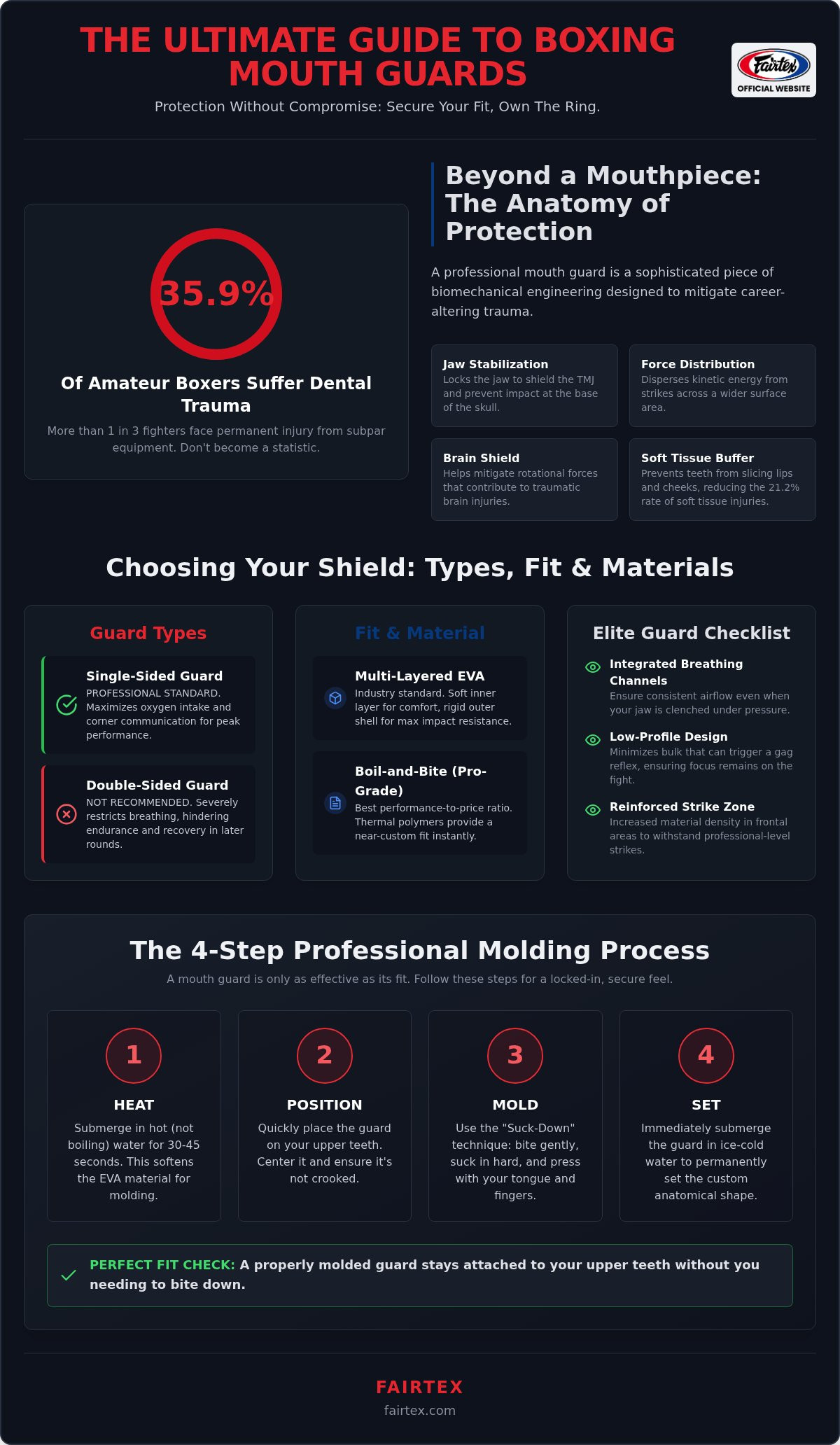
Did you know that 35.9% of amateur boxers have suffered dental trauma during their time in the ring? That is more than one in three fighters facing permanent injury because of subpar equipment. A high-performance boxing mouth guard must do more than just sit in your mouth; it needs to act as a structural stabilizer for your jaw and a shield for your brain. If you have ever struggled to breathe during high-intensity rounds or felt a gag reflex from a bulky, poorly fitting guard, you know that professional-grade gear is not a luxury.
We believe in protection without compromise. This guide shows you how to select and fit the gear you need to defend your teeth and improve your breathing under pressure. You will learn the technical differences between boil-and-bite and custom-fit options, understand the latest 2026 safety regulations, and discover how to maintain your gear for maximum durability. Master your craft with total confidence. Secure your fit. Own the ring.
What is a Boxing Mouth Guard and Why Is It Essential?
A boxing mouth guard is a specialized protective device engineered to cover the teeth and gums, acting as the primary line of defense against blunt force trauma. Its function extends beyond simple padding. By absorbing kinetic energy from direct facial impacts, it prevents violent tooth-on-tooth contact and distributes force across a wider surface area. A boxing mouth guard is the definitive baseline for combat safety in 2026, serving as a non-negotiable barrier between an athlete and career-altering trauma.
Beyond the teeth, a professional guard stabilizes the mandible. This prevents the lower jaw from being driven upward and backward into the skull during a heavy hook or uppercut. By locking the jaw into a neutral position, the guard shields the temporomandibular joint and reduces the risk of bone-on-bone impact at the base of the cranium. For those using all protectives in their kit, this component is the most vital for long-term health.
Injury Prevention Beyond the Teeth
A secure fit protects more than just bone. It creates a physical buffer that prevents the teeth from slicing through the lips and inner cheeks during impact, reducing the 21.2% rate of soft tissue injuries often seen in combat sports. While no gear can eliminate concussions entirely, a stabilized jaw helps mitigate the violent rotational forces that contribute to traumatic brain injuries during high-intensity rounds.
Difference Between Boxing and Other Sports Guards
Standard guards for football or basketball prioritize low-profile comfort over high-velocity impact protection. Boxing requires a reinforced frontal strike zone. These specialized guards feature increased material density where contact is most frequent, ensuring the guard doesn't compress fully under the weight of a professional strike. Generic options simply lack the structural integrity needed for the ring.
Choosing the Best Boxing Mouth Guard: Types and Materials
High-impact Ethylene Vinyl Acetate (EVA) is the industry standard for a reason. It offers superior energy dispersion, absorbing shock before it reaches the teeth. When selecting a boxing mouth guard, look for multi-layered EVA construction. This provides a soft inner layer for comfort and a rigid outer shell for maximum impact resistance. Authentic Thai-engineered gear often utilizes these high-density polymers to ensure long-lasting durability through a full season of sparring, maintaining its shape even after hundreds of rounds.
Professionals almost exclusively prioritize single-sided guards. Double guards might offer more coverage, but they severely restrict oxygen intake. In a high-intensity round, your ability to breathe through a clenched jaw is the difference between victory and exhaustion. A single-sided guard allows for better communication with your corner while maintaining a secure, locked-in fit. It's about finding the balance between absolute safety and the physiological demands of the sport.
Boil-and-Bite vs. Custom-Fit
While dentist-made guards offer the highest level of retention, professional-grade boil-and-bite options provide an excellent performance-to-price ratio for most athletes. They utilize advanced thermal-fitting polymers that rival the fit of custom gear. This makes them the ideal choice for fighters who need immediate, reliable protection that stays in place during heavy exchanges without the multi-week wait time of a dental lab.
Anatomy of a Professional Guard
Elite guards feature integrated breathing channels. These allow for consistent airflow even during heavy exchanges when the jaw is clenched. For athletes with orthodontic work, specialized braces-compatible options include channels that prevent the guard from snagging on brackets. A low-profile design is essential to minimize the bulk that often triggers a gag reflex. You can explore all professional-grade protectives to find a boxing mouth guard that balances comfort with maximum shock absorption.
How to Mold and Maintain Your Boxing Mouth Guard for Maximum Safety
A boxing mouth guard is only as effective as its fit. If it shifts or falls out when you open your mouth to breathe, it is failing its primary purpose. Precision molding ensures the material contours to every ridge of your teeth, creating the necessary vacuum seal for impact dispersion. According to the American Dental Association, a proper fit is the most critical factor in preventing oral injury. A guard should stay attached to the upper teeth without biting down. While a proper fit is essential for prevention, those who have already suffered tooth loss or damage can find specialized restorative solutions like dental implants at Reston Family Dental Center.
Step-by-Step Molding Process
Success depends on temperature control and physical pressure. Avoid using rolling boiled water; let it sit for 30 to 45 seconds to prevent deforming the EVA material. Once submerged for the recommended time, use the "Suck-Down" technique. Place the guard in your mouth and use your tongue to push firmly against the back of your teeth while sucking in hard to create a vacuum. This pulls the material into the gaps between teeth for a locked-in fit. Finally, submerge it in ice-cold water to set the anatomical shape permanently.
Maintenance and When to Replace
Sanitization is mandatory for longevity. Rinse your gear after every session and use a non-abrasive cleanser to prevent bacterial buildup. Never leave a damp guard in a sealed plastic container. Instead, organize your gear with a professional gym bag that allows for proper ventilation. Follow the "Season Rule" by replacing your guard every 6 to 12 months. If you notice thinning in the molar area, bite-through marks, or a loose fit, the shock absorption is compromised. Protect your health. Replace your gear before it fails you in the ring.
Integrating Your Protection: Mouth Guards and Headgear
Elite safety requires a "Full System" approach. While headgear shields the outer skull, a boxing mouth guard provides the internal structural support necessary to handle high-velocity strikes. These tools work in tandem. High-quality professional headguards rely on a stabilized jaw to prevent the head from snapping back violently upon impact. Without this internal brace, even the thickest external padding cannot fully mitigate the force of a direct strike. Fairtex engineers these components to function as a single defensive unit, ensuring maximum energy dispersion across the entire head and jaw area.
The Role of Mandible Stability in Sparring
A secure mouth guard prevents the jaw from "floating" during heavy exchanges. When the mandible is locked into place, it reduces the rattle effect often felt after a chin strike. This stability is vital during sparring, where repeated sub-maximal impacts can accumulate. By stabilizing the lower jaw, you protect the brain from the jarring movement caused by an unsecured mandible. It's about structural integrity. For a deeper look at coordinating your equipment, read our Essential Muay Thai Gear: The Complete Buyer's Guide. A stable jaw is the foundation of a safe training session. This focus on stability is a core component of training at Flinn Taekwondo Academy, where students are taught that the right protective gear is essential for safe, high-level performance.
Building Your Professional Protection Kit
Building a professional kit means prioritizing synergy. Combine your boxing mouth guard with elite gloves and hand wraps for total impact management. Fairtex has engineered gear since 1971, surviving the world's most rigorous training camps. Our protective ecosystem is built on heritage and high-performance standards. Elite athletes globally trust this integrated approach because it maintains mobility without compromising safety. Every piece of gear serves a purpose in the fighter's defensive architecture. Authentic Thai engineering ensures your gear lasts through the most grueling seasons. Secure your protection with the Fairtex Starter Pack and step into the ring with total confidence.
Dominate the Ring with Total Confidence
Selecting a professional-grade boxing mouth guard is a commitment to your long-term health and performance. We've explored how high-impact EVA materials and precision molding create the vacuum seal needed to stabilize your jaw and protect your brain. Your safety gear must function as a cohesive ecosystem. A high-performance guard works best when integrated with elite headgear to mitigate the violent rotational forces of the ring. This integrated approach is what separates the casual hobbyist from the dedicated athlete, much like how professionals in other safety fields rely on the specialized gear and expertise of HOFTAC iNDUSTRIES.
Fairtex has provided professional-grade materials for elite athletes since 1971. We understand the demands of the world's toughest training camps. Our gear is built to endure the most grueling sessions. With global shipping on all combat protective gear, the same equipment trusted by world champions is now within your reach. Upgrade your protection with Fairtex Professional Gear. Step into your next sparring session backed by a legacy of excellence. Protect your craft. Own every round.
Frequently Asked Questions
What is the best boxing mouth guard for beginners?
A professional-grade boil-and-bite boxing mouth guard is the definitive choice for beginners. It offers a high level of protection through advanced thermal-fitting polymers without the significant investment of a custom dental impression. These guards use high-density EVA materials that provide immediate shock absorption. For those starting their journey, this gear ensures you can focus on technique while maintaining essential safety standards during your first sparring sessions. To help you master those fundamentals, FA Boxing offers personalized training sessions that prioritize both performance and safety.
How do I stop my mouth guard from making me gag?
To prevent a gag reflex, select a low-profile boxing mouth guard and prioritize a precision mold. If the material extends too far back toward the soft palate, it triggers the throat's sensitivity. You can carefully trim the posterior edges of a boil-and-bite guard before fitting. A secure, vacuum-sealed fit prevents the guard from shifting, which is the primary cause of discomfort and gagging during high-intensity training.
Can I wear a boxing mouth guard with braces?
You can wear a guard with braces, but you must utilize a specialized braces-compatible model. These guards feature a unique structural channel that accommodates brackets and allows for tooth movement as your orthodontic treatment progresses. Standard guards can snag on wires or apply improper pressure to the hardware. A dedicated braces guard prevents the inner lips from being sliced by metal brackets during direct facial impacts.
Should I get a single or double mouth guard for boxing?
Professional fighters almost exclusively choose single-sided mouth guards for superior breathability and communication. While double guards offer more coverage, they make it nearly impossible to draw enough oxygen during high-intensity rounds. A single boxing mouth guard allows you to speak to your corner and breathe through a clenched jaw. It provides total protection by stabilizing the mandible against the upper teeth without sacrificing your physical performance.
How often should I replace my boxing mouth guard?
You should replace your mouth guard every 6 to 12 months to ensure maximum shock absorption. This is known as the "Season Rule" in combat sports. Over time, the protective material compresses and loses its ability to disperse impact forces effectively. Inspect your gear regularly for bite-through marks or thinning in the molar area. If the guard no longer stays attached to your upper teeth, its structural integrity is compromised.